
For live emergency information access: VicEmergency app, ABC local radio (for Ballarat – 107.9FM), or VicEmergency Hotline – 1800 226 226. In an emergency, call 000
Brown Hill FireAware Network
Planning: Writing your plan – time to put it all together
Start here if this is your first visit
This page is a reference resource for how to write your bushfire plan and what it needs to cover, specifically for Brown Hill northside residents, but as relevant for other locations and housing types within Brown Hill. It works best once you’ve been through the anchor page first: “What you need to know when you can’t leave“ which explains the reasoning, the context, and how everything connects. The links from that page will bring you directly to the relevant section here when you need it.
- If you’ve arrived here directly, welcome, but we suggest starting there as well → “What you need to know when you can’t leave”
- Already been there? Use the section links at the top of this page to find what you need.
What you will find on this page:
Before you write your plan – five things to hold onto
Section 1 Triggers and checks
Dr Kevin Tolhurst: Importance of knowing your triggers:
- what a trigger looks like in practice:
- triggers must be cascading;
- decisions made in winter
Knowing your triggers is the straightforward part. The harder question…
- Understand fire risk?
- Understand basics of fire & FDR?
- Physical capacity assessment
- Psychological and emotional assessment
SECTION 2 The “cannot leave” psychological reality
- Dr Rob Gordon “Emotional preparedness as part of bushfire preparedness” (video)
- Key points from video
- An example: India MacDonell, at the end of a hose (video)
- Honestly assess following before you write you plan
SECTION 3 How to make your plan hold under pressure
- Stage your gear before fire season
- Watch Canberra footage before fire season
- Write your triggers on a card
- Dr Gordon’s on-the-day techniques for your plan
Access to download: Psychological & Emotional Preparation Checklist V3
SECTION 4 Writing your plan – time to put it all together
- Be Ready Warrandyte – Do you have a plan? (video)
- Emergency tips ABC Australia: How to plan and prepare for bushfires (video)
- Prepare as if you CAN’T leave but act on your triggers TO leave
- Start with a physical folder, not just a phone: what needs to be in your folder
- Planning templates for you to choose from
- Other plan formats for specific circumstances
Before you write your plan – five things to hold onto
- Leaving early is always the safest option, but ember-proofing gives your house its best chance of still being there when you return
- House loss is devastating in ways that are hard to anticipate, “Though you may feel it doesn’t matter about the house; it will matter afterwards”, Joan Webster
- Ember-proofing your home each fire season is the most cost-effective insurance you will ever take out, you pay it with your time
- Your prepared empty house protects neighbours who cannot leave, your unprepared empty house becomes a threat to them
- If you cannot leave for any reason, everything depends on what you did in the weeks before
Dr Kevin Tolhurst: The importance of knowing your triggers
What is a trigger, and why it isn’t the same as a plan: When you read official guidance from CFA and other emergency services you will often read about “triggers”. But what are they and why are they important. Here is what Dr Tolhurst says about triggers.
Have a bushfire plan: Know what you are going to do pre-season; on high fire risk days and days leading up to them; decide if you are going to leave, or stay and defend, and then have a plan to know what to do if circumstances change; A fundamental element of your plan is to know your triggers for when these decisions will be made. review your plan regularly.
Dr Tolhurst’s framework on triggers is one of the most important and least understood elements of bushfire planning. His opening point is blunt: most people who say they have a plan have an intention. An intention is “we’ll leave if it gets bad” – this is NOT a plan A plan answers when, where, by what route, with what contingency, and who needs to know. A trigger is more specific still. Dr Tolhurst defines it as the point beyond which your ability to safely implement your plan becomes unacceptably low. Not the point at which fire is visible. Not the point at which an official warning is issued. The point before which you must already be moving.
This matters for northside estate residents in a specific way. The Springs Road potential bottleneck means your departure window is narrower than it appears. As where a fire may start is the critical unknown factor that determines how long or how quickly a fire can impact on your estate. Under extreme conditions, by the time smoke is visible, the departure window may already be closing. Your trigger must precede the event, not respond to it.
What a trigger looks like in practice
- Under a High fire danger rating: rate of spread of fire is approximately 2 km/h, spotting distance approximately 10 km. A fire within 5 km of you gives less than two hours before embers, smoke and surface fire may impact your property. Your trigger is: any fire reported within 5 km on a High fire danger day, I/we will…
- Under an Extreme fire danger rating: rate of spread of fire is approximately 4–8 km/h, spotting up to 20 km. Any fire within 10–20 km is a concern. Your trigger should activate well before the fire reaches that distance.
- Under Catastrophic conditions: rate of spread of a fire is approximately 12 km/h, spotting up to 30 km. Any fire within 30 km warrants immediate departure. On Catastrophic days, Tolhurst’s guidance is unambiguous: leave the night before or early in the morning. Do not wait for a fire to start.
Triggers must be cascading
When a single trigger fails. If your plan is “we leave when the rating reaches Extreme,” what happens if you wake to an Extreme rating and a fire is already burning 15 km north? Tolhurst’s framework requires triggers at multiple levels:
-
-
-
-
- Weather-based: fire danger rating for the Ballarat district (check the night before and again first thing in the morning)
- Fire activity-based: any fire reported within your distance threshold for the current rating
- Local observation: smell of smoke, change in wind, darkening sky, do not wait for official confirmation
- Road viability: Springs Road bottleneck, if you have any doubt about road access, your departure window is already tightening
-
-
-
The decision that must be made in winter
Tolhurst’s research, and Katharine Haynes’ findings from Black Saturday survivor interviews, converge on a single point: the decision to leave cannot be made on the day under stress. It must be made in advance, at the kitchen table, when no fire is threatening, by every member of the household together.
“There’s a lot of people who will say they have a plan when asked, but when we question them further it becomes clear that there is no detailed planning around that intention.” Dr Katharine Haynes, BRI Webinar
The pre-committed decision removes the information overload of deciding under adrenaline, smoke and fear. Write it down for example: “If the fire danger rating is Extreme or Catastrophic for the Ballarat district, we leave before [time]. The car faces out. It is fuelled. We go to [specific place]. No discussion required on the day.”
Do not rely on official warnings alone
Dr Tolhurst is explicit: “… official fire danger declarations are a necessary input to planning, not a sufficient substitute for it. Significant house loss has occurred at High and Extreme ratings, not only at Catastrophic. You can be in a life-threatening situation without a Total Fire Ban being declared. Monitor the VicEmergency app, ABC local radio, and your own observations simultaneously. Do not wait to be told.
Knowing your triggers is the straightforward part.
The harder question is: when the moment comes, will you act on them?
Once you know your triggers, the harder work begins, knowing yourself well enough to act on them.
The research on Black Saturday is direct. Most people who died had a plan. What failed was not the plan, it was the ability to execute it under extreme stress; in conditions they had not genuinely imagined in advance. This is not a character failing. It is a documented feature of how humans respond to genuine threat. Preparing for it is as important as cleaning your gutters.
Self assessment checks
Before moving to the planning steps, take a moment to honestly assess your own situation, your knowledge, your physical capacity, and your emotional readiness. This is about knowing yourself well enough to write a plan that will actually hold under pressure. These are not abstract questions.
Do you have a good understanding of the fire risk to you and your location?
- What is your location & housing type? southside; northside; older mixed housing; bush block; estate housing; along Springs Rd Don’t know? If no, revisit this section
- What is your primary bushfire threat? fire front; embers; both. Do you understand what each entails? YES / NO If no, revisit this section
- What is your secondary fire threat? house to house ignition – Do you understand what this entails? YES / NO If no, revisit this section
Do you understand the basics of what fire is; how to interpret Fire Danger Ratings?
- Do you understand what fire is and fire behaviour? YES / NO, If no revisit this section:
- Do you understand what are the Fire Danger Ratings and what they mean? YES / NO, If no revisit this section:
Physical capacity assessment
You need to be physically capable to defend your family and home during a bushfire. Practise your Bushfire Survival Plan and check whether you can:
- Lift items such as hoses, knapsack sprayers and furniture that may have to be moved: YES / NO
- Get up into the roof space to check for embers YES/ NO
- Patrol inside and outside for long periods. YES / NO
If you have concerns after you have made your assessment, consider whether you could modify your plan to enable you to cope. For example, you can half fill your knapsack sprayer with water or stand it on a bench when filling it to avoid having to pick it up off the floor. A good general check is to go for a brisk 30-minute walk. If you are unable to walk briskly for that length of time you should reconsider your plan to stay and defend your property. If you or a member of your family has a temporary condition such as a broken arm during the fire season, consider how that might affect your Bushfire Survival Plan. Your lack of confidence to cope physically will diminish your ability to cope emotionally during a bushfire. Know and practise your Bushfire Survival Plan so that you and your family can follow it, even when under stress. Source: CFS SA
Psychological and emotional assessment
In developing your Bushfire Survival Plan, it is important to understand the threat of a bushfire places you on:
- high alert – this allows you to respond rapidly to urgent situations but it can cause stress if it continues for extended periods.
- under stress – defending your home can be a long and exhausting process.
CFA Fire Ready Kit: A bushfire can be a terrifying situation. Strong gusty winds and intense heat will make you tired quickly. Thick, heavy smoke will sting your eyes. It will be difficult to see and breathe. The roaring sound of the wind and the fire approaching will make it hard to hear. Embers will rain down causing spot fires all around you. Power and water may be cut off. You may be isolated. It will be dark, noisy and extremely physically and mentally exhausting. Understanding what to expect and planning for what you will do can help you to cope.
How we respond to the initial threat and manage the stress will be different for each of us. Recognising the signs of stress, and understanding how you manage your responses will help your decision-making and bushfire preparation. Source: CFS SA
- Do you understand what to expect? The darkness, the noise, the smoke, the heat, the disorientation? YES / NO. If no, revisit this section and watch the 2003 Canberra footage
- Do you understand what you might feel and what you might have to deal with? YES / NO If no, revisit this section: Think about how you could manage such fearful situations.
SECTION 2: The “cannot leave” psychological reality
This section is specifically for the scenario where leaving is no longer possible. It is the harder conversation.
What it actually feels like, and why preparation is the only answer. Most northside residents have never experienced a bushfire. That is not a failing, it is simply the reality of where they came from and when they arrived. But it means the mental model they carry into a fire event is built from everyday life, not from fire…
Dr Katie Moon is a social scientist who was trapped when a Black Summer fire changed course rapidly on New Year’s Eve 2019, cutting off all exits and coming within hundreds of metres of her home. She had prepared her house. No firefighters came. No aerial support. No police. No communications. She describes looking up at the black sky, hands shaking, feeling nauseous, and thinking: “I might die.” She writes: “I experienced a sense of futility: we had prepared our house and belongings, and yet we were surrounded by fire, and all escape routes were closed; we had no alternatives to choose among.”
In the weeks that followed, as the fire threat continued, she observed what sustained uncertainty does to people: “Many people were wracked with indecision and second guessed themselves… the immediate and confrontational nature of the experience left many feeling uncertain as to what was the best course of action. We were panicked.” Source: “Understanding the Experience of an Extreme Event: A Personal Reflection
This is the mental state that poor preparation produces, not cowardice, not weakness, but the predictable result of encountering an extreme event without a pre-built mental framework for it.
Preparing yourself psychologically or emotionally to cope with a bushfire is as important as preparing your home and surroundings. Although everyone will cope differently with a frightening event, you can use strategies to resist the natural reaction to panic. Whether you want to leave early or end up having to stay and actively defend your home, both involve difficult choices that you need to think through depending on your circumstances and the predicted fire conditions.
Your foundation is your Plan A and Plan B which require two different self-assessments
If your plan (A) is to leave early – the relevant question is: will I actually act on my trigger before conditions feel urgent, or will I wait for visible confirmation? Most people overestimate their ability to act before they feel they need to. The danger is not cowardice. It is the human tendency to wait for one more piece of evidence.
Plan (B) must then account for the possibility that you cannot leave – the relevant question is harder: do I have the psychological capacity to function under sustained extreme stress, managing others who are also frightened, making decisions with degraded thinking, in conditions I have never experienced?
What the experts say…
Dr Rob Gordon, who has worked with Victorian bushfire survivors including the Scotsburn community, opens his preparation guidance with a single observation that should sit at the foundation of every plan: ” Anyone who has been through a fire knows how overwhelming it is, how unpredictable it is, and how adrenaline drives you into a state of high arousal where people don’t make good decisions and find it very hard to think.”
This is what happens to everyone under genuine threat. The question is not whether it will happen to you. The question is what you have put in place in advance so that when it does, you can still function.
The following video was produced by Emergency Recovery Victoria in 2020
Dr Gordon’s key points:
- High arousal degrades thinking. Anyone under genuine fire threat will experience adrenaline-driven arousal. In that state, decision-making fails, thinking becomes fragmented, and actions become chaotic. This applies whether you are leaving or staying.
- Rehearsal is the only reliable solution. If you haven’t enacted your plan so often you can do it automatically — in all your gear, without thinking — you will dither under pressure. The plan on paper is not enough.
- Factor emotional and psychological preparedness into your planning. Preparing to manage your own mental state, and the mental state of others in your household, is as important as cleaning gutters or staging equipment.
- Keep arousal in the useful range. High enough to be focused, strong and ready to act. Not so high that you become confused and chaotic. The goal is to manage arousal — not eliminate it.
- Your mind is your most precious resource. Everything else depends on it. Protecting your mental state is not a soft consideration — it is the foundation of everything you do
Full transcript access here: Emotional Preparedness as part of Bushfire Preparedness (video)
This is an example of what Rob Gordon says is a highly aroused person in a threatening situation. This is India MacDonell helping her dad save their house in East Gippsland. It was India’s first time at the end of a hose. Source: India’s Facebook page.
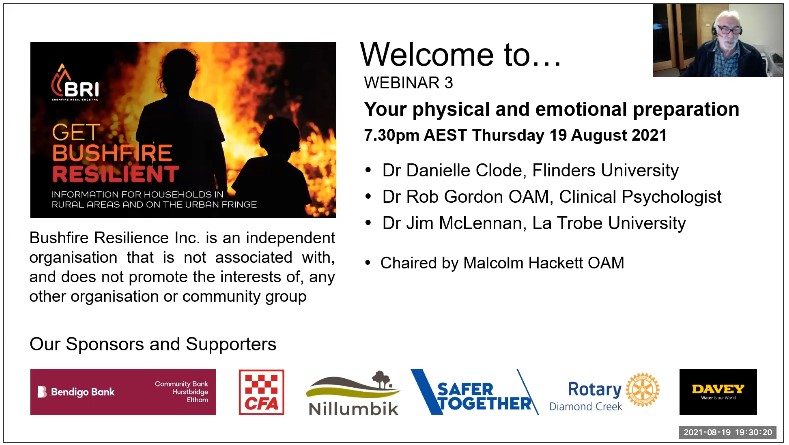 For those wishing more detail, you can access this Bushfire Resilient Inc (BRI) Webinar here
INTRODUCTION: Tonight’s webinar will begin with Associate Professor Dr. Danielle Clode from Flinders University. Danielle will examine the issues and what is known about human responses to bushfire threat. As a past resident of Nillumbik Shire during Black Saturday, Danielle has a knowledge of life in Bushfire Prone Areas, and more recently she experienced the threat of fire while defending her home in the Adelaide Hills.
After Danielle’s presentation, Dr. Rob Gordon OAM, and Adjunct Professor Jim McLennan from La Trobe University discuss in panel format their responses to the issues raised by Danielle. Both had
extensive experience in the bushfire disaster field, researching and documenting events, psychological responses and behaviour.
Access Webinar transcript here for the presentation
Access Webinar transcript here for panel session
Dr Rob Gordon: “One thing that’s been shown again and again to work is pretending to be calm. You don’t have to be calm you just need to behave as though you’re calm. Which means you walk systematically, you speak in a measured tone, you don’t scream, you don’t swear, you finish your sentences. You just do everything systematically. Keep telling yourself It’ll be faster if I do it this way. If I run I’m going to get tired and I’ll only be able to do three passages with the bucket and then I’ll fall over. Now I’ve got to keep this kind of calming rationally. Adults do it with children all the time. And it’s a really important protective behaviour for others and for ourselves. I’d say that’s one of the key points.” Quote from the above webinar for panel session
Honestly assess the following before you write your plan
- Do you freeze or become indecisive under significant stress? If yes, your plan needs pre-committed decisions written down in advance, not choices to make on the day.
- Do you have anxiety, PTSD, or health conditions that impair function under pressure? If yes, your personal trigger to leave needs to be earlier than the standard framework suggests.
- Is anyone in your household likely to resist leaving or panic? If yes, your plan needs to account for that specifically, including who makes the final call if there is disagreement.
If you believe you could not manage the “cannot leave” scenario, that is important information. It means one thing above all others: your plan must be to leave, and you must leave earlier than you think necessary. Your personal trigger needs to be earlier, not the same as the standard framework. Your plan needs a nominated person, a family member, neighbour, or friend who knows your trigger and will make the call if you are hesitating. Your car faces out, is fuelled, and your bag is packed before the day arrives. The psychological assessment is not a test to pass. It is information to build into a plan that is honest about who you actually are under pressure, not who you hope you will be.
- Acceptance is not resignation. It is the precondition for effective action. One practical anchor when thinking fails.
- If you find yourself overwhelmed and unable to think clearly, return to the simplest possible version of your plan.
Close doors. Check for smoke. Address small fires immediately. Do not go outside if heat is intense. Move to already-burnt ground if your close neighbour’s house is burning or your house becomes untenable. That sequence requires no complex decision-making. It can be written on a card and put on the fridge.
SECTION 3: How to make your plan hold under pressure
Dr Gordon is direct about the standard that makes a plan reliable: if you haven’t enacted your plan so often that you can do it without thinking, in all your gear, under pressure, you are liable to dither, rush from one thing to another, and not get anything done.
Most people may face a serious bushfire threat once, perhaps twice, in a lifetime. There is no opportunity for a practice run, and no realistic way to simulate the noise, the smoke, the heat, the cognitive load, or the fear. For the majority of northside residents, Gordon’s standard is simply out of reach.
What follows are three partial substitutes. They are not the equivalent of genuine rehearsal. They are better than nothing, and the evidence suggests they make a measurable difference to whether a plan holds or dissolves at first contact with reality.
Stage your gear before fire season — once, deliberately
Torch by the manhole. Protective clothing in one bag, one place. Buckets staged. Hoses, fire extinguisher checked. This takes 20 minutes. It removes the most predictable failure points, can’t find anything, flat batteries, wrong location, without requiring a drill. Access details for your Protective
When you do it, run it in difficult circumstances – at night, lights off; add the conditions mentally: smoke alarm screaming, power gone, someone calling out to you; The bucket you planned to use can’t be found; torch batteries are flat; hoses won’t reach.These gaps reveal themselves now, not on the day. This is the honest version of the physical walk-through — not a calm daytime inspection, but a deliberate encounter with what actually could go wrong.
Rob Gordon: “I live in a bushfire area and my work is sitting on my bum listening to people in a comfortable chair. And so, to suddenly rip out that sort of lifestyle, and run around on a 40-degree day makes you probably faint. So, I’m certain when summer comes, I’ll make a policy to actually be out and about in those hot days with the sort of gear on that I would need to wear. And curiously, I actually feel protected from the heat with heavy clothes, once you kick off your thongs and put your boots on. And so, actually, the whole business of kitting up and being out and about in those days is not a powerful, overwhelming experience, but I think you need to make sure that your body’s up to it, that your blood circulation is good enough and, you know, you can deal with that, otherwise you shouldn’t be there. Because we know people die of heart attacks, don’t we? Quote from the above BRI webinar for Q&A session
Watch the Canberra footage before fire season — actively, not passively
Watch this 45-minute ABC footage of the 2003 Canberra fires as preparation. Gordon’s point about rehearsal is that mentally imagining yourself specifically in the scenario is a partial substitute for physical rehearsal. Passive watching achieves little. Watching while asking: what am I seeing: embers, day turning to night, wind, confusion, noise? what would I do? is the exercise. This is the closest most residents will get to genuine rehearsal — and it is significantly better than nothing.
Go through the same exercise with the Black Summer interviews especially the first interview “Behind the Burnt Hose”
Whenever there is a bushfire event highlighted in the media use this as an opportunity to actively watch what is happening: embers, smoke, noise; houses not burning; how people respond; place yourself in their position – how would you respond.
Write your triggers on a card and put it on the fridge
This is the most important single output of your entire plan. When thinking has largely failed, and under extreme fire stress it will, you need a sequence that requires no decision-making. The card is that sequence.
e.g. “Fire danger rating is Extreme or Catastrophic for our district → we leave before 10am. No discussion on the day.”
Decide your triggers now, in the calm of winter, and write them down:
e.g. “Any known fire within 20km on an Extreme day, or 30km on a Catastrophic day → we leave now.”
Then the minimum action sequence for when thinking has largely failed:
That card on the fridge is your backup when the plan fails. It is the distillation of everything on this page into something that can be executed when you can no longer think clearly.
e.g. “drink, eat, rest – patrol Zone Zero: in, out, in, out
What Dr Gordon’s on-the-day techniques are, and why they belong in your plan
These are not things that happen automatically. They are decisions made in advance and committed to. They belong in your plan because they are the responses that keep arousal manageable, and manageable arousal is the difference between a person who functions and a person who doesn’t.
Include the following as explicit commitments in your plan:
- Walk, don’t run. Gordon’s observation from the children’s hospital: the people saving lives walk quickly and calmly, because they know they need to be clear and skilled when they arrive. Running escalates arousal and achieves the opposite. Decide now that you will walk.
- Complete your sentences. Don’t yell. High arousal produces fragmented communication that the people around you cannot follow. This escalates everyone’s fear. Decide now that you will speak calmly and in complete sentences, even under pressure.
- Keep breathing slowly and steadily. This is physiological, it works directly on the arousal state.
- Eat, drink and rest on a schedule, not when you feel like it. Adrenaline shuts down the body’s normal feedback system. You will not feel thirsty, hungry or exhausted until you are seriously depleted. Decide now: every 30 minutes, rest briefly, drink, eat something. Do it for each other, don’t wait to feel the need.
- Anger is a fear signal, not a response. If you find yourself getting angry because others don’t instantly understand you, recognise it: that anger is driven by fear rising too high. Use it as a signal to slow down, breathe, and re-focus on the immediate physical task in front of you.
- When panic rises: breathe, ground, find a task. Breathe slowly. Look around you. Focus on the physical situation immediately in front of you. If you have nothing to do, find something to do.
- Give everyone a task, including children. Purposeful action contains fear. Waiting amplifies it. You don’t need to share your fears with children. Share your determination to get through it, and give them something specific to do: hold the cat, watch for this, bring me that.
Gordon’s closing point applies to all of this: “The mind is your most precious resource. Everything else depends on it. Protecting your mental state is not a soft consideration — it is the foundation of everything you do.” Everything on this list is a decision to protect it.
Psychological & Emotional Preparation Checklist V3
Preparing your property is only half the job. Research into bushfire survival, Black Saturday, Black Summer, Canberra 2003, consistently finds that the single biggest difference between people who coped and people who didn’t was not equipment or house design. It was whether they had genuinely imagined the scenario in advance, made decisions about it, and knew how to manage their own state of mind when thinking gets hard.
This checklist is a companion to your written Bushfire Survival Plan – not a replacement for it. Use it to check what’s missing before you write your plan, and again before each fire season. Tick what you’ve genuinely done, not what you intend to do. Print and add to your Prep and Planning Folder.
NOTE: Some items throughout the checklist link to videos and further reading you can use as refreshers.
Access to download: Psychological Emotional Prep Checklist V3
SECTION 4: Writing your plan – time to put it all together
“A person’s ability to cope with the threat of fire is influenced by their knowledge of fire behaviour, awareness of the risk, awareness of what is happening around them, sensitivity to environmental cues relating to fire risk, the extent of the planning and preparation they have undertaken, and their physical and emotional strength in stressful circumstances.” Source: AFAC
Following is a light-hearted video on bushfire planning with a serious message which has been praised by emergency services representatives. The video “Do you have a fire plan?” was produced by the Warrandyte Community Association and the Warrandyte Theatre Company, as part of a ‘Toolkit’ of six activities designed to raise awareness and understanding of the problem. Even though this video was made specifically for the Warrandyte community it can equally apply to our Brown Hill Fire Prone Areas.
By now you have a grounding in the risk to your location, the key vulnerabilities of your estate housing and understand how to apply the Home Ignition Zone/Zone Zero to your specific circumstances. You have what you need to write your plan but it won’t stay in your head under pressure. Write it down.
The plan is not only for THE day but even more so for the preparations that need to happen: before the fire season; once the fire season is officially here; when hot days / fire ban days are scheduled; days before the hottest day arrives and then THE day, and then IF a fire is in your area. If you don’t write down what needs to be done, and when, AND practiced – it won’t happen.
Most bushfire plan templates ask one central question: will you go, or will you stay? Which is an important question. But before that question ask: What have you done to your property in the weeks before that decision? The answer to that question largely determines the answer to everything that follows.
A resident who has ember-proofed and cleared their Zone Zero, knows their triggers, and has pre-decided their actions, is not starting from scratch on the day. A resident who hasn’t is starting from scratch on the day, and no plan template changes that.
Prepare your plan as if you CAN’T leave but act on your triggers TO leave
The information above describes what a sound plan needs to cover. Writing it, specifically, for your address, your household, your circumstances, is work only you can do.
Start with a physical folder, not just your phone
A plan that lives on your phone or computer is a plan you may not be able to access when you need it. A plan on your phone is invisible. It depends on battery, signal, and one person knowing where to find it. A folder on the kitchen bench is available to everyone in the household, including children, visitors, and anyone who might be there on the day you are not. Start with a folder with plastic sleeves to make reviewing and updating easier.
For the high-risk days specifically, reformat the relevant checklists in large font, laminate them, and keep them somewhere obvious and accessible to every household member, a hook in the kitchen pantry works well. When conditions deteriorate, you are then not searching for a document. You reach for it. This is not overcautious. It is what works.
What needs to be in your folder
- House & Yard Vulnerability Assessment Checklist V3
- US based: IBHS Wildfire Prepared Home Checklist
- Seasonal House & Yard Action Checklist V3
- High fire days checklist
- Bare Bones Tubs & Kits Checklist V2 (emergency Kits)
- Psychological Emotional Prep Checklist V3
- Your trigger list — for when you leave AND when you can’t
- Contact list — who to notify, where you are going
- Plan A and Plan B
- Other information you find useful
Planning templates
The CFA templates below cover the full planning framework and are the right starting point. What they don’t cover in detail are the zones closest to your house (HIZ/Zone Zero/1): the specific vulnerabilities of estate housing where structures are 3–6 metres apart, ember attack as the main threat to estates not the fire front, and the house-to-house ignition scenario. That gap is what the FireAware material throughout these web pages address.
When working through the templates, read them through the lens of your specific situation. The CFA’s planning framework was designed for rural and semi-rural properties with meaningful separation from vegetation and an approaching fire front. The guidance is sound, applying it to your address is your job. For northside estate residents that means: your 30-metre buffer is your neighbour’s house, your exit route is Springs Road, and your primary threat is ember attack from multiple directions at once, not a single fire front.
To complete your plan, choose what is useful from the following for your framework
- CFA Fire Ready Kit: templates for CFA Bushfire Plan Leave Early (2022) and Defending-your-Property_Bushfire-Survival-Planning-Template;
- CFA Bushfire Survival Plan Template (Version 2) – for vulnerable household members
- FPA Australia: Protecting Your Home from Bushfires, the only Australian official publication with specific Home Ignition Zone and Zone Zero guidance. Also access FPA Community page here
- CFS South Australia: Bushfire Survival Plan, a well-structured planning template for SA but is applicable beyond SA; useful for working through detail systematically.
For broader advice for all emergency situations access these Red Cross publications: Are you prepared for an emergency? Red Cross Rediplan template; Get Packing Checklist
Other plan formats for specific circumstances
- Do you live alone?
- Do you live with children?
- Do you live with pets?
- Do you live with children and pets?
Source: Be Ready Warrandyte website
REMEMBER: Have a backup plan if you can’t leave Fires are unpredictable and plans can fail. Having a back- up plan can save your life if you are caught in a fire. If you cannot leave the area, consider shelter options close by. CFA provides the following options be aware they do not guarantee your safety but may offer enough protection from radiant heat to ensure your survival. These may include: a well-prepared home (yours or a neighbour) that you can actively defend. CFA also recommends these options: a private bunker – that meets current regulations (unfortunately not likely to be found in northside); or, a designated community shelter or refuge (there isn’t any in Brown Hill).
Your prepared house and yard is safer for you. It is also safer for every neighbour who cannot leave. That is what this is all about — one folder on a kitchen bench.
Disclaimer: The information on this page is drawn from publicly available fire science research, expert assessments, and official guidance, and is provided in good faith to help residents understand their situation and make their own informed decisions. It is not official advice from CFA or any emergency service. Every property and household is different, residents need to assess their own circumstances before acting.
AFAC (Australasian Fire and Emergency Services Authorities Council). Bushfires and Community Safety Position (2019, Version 6) is a policy document for fire and emergency service agencies. Quoted here as evidence of the official evidence base underpinning this information. This document (2019, Version 6.0) was scheduled for review April 2024; no updated version located at time of web page publication.
For live emergency information: VicEmergency app, ABC Ballarat 107.9FM, or 1800 226 226. In an emergency, call 000.
Sources for this page
- Dr Kevin Tolhurst AM — Triggers for Action, BRI Webinar 4, 2021 — bushfireresilience.org.au
- Dr Katharine Haynes — Triggers for Action panel, BRI Webinar 4, 2021
- Dr Danielle Clode, Flinders University — presentation and panel session, BRI Webinar 3, 2021 (webinar-recordings/2021-webinar-3) — quoted on human response to bushfire threat
- Adjunct Professor Jim McLennan, La Trobe University — panel participant, BRI Webinar 3, 2021
- Dr Rob Gordon OAM — Emotional Preparedness as Part of Bushfire Preparedness, Emergency Recovery Victoria, December 2020 (video + transcript PDF); also quoted from BRI Webinar 3 panel session (“pretending to be calm”) and Q&A session (heat/fitness quote)
- Dr Katie Moon, UNSW — Understanding the Experience of an Extreme Event: A Personal Reflection, ScienceDirect
- India MacDonell — Black Summer survivor footage/interview, referenced via India’s Facebook page
- CFA — Fire Ready Kit, Version 2, Country Fire Authority Victoria
- CFA — Bushfire Plan: Leave Early (2022) — linked from this page
- CFA — Defending Your Property: Bushfire Survival Planning Template — linked from this page
- CFA — Bushfire Survival Plan Template (Version 2), for vulnerable household members
- CFS South Australia — physical and psychological/emotional preparedness guidance (preparing-yourself-mentally-physically); also Bushfire Survival Plan template
- FPA Australia — Protecting Your Home from Bushfires (2025); FPA Community Bushfire Hub
- Be Ready Warrandyte — “Do you have a fire plan?” video; living-circumstance planning kits (living alone, with children, with pets, with children and pets) — warrandyte.org.au
- ABC Emergency — How to plan and prepare for bushfires (Nov 2020 video)
- ABC footage — 2003 Canberra fires — linked from FireAware Resources page
- Red Cross — Rediplan and Get Packing Checklist
- AFAC — Bushfires and Community Safety Position (2019, Version 6) — quoted on coping with fire threat
- La Trobe University — Issues in Community Bushfire Safety, 2011 (referenced generally re: Black Saturday planning failures)