
For live emergency information access: VicEmergency app, ABC local radio (for Ballarat – 107.9FM), or VicEmergency Hotline – 1800 226 226. In an emergency, call 000
Brown Hill FireAware Network
What you need to know when you CAN’T leave
If you’re thinking “but we plan to leave early so this doesn’t apply to us” — it applies to you most of all
Start here if this is your first visit
This is the anchor page and starting point for understanding bushfire risk to the urban-rural fringe suburb of Brown Hill, particularly northside estates as their location makes them the most vulnerable/first in line to a bushfire event. Here you will find what the fire science says, what it means for your street and your house, and what you can do about it.
Not living in a northside estate? The principles here equally apply across ALL of Brown Hill. A fire starting northside doesn’t stay there, house-to-house ignition doesn’t respect suburb boundaries. Whatever your location and circumstances, including those not officially within the Bushfire Prone Area, can be affected by a town fire that originates in the Bushfire Prone Area. Understand the basics, and apply to your situation.
The material here complements CFA’s official guidance, it doesn’t replace it. CFA materials are written for a broad audience. This page is written specifically for urban-rural fringe residents in Brown Hill, where the housing type, road access, and fire threat create a situation that generic guidance doesn’t fully address.
No single resource, including this one, can cover every household’s circumstances. Use this as a foundation, then apply your own research and judgement to your specific property, household, and situation.
- New here: read from the top, section by section, which build on each other. Take your time.
- Returning: use the section links at the top to go directly to what you need.
- Going deeper: links within each section will take you to greater detail, research and official sources.
What you will find on this page:
SECTION 1: Your suburb, your street, your risk: risk assessment for Brown Hill residents (video)
SECTION 2: What it is like to BE in a bushfire event
- When imagination cannot help; ABC Four Corners: interviews and footage (video); India MacDonell: End of a Hose (video)
- CFA: ember attack (video); ABC News: ember attack (video)
- When fire meets urban-rural fringe; Do you really want to know what the Canberra fires were like (video)
- 9 January 2026: most residents will remember this date
SECTION 3: The urban-rural fringe and housing separation of 3-6m
- What the research says: Home Ignition Zone concept; Jack Cohen explains the Home Ignition Zone (HIZ) concept (video); What HIZ zones look like
- But… “I don’t have a 30m buffer..! The urban-rural fringe compromise
SECTION 4: Is the Home Ignition Zone being put into practice?
The answer is YES at scale – Marin Co. California; Introduction to Firewise USA (video); Why an example from California?
SECTION 5: For residents who think…
- Insurance will cover any loss – things are changing: IBHS Wildfire Prepared Program; But how does this relate to Brown Hill? A reality check of what rebuilding entails
- CFA firefighters will protect us
- Their BAL rated house will survive
- It won’t happen to us. Spokane, Washington State: “Spokane fire victim… Never dreamed of wildfire danger.” (video)
- We will just leave
- One house won’t matter. Spokane, Washington State: “We lost literally everything” (video)
- It is all too hard or too costly
SECTION 6 – Step 1: Time to start
- Step 1: Assessing vulnerabilities of house and yard to embers
- Download: Step 1 Vulnerability assessment checklist
- When you look through FireSmart (FireAware) eyes risk become obvious (video)
SECTION 7 – Step 2: From knowing to doing
Closing those gaps – ember-proofing
- Five priority areas to start with
- Note on mulch – How to create Fire Smart Landscaping (video)
- Download: STEP 2 US based IBHS Wildfire Prepared Home Program checklist
Writing down what you will do – the planning
- What you need to understand before you start writing
- What you could expect when a high fire day arrives – 3 scenarios
- Time to put it all together – writing your plan
SECTION 8 – Step 3: Making it a habit, not a memory
- Action timeline on a seasonal basis
- Details of actions
- Download: STEP 3 Seasonal Action Checklist to download
Links to further reference material web pages
Cornerstone Statement
If you’re thinking “but we plan to leave early so this doesn’t apply to us” — it applies to you most of all.
Ember-proofing your home gives it its best chance of still being there when you return. And as Joan Webster, Australia’s most authoritative independent voice on bushfire safety,writes: ‘Though you may feel it doesn’t matter about the house, it will matter afterwards.‘ The research on what house loss does to people confirms this. It is not just the financial loss or the years it may take to rebuild. It is the loss of home, and that ripples through every aspect of life in ways that are hard to anticipate and harder to recover from.
Ember-proofing your home, as best as you can, each fire season is the most cost-effective insurance you will ever take out. Unlike your home and contents policy, you pay this one with your time. And unlike that policy, it may actually help your house to survive.
Your prepared empty house is also safer for the neighbours who cannot leave. An unprepared empty house is not just a victim of fire, it is a source of it. Every unprepared house that ignites becomes a threat to the next one. For the neighbour who is unable to leave and doing everything possible, your burning house makes their situation harder and more dangerous.
And if you find yourself unable to leave, for whatever reason,everything that follows on this page begins with what you did in the weeks before. Ember-proofing your home is not preparation for a decision. It is preparation regardless of what happens.”
SECTION 1: Your suburb, your street, your risk
Your suburb sits on the urban-rural fringe of Ballarat: The late Dr Kevin Tolhurst AM, one of Australia’s most respected fire scientists, stood on the Wallaby Track and spoke directly to the residents of Brown Hill. He described the worst-case scenario that residents could face under Catastrophic or Extreme fire weather conditions.
He said residents in Brown Hill along with Nerrina and Invermay, are potentially in the worst bushfire risk areas in Ballarat. Hot northerly winds under the above conditions can fan a fire starting in the Clunes/Creswick areas to build to a large scale, which could hit the westerly side of Brown Hill with large showers of embers. These embers provide a massive threat with the potential for a lot of backyards catching fire from spot fires; houses close together as in Brown Hill, are then at risk of house-to-house ignition.
Your street: Kevin also provided risk evaluations specific to housing styles: he stood in Janson Rd and spoke about bush blocks and the potential of a fire front event facing residents; he stood in Coorabin Estate and spoke about the difficulties where the majority of houses are closer than 10 metres apart can become a real threat to their neighbours.
NOTE: Since Kevin’s risk assessments in 2017 the northside area has substantially changed with in-fill estates between Springs Rd and the Gong-Gong Reserve & Daylesford Rd. This has highlighted a distinct subset of northside housing that sits on or adjacent to the western edge of the northside area: mixed housing along Springs Road; older housing within the Benson/Ditchfield/Hearn Rd area; newer estate housing where Janson Rd (from the crest) has been extended to Hillview Rd. These properties could face a mixed threat profile differing from the estates that Kevin was primarily focusing on in Video 4. Currently I have been unable to obtain an authoritative risk assessment for these mixed profiles.
Your risk: Brown Hill is in a designated Bushfire Prone Area, a formal government assessment that an area is subject to, or likely to be subject to, bushfire. Check to see whether your property sits within the BPA. Even if your property sits outside the designated BPA boundary, once a fire takes hold within the suburb house-to-house fire spread does not stop at a line on a map.
When the primary bushfire risk is from ember attack you can find within a few minutes, the whole area basically has fire within it: fire will appear to be coming from every direction adding to the confusion as to what to do. Even though you may not be dealing with a big fire front but with smaller spot fires to start with, it can go on for hours, so you have to have a fair amount of stamina.
North of the free-way (northside) estate residents are particularly vulnerable as they have the added difficulty in limited exit roads (Springs Rd) that could become easily blocked or congested, preventing residents from leaving.
Kevin’s assessments were made in 2017. Fire science and climate projections since then have only strengthened his conclusions — the conditions he described as possible are now assessed as more frequent and more intense. Nothing in the intervening years has reduced the risk he identified.
This video provides the risk assessment for Brown Hill residents
SECTION 2: What it is like to BE in a bushfire event
Kevin Tolhurst has described the risk plainly and specifically for the Brown Hill suburb, its streets, and its housing. But can you see yourself in such a situation? As most Brown Hill residents have never experienced a bushfire, it means, to imagine such a situation, needs to be built from everyday life, not from fire. Unfortunately, imagination here does not help.
Why does this happen? A quick biology lesson: Our brain creates imagination by recombining past memories and sensory experiences. Because we cannot fully replicate an unfamiliar sensory feeling, we struggle to mentally simulate it. For a bushfire, we can recall heat and smoke, but we cannot imagine the crushing overwhelm without experiencing it. For a bushfire event there genuinely is no opportunity for a dress rehearsal.
When imagination cannot help
Researchers have grappled with this for many years and they have come up with a partial answer to the rehearsal problem: other people’s testimony. First-hand accounts can do something that statistics and risk tables cannot. They can make the abstract concrete and the future present. The following are accounts and sentiments frequently expressed by survivors:
- “We never thought it would happen to us”: Most survivors note that despite seeing smoke or hearing warnings, they assumed the fire would bypass their specific property or town. They often acknowledge experiencing “normalcy bias,” leading to delayed evacuations or inadequate preparation.
“Normalcy bias” is a mental bias where the human brain underestimates the likelihood of a disaster and its potential impact. Driven by a desire for predictability, it causes people to believe that “things will continue as they have in the past”, leading them to ignore warning signs, downplay threats, and delay taking protective action.
- “It was worse than we ever expected”: Survivors consistently emphasise that the ferocity, speed, heat, and roaring noise of a catastrophic bushfire are impossible to imagine. Many describe the experience as apocalyptic or biblical, noting that standard fire plans quickly fell apart in the chaos… the choking smoke, a darkness in the middle of the day that a torch cannot penetrate.
-
“It was just a roar … there’s this constant, almost threatening sound. It was a whole-body experience. You’ve got the smell of the smoke, the sight of it and then it gets dark … then it turns orange. It’s really hot, it’s really windy. “It was my worst nightmare. I could see people with their garden hose, trying to put out their house. It was just massive”
- When people lose their homes in a bushfire they consistently say the same thing. “It wasn’t the structure they grieved. It was everything the structure held.” ‘It wasn’t just a house. It was a home. Our home.’
- In Los Angeles, a woman fleeing the Palisades fire grabbed her dog and her laptop. She left behind a scrapbook of her mother, who had died when she was six years old. And the handprints and footprints of a son she had lost. These are the things that cannot be insured. They are what ‘home’ actually means.
Grief specialist David Kessler, working with LA fire survivors: ‘The biggest myth is that we think of grief as death. But grief is any change to ourselves we don’t want.’ Home loss is grief. Not metaphorically — clinically, measurably, and durably.
Katie Moon is a social scientist who was trapped when a Black Summer fire changed course rapidly on New Year’s Eve 2019, cutting off all exits and coming within hundreds of metres of her home. She had prepared her house. No firefighters came. No aerial support. No police. No communications. She describes looking up at the black sky, hands shaking, feeling nauseous, and thinking: “I might die.” She writes: “I experienced a sense of futility: we had prepared our house and belongings, and yet we were surrounded by fire, and all escape routes were closed; we had no alternatives to choose among.”
In the weeks that followed, as the fire threat continued, she observed what sustained uncertainty does to people: “Many people were wracked with indecision and second guessed themselves… the immediate and confrontational nature of the experience left many feeling uncertain as to what was the best course of action. We were panicked.” Source: “Understanding the Experience of an Extreme Event: A Personal Reflection
Other first hand accounts can be found through out this video: CFA Documentary “Being Mentally Prepared”
In the aftermath of the Black Summer fires, ABC Four Corners put together interviews and footage of life-or-death moments posted by people in real time from inside the inferno.
Access interviews & footage here.
One of those interviewed was India MacDonell who helped her dad save their house in East Gippsland. It was India’s first time at the end of a hose. India watched from their roof as the fire approached and thought it looked “almost spectacular”. But the firestorm was far worse than expected. this is what she recorded. (Source: India’s Facebook page)
Access this link for more details concerning Section 2 issues
“Yes, I know embers.”
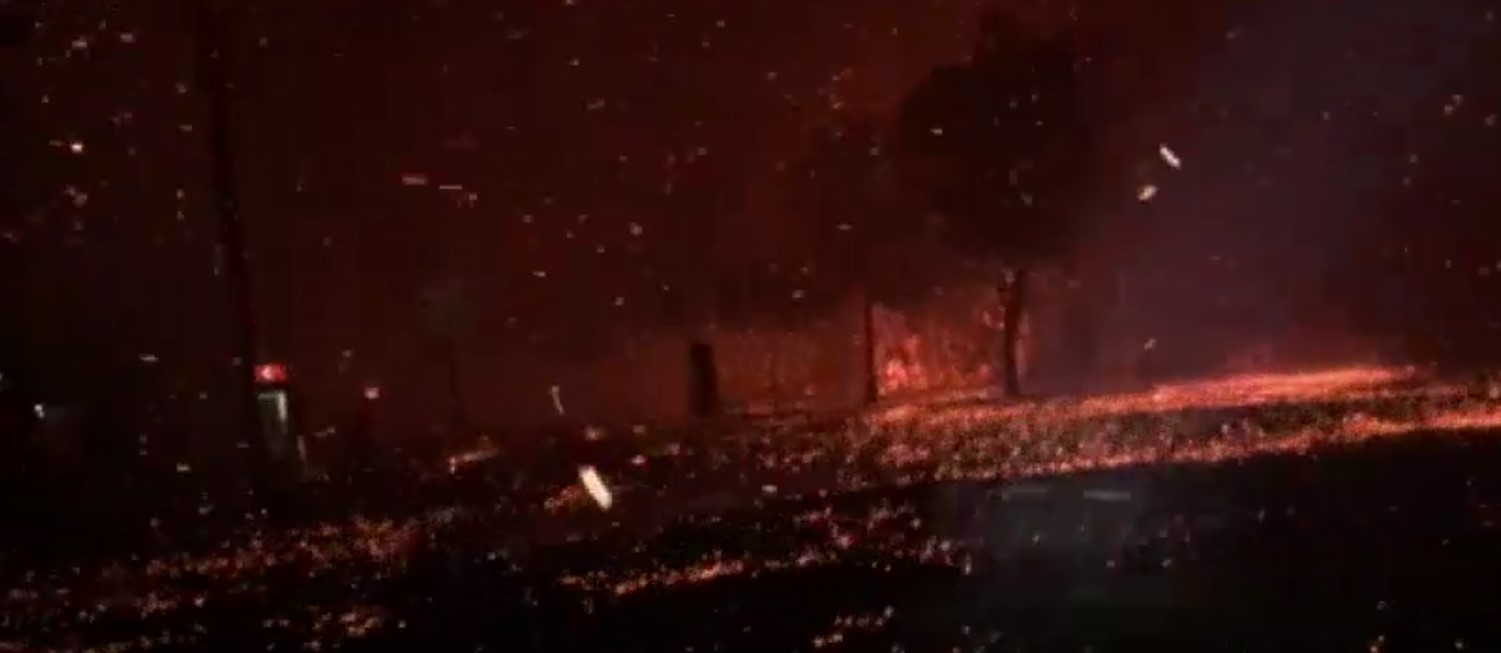
Another key take away from Kevin Tolhurst’s assessments was that ember attack was the main threat. For most of us we could say, “Yes, I know embers.” I see them when I put a log on a fire, sometimes they can be annoying if they land on bare skin. This is our every day experience of embers. This is NOT an ember attack!
This is how Malcolm Hackett OAM, who lost his own property on Black Saturday, describes ember attack: “I tended to think of embers as a single thing that might get in and start a fire. But in fact, embers come like a sandstorm and they build up against things and so, in the end, you’ve got this red-hot stuff that’s actually going to ignite your window frame, or your mulch, or whatever it happens to land on.”
CFA Ember attack video
ABC News video: 9 September 2019: Ember attack during bushfire on the Sunshine Coast. Click on image below
When fire meets the urban-rural fringe
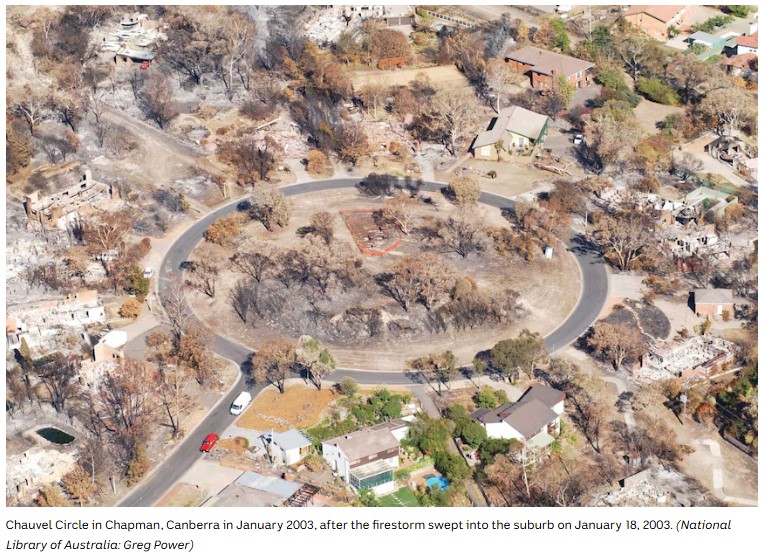 The Canberra 2003 fires destroyed houses in the urban-rural fringe suburbs with the same housing profile as Brown Hill: large houses on medium blocks, timber fencing, gardens with combustible ground cover, close to bushland. The CSIRO field survey of 229 houses found that no house showed evidence of direct flame contact from the fire front. Of the houses that were destroyed, over 90% were lost to ember attack alone, or ember attack combined with radiant heat from adjacent burning structures.
The same survey found that if no suppression activity had occurred in the hours after the fire front passed, house loss would likely have approached 100%. The actual loss rate was 47%. The difference was human intervention, residents and fire services, during the ember phase.
The difference between houses that survived and those that didn’t was not luck. There were identifiable reasons — and most of them were within the control of the resident, in the weeks before the fire arrived.
Do you really want to know what the Canberra fire was like?
This video is unedited footage taken by Channel Nine cameraman, Chris McKee, during a ride through the fires with A.C.T. Fire Brigade District Officer Darrell Thornthwaite. It is taken from ACT Fire Brigade perspective. If you want to understand how fire services can be overwhelmed watch this video.
It is 45 minutes long, it starts off calm with expectation as the fire moves towards the westerly edge of Canberra’s suburbs; it then moves into heightened alarm with the darkening sky, ember storm and houses on fire; then into chaos of doing the best they could; you notice cars on the roads, residents desperately trying to save their houses; stunned survivors wondering the streets; and eventually things settle into more order to save what they could.
All of it is worth watching, on a full screen and volume high. Click on the image to access video (you will need to move it along a bit at the beginning)
9 January 2026 — a day most Brown Hill residents remember
Ballarat recorded its highest temperature for that date on record: 40.8°C. Wind gusts of 55–65 km/h with peaks forecast to approximately 90 km/h. A classic hot north-westerly airstream, very dry and unstable. A significant cool change was forecast for later in the day.
No major fire reached Brown Hill that day. But the conditions Tolhurst described as the scenario residents needed to prepare for were present. What held was that there was no local ignition. This is not a theoretical risk. It is a real one that will present again.
Every fire safety message you will hear focuses on the worst-case day, the kind that generates a royal commission. That framing, while not wrong, can work against preparation. If the only fire worth preparing for is one that may never arrive in your lifetime, it is too easy to put it off. Here is what the data actually shows. Since Australia’s current fire danger rating system was introduced in September 2022, Victoria has recorded Catastrophic fire danger on just a handful of days across two fire seasons. Extreme fire danger days have been recorded roughly seven to ten times per season, approximately once a fortnight through the fire season, somewhere in Victoria.
The historical record tells the same story. Looking at Victorian fire events with significant documented house losses or fatalities since 1983, roughly twice as many occurred under Extreme conditions as under Catastrophic. The 1997 Dandenong Ranges fires (43 homes destroyed, 3 deaths), the 2015 Wye River fires (116 homes), both Extreme days, not Catastrophic ones. These are the fire days residents need to prepare for.
Kevin Tolhurst, said it directly: “We shouldn’t just be focused on Catastrophic conditions, even under High or Extreme fire danger ratings we could have hundreds of houses lost.”
Preparation is however, identical either way. Every action that reduces your risk on an Extreme day is exactly the same action that gives your house its best chance on a Catastrophic day. There is no version of preparing for Extreme that leaves you worse off if Catastrophic arrives. Source: The Bottom line
SECTION 3: The urban-rural fringe and housing separation of 3-6m
Dr Kevin Tolhurst, extract from risk assessment: “One of the things that is likely to happen, and we have the experience of the Canberra fires in 2003 and more recently the Wye River Fire in 2015, is that a lot of the houses were lost from house-to-house ignition. People’s gardens are burning, sitting close to their house, and the house itself is the biggest fuel load in the environment, unless you’re able to stop one house fire from spreading to the neighbour’s house… When houses are closer than about ten metres to each other, they become a real threat to their neighbours.”
Dr Justin Leonard’s research establishes that at house separations of 3-6 metres in urban-rural fringe suburbs, like Brown Hill; a single burning house can directly ignite the next. Once a house is burning, it generates sustained radiant heat on adjacent structures for an hour or more, far longer than the passage of a fire front. Even though you may think you’ve built your house to a high standard, it’s not necessarily going to withstand a house-to-house ignition circumstance. It is therefore important to understand this specific risk to where you chose to live, either intentionally or not. This is a dilemma and not a comfortable position for residents.
The question, most likely, upper most in your mind at this point, “Is there anything I can do?” The answer? YES. It is however, not a complete answer. It is not a guarantee. But it is the only scientifically grounded lever that urban fringe residents in this specific housing type actually possess, and it is more effective than most people assume. But first let us look at the science and research behind these statements of risk.
What the research says:
A 2023 peer-reviewed paper in PNAS – co-authored by Jack Cohen – makes the argument that should sit at the foundation of all urban fringe fire guidance: “These problem fires were defined as an issue of wildfires (bushfires) that involved houses. In reality, they are urban fires initiated by wildfires. That’s an important distinction.”
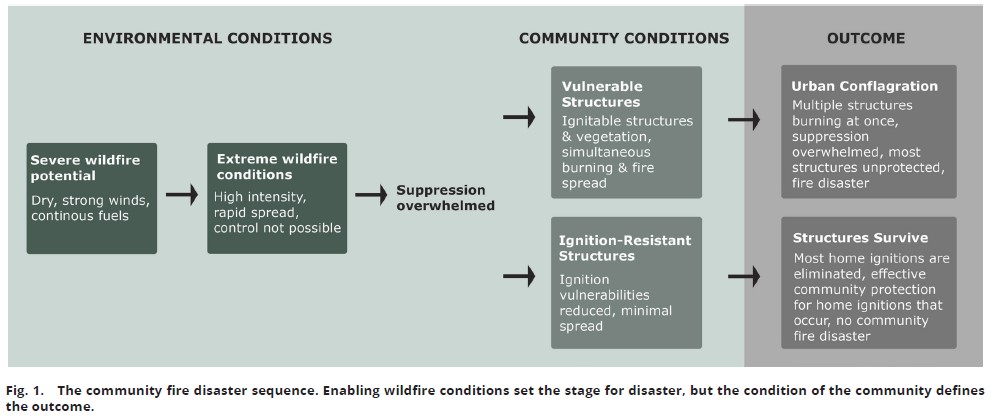
This matters enormously for northside estates. If the problem is a bushfire, the solutions are landscape-scale: fuel reduction, vegetation management, fire front suppression, and individual residents can do little. If the problem is an urban fire initiated by bushfire, the solutions are at the structure and its immediate surrounds, exactly where residents have control.
The paper’s central finding: extreme wildfire is largely inevitable and largely uncontrollable. What determines whether a community is destroyed is not the fire, it is the condition of the structures and their immediate surroundings. Same fire conditions, two outcomes: vulnerable structures produce urban conflagration; ignition-resistant structures survive. The wildfire sets the stage. The community defines the outcome.
Home Ignition Zone concept
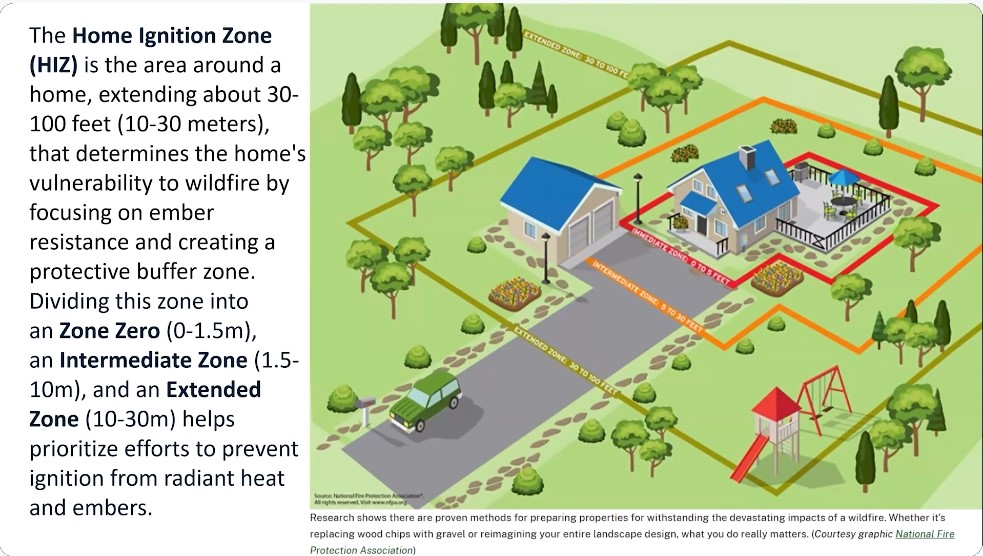
Two independent research traditions arrived at the same conclusion. American fire researcher Jack Cohen (USDA) found that houses do not primarily ignite from radiant heat of an approaching fire front, they ignite from embers landing in and around the structure. The decisive zone is not the distant bushland; it is the immediate area around the house, almost entirely within the resident’s control. His finding, became the basis of the Home Ignition Zone concept.
This is what Jack says: “Thus, community wildfire risk is not directly determined by wildfire intensity and its location related to wildland. Burning embers, initially from the wildfire and then from burning structures within the community are a principal contributor to community fire spread. Thus, not having a flammable wood roof, removing flammable tree debris from the roof, in rain gutters, on decks, assuring nothing burns (flaming or smoldering) within 5 feet (1.5 m) of flammable walls and attachments, and vents covered with 1/8 inch (2 mm) mesh screen can significantly increase home ignition resistance… The inevitability of uncontrolled extreme wildfires spreading to communities does not mean Wildfire Urban fire disasters are inevitable. We can effectively prevent WU fire disasters by reducing home ignitability and collectively, the community.”
Dr Justin Leonard at CSIRO reached the same conclusion through a different route: systematic post-fire surveys of more than 1,800 houses across three major Australian fires, including Canberra 2003, Sydney 1994 and Ash Wednesday 1983. His finding is precise: in the Canberra 2003 fires, no house in the surveyed area showed evidence of direct flame contact from the fire front itself. Over 90% of losses were caused by ember attack, alone or in combination with radiant heat from adjacent burning structures. The fire front was not what destroyed those houses. The fire front passed. Houses burned down hours later from small ignitions that were not caught.
This is what Justin says: “Invariably, the greatest risk by fire is the ember attack and the surface fire that ignites the houses. That’s the predominant way houses are ignited.”
In the following video Jack Cohen explains how he developed the Home Ignition Zone (HIZ) concept.
This is what Home Ignition Zones look like
But you say: I don’t have a 30m buffer around my house!”
Your decisive zone is therefore not the 30-metre buffer. It is the area immediately surrounding the house – what Jack Cohen defines as the Home Ignition Zone, and what his 2025 BRI presentation with Justin Leonard identified specifically as Zone Zero: the 0–1.5 metres immediately against the structure itself. It requires no council permits, no large budget, no vegetation management at landscape scale.
What it requires is attention to specific, identifiable ignition pathways: the gap under the garage door, the bark mulch in the garden bed against the house wall, the timber fence connecting boundary to structure, the accumulated debris in gutters and under decks.
Justin Leonard’s formulation from the 2025 BRI webinar is direct: “If you haven’t got your house and its immediate surroundings in complete order, all the rest of the work in the broader landscape is dramatically diminished in relevance and usefulness.”
Access this link for more detail concerning Zone Zero (a California video – 5′ = 1.5m)
The urban-rural fringe compromise: where zones overlap
The Home Ignition Zone research sets out an ideal: a clear Zone Zero immediately against your house, managed zones extending to 30 metres. On a northside estate block, you can reach your neighbour’s fence before you reach Zone One. This is not a failure of preparation. It is the structural reality of estate housing, and it changes what “lowering your risk” means.
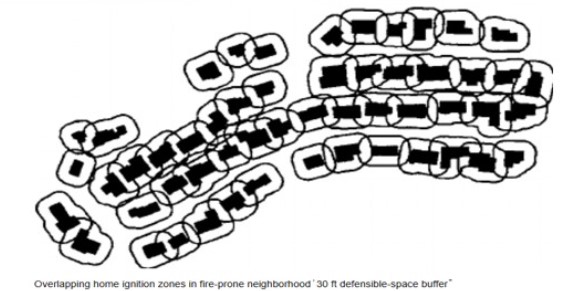 Your Zone Zero is yours to control, and it is the highest-value action available to you. But your full ember risk extends beyond your boundary into zones that belong to your neighbours, just as theirs extend into yours. This diagram is northside equivalent. Every house’s ignition zone overlaps with the houses around it.
In a potential house-to-house fire scenario with a 3–6 metre separation between houses – one burning house directly threatens the next. Your Zone Zero preparation matters most to your neighbours. Theirs matters most to you. This is not an individual problem with an individual solution. It is a street-level problem that only has a street-level answer.
Maintain your Zone Zero and what you can in Zone 1, then talk to your neighbours. Whether any of you are there on the day or not, a street where every household has done its Zone Zero is a street that gives itself the best chance of not becoming a town fire.
For more details on the latest experimental research access this link
Jack Cohen, says it this way: “A fire-adapted community is what you get when you have collectively ignition-resistant houses. And if it’s of higher density, such that you’ve got Home Ignition Zones overlapping, then you’ve got ignition-resistant Home Ignition Zones, house after house.”
SECTION 4: Where the Home Ignition Zone is put into practice
The research is compelling. But for a resident of a northside estate who has never experienced a bushfire and has no fire frame of reference, the question underneath all of it is a simpler one: “Has anyone actually done this? And did it make a difference?”
No, not in Australia BUT yes and at scale, under mandatory evacuation orders, in denser and more fire-prone conditions than Brown Hill. A well-established example comes from Marin County, California, and their Fire Safe Marin program. Communities whose situation maps directly onto Brown Hill in ways that matter.
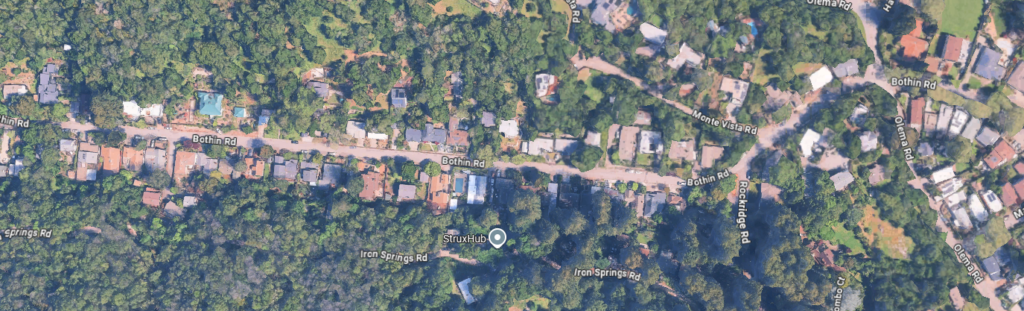 Marin County’s wildland-urban interface neighbourhoods are small, densely packed subdivisions adjacent to steep, fire-prone hillsides. This county runs the largest county-wide Firewise USA program in the US: more than 60,000 residents across 90+ recognised sites, coordinated by the non-profit Fire Safe Marin, founded in 1992. Since 2020 they have added to their program, the primary focus of Home Ignition Zone (HIZ) and Zone Zero.
The logic driving it is explicit: leave early, yes, and harden (ember-proof) your home before you go, because that is the only thing that gives it a chance of still being there when you return. This is precisely the FireAware Network’s cornerstone argument, arrived at independently. But Marin Co. are operating at scale, under mandatory evacuation conditions.
Marin residents aren’t doing it instead of leaving they’re doing it as well as leaving, because they understand the prepared empty house argument. That framing directly addresses the “we’ll just leave” objection without dismissing it.
May 14, 2022: An Introduction to Firewise USA: Santa Barbara County Fire Safe Council developed this informative video to explain the Firewise program and the benefit it provides community members.
To also learn more about the Firewise program access this link for frequently asked questions.
Why did I need to go to California to find an example? Because there is NO equivalent in Australia: The gap between Brown Hill and Marin County is not the research, the logic, or the resident capacity to act. The gap is simply that no equivalent program exists here. The Marin example answers northside resident’s question directly: “Has anyone actually done this?” Real communities, in real subdivisions, under mandatory evacuation orders, have taken the HIZ framework from research and are putting it into practice. The science is not theoretical. It is being tested at scale, right now, by communities whose situation closely resembles Brown Hill and northside in particular.
SECTION 5: For residents who think…
Fire Safe Marin shows what’s possible once the Home Ignition Zone approach is put into practice. But knowing something works doesn’t automatically translate into action — there are specific reasons people can put it off, even once convinced. The following works through the most common reasons, and what the evidence says about each.
For residents who think insurance will cover any loss – things are changing
Insurance is not a guarantee it will “cover it.” A good example is In California, where the industry itself is in crisis: between September 2024 and December 2025, 43% of private insurers withdrew from wildfire-prone parts of California following the LA fires, pushing home owner enrolments in the state’s insurer-of-last-resort to record levels. Premiums have risen and are rising here too — Australian home insurance costs have climbed an average of 7.2% a year since 2010.
The thing that is changing is how insurers assess bushfire risk, along with other weather related events. For decades, the foundation for wildfire pricing was based almost entirely on location. IBHS (Insurance Institute for Business & Home Safety) the research arm funded by the US insurance industry, has moved that foundation: to what a house is made of, and what’s in the first 1.5 metres around it. It is now understood this is the primary determinant of whether a structure ignites at all. Ember-proofing isn’t just a fire-safety action anymore; it’s becoming the thing that determines whether, and how affordably, a house can be insured at all.
IBHS has also recognised that individual mitigation isn’t enough at estate-style spacing and that structure-to-structure spread at 3–6 metres requires street-level, not just household-level, action.
IBHS Wildfire Prepared Program — progression timeline:
- 2022: Wildfire Prepared Home: the first standard distinguishing ember-resistant homes.
- 2025: Updated Wildfire Prepared Home: Zone Zero (0–1.5m, noncombustible) becomes a core requirement;
- 2026: Community Wildfire Risk Reduction Framework: keeping communities insurable
- 2026: Wildfire Prepared Home standard expands from individual homes to whole neighbourhoods, now covering 14 US States. IBHS: “The decisions you make to protect your home can directly affect the homes around you during a wildfire.”
The industry that underwrites policy is now telling homeowners that HIZ is the path to remaining insurable at all.
But how does this relate to Brown Hill?
The Australian insurance industry is under the same structural pressure as the US — it has arrived by a different route but the destination is identical. Weather-related insured losses exceeded $7 billion in 2022 alone. Home insurance premiums rose an average of 7.2% annually between 2010 and 2025. APRA’s March 2026 Insurance Climate Vulnerability Assessment projected that one in seven Australian houses are currently uninsured, rising to potentially one in four by 2050. The Australia Institute estimated 1.4 million homes are already uninsured or underinsured. The drivers are floods, cyclones and bushfires, the industry is not distinguishing between them, it is repricing all climate risk simultaneously.
The bushfire-specific response is now beginning. Half the Australian home insurance market prices bushfire mitigation following the launch of the Resilience Building Council certification app. APRA has named household and community-level resilience measures as a lever capable of narrowing the protection gap. ICA chief executive Andrew Hall described the certification approach as “an Australian innovation now being studied globally as proof that household-level risk reduction can help improve insurance affordability.“
Australia is five to eight years behind the US in formally linking mitigation to pricing — but the trajectory is the same. The science IBHS has built its program on is identical to the science Leonard and Tolhurst established for estates like Brown Hill. The industry conclusion is coming. The research is already here.
A reality check of what rebuilding would entail – Marysville
On the 7 February 2009, Black Saturday bushfires destroyed over 90% of the buildings in the small town of Marysville and killed 34 residents. Marysville fire survivors faced a deeply challenging, slow, and traumatic rebuilding process. The community grappled with significant bureaucratic, financial, and emotional hurdles that persisted for years after the disaster.
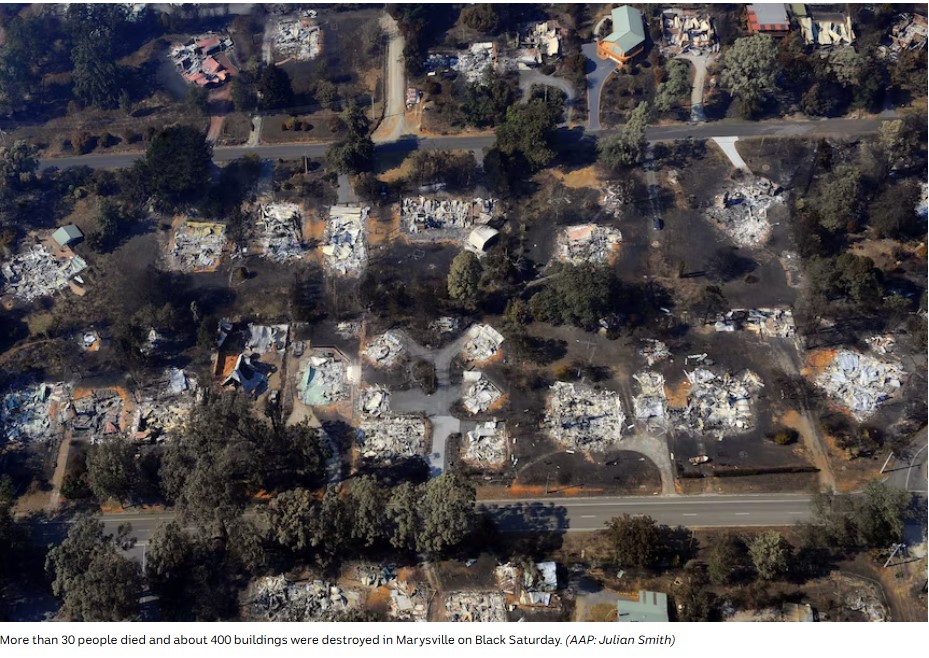 What survivors consistently describe is not a single catastrophe but a cascade of them: the fire, then the years that followed. Here are a list of difficulties they faced in rebuilding:
- Building delays: new regulations and permit hold-ups under the Murrindindi Shire Council stalled rebuilding for years.
- Tradie and cost shortages: high demand for builders across all fire-affected areas pushed costs up and slowed construction.
- Underinsurance: many residents couldn’t cover the cost of rebuilding to new, safer standards.
- Red tape: police roadblocks and bureaucracy delayed even clean-up and damage assessment.
- Economic collapse: the town’s tourism economy collapsed — population dropped from 700 to 250 by 2015.
The above difficulties do not include the social and psychological challenges they faced. These listed difficulties were not unique to Marysville they have been repeated over and over again in small and larger communities, after every major extreme event across Australia.
For residents who think CFA firefighters will protect them
In a recent CFA survey it showed that 44.4% of Victorians believe CFA is responsible for protecting them during a bushfire, and 43.8% say CFA is responsible for protecting their home.
The CFA will respond when possible, but responding in a major fire event is not the same as protection of every property. AFAC, the peak national fire agency body, states plainly: “There will be circumstances where fire agencies and other emergency services will not be able to assist or protect every property that is threatened during a bushfire.” This is not a criticism of CFA. It is reality.
“We simply can’t get a truck to every house during a major bushfire. Fire safety is a joint effort and the community needs to also take on this responsibility when living in a bushfire prone area,” CFA Chief Officer Heffernan said.
For northside estates specifically, Tolhurst was direct: In a significant fire event, firefighting resources are scattered widely across the landscape. Springs Road, the main exit and entry point, is vulnerable to tree fall and powerline failure. A blocked road means CFA cannot reach your street any more than you can leave it. On the day that matters most, the preparation you did in the weeks before is what stands between your house and the fire. (If you are not convinced – revisit the Canberra 2003 fire video)
Prepare and act as if there is no fire truck coming to rescue you. Then you won’t waste time or be surprised when one doesn’t turn up.
For residents who think their BAL rated house will survive
Your BAL rating tells you how your house was built relative to classified vegetation when the permit was issued. It does not tell you your current fire risk. It also does not tell you about ember attack risk from a neighbours burning house. Visit this section to find out more about BAL ratings.
Embers travel kilometres ahead of a fire front, meaning properties well beyond the immediate bush edge, including across southside Brown Hill, can receive ember fall from a major fire event. And once houses begin to ignite, they become ember sources themselves.
Dr Kevin Tolhurst stated: “Even though some of these houses in these subdivisions have been built to Australian Standard 3959 (BAL ratings), that standard is for the individual building in isolation. It’s not considering a house fire next door, it’s only considering the bushfire from vegetation. So even though you may think you’ve built your house to a high standard, it’s not necessarily going to withstand a house-to-house ignition circumstance.”
This is a common belief among most survivors BEFORE the event. Despite seeing smoke or hearing warnings, they assumed the fire would bypass their specific property or town. They often acknowledge experiencing “normalcy bias,” leading to delayed evacuations or inadequate preparation. It is not a helpful belief.
DEFINITION: “Normalcy bias” is a mental bias where the human brain underestimates the likelihood of a disaster and its potential impact. Driven by a desire for predictability, it causes people to believe that “things will continue as they have in the past”, leading them to ignore warning signs, downplay threats, and delay taking protective action.
Kami Fehlig: “What would be better than living at a state park, right? Like right next to the state park. Amazing, right? Everything. Hiking, biking, everything. Never dreamed of wildfire danger.”
Dr Danielle Clode: Successfully leaving is not as easy as people think. Making sure you have what you need, that you’re ready early enough, that you’re actually making that decision safely, it can be derailed by any number of things: family commitments on the day, medical appointments, pets, a visitor arriving. All sorts of things can interfere and change plans. Staying is not an easy decision either. The truth is that leaving early is genuinely hard. You really need to think through how prepared you are to do it, and to practise it…
It is a complex decision to make and to do it properly means that decisions need to be discussed and agreed to amongst household members well before the bushfire season. This link will provide you with more details to help you understand what leaving entails.
As the research has shown when houses are 3-6m apart the solution for house survival stops being an individual solution and becomes a collective/street by street solution. For you to give your house the best chance of surviving a fire event then it needs to be prepared/ember-proofed and Zone Zero/1 cleared of combustibles BEFORE you leave.
This not only gives you the chance of coming back to a still standing house but also coming back to a street that is also still standing. Leaving or staying requires the same commitment and preparation. As there are no guarantees – when you leave you have to pack as if your house will not be there when you return.
Tolhurst’s specific assessment: Even under High or Extreme conditions a fire may start quite close to you and within an hour be impacting your property. The window between ‘thinking about leaving’ and ‘too late to leave safely’ is shorter than most residents assume.
For the compromised situation of closely spaced housing, as in Brown Hill, every house that does not ignite matters. The house-to-house problem has no individual solution – only collective ones. Leonard’s research establishes that at estate separations of 3-6 metres; a single burning house can directly ignite the next. Tolhurst named this explicitly: “when houses are closer than about ten metres to each other, they become a real threat to their neighbours.” Once a house is burning, it generates sustained radiant heat on adjacent structures for an hour or more.
The “why bother” question deserves a direct answer: Zone Zero preparation cannot protect you from a fully involved neighbouring house at 3 metres. Nothing at an individual property level can. What it does is: (1) reduce the chance your house ignites first from embers, before any neighbour is involved; (2) slows the ignition process if radiant heat is building, buying time; (3) collectively, if enough houses in an estate are prepared, it reduces the probability of the first ignition that starts the cascade. Your Zone Zero preparation matters most to your neighbours. Theirs matters most to you.
A house is a structure. It can, in principle, be rebuilt, replaced, insured against. However a home is the accumulation of lived experience embedded in and around that structure. It cannot be rebuilt. It can only be lived again, slowly, elsewhere, which is a different thing entirely.
When people lose their homes in a bushfire, they consistently say the same thing: it wasn’t the structure they grieved, it was everything the structure held. Research confirms that for most adults, the two biggest sources of mental health problems after a disaster are: how close to the centre of devastation they were, and how much was lost: property, material things, resources. The loss of home is one of the strongest predictors of long-term psychological harm from any disaster.
Joan Webster: “Though you may feel it doesn’t matter about the house, it will matter afterwards.” She is not speculating. She is reporting what she learned from people who found out.
Associated Press. A family describes losing their home and irreplaceable family heirlooms to wildfire. This is why a home is more than just a house.
Most homes don’t ignite from a fire front. They ignite from embers, burning fragments landing in and around your house finding a gap, a vent, a bed of bark mulch, a timber fence touching the wall, and then accumulating. Ember-proofing a home to bushfire embers means making physical changes, before the season, that reduce the ways embers can get into your home or take hold. It is work done in advance, not on the day.
Most of the work can be done once, properly, before the season. After that it is annual checks, maintenance and actions for expected fire days. Zone Zero are the highest-value actions costing an afternoon and hardware store money. Costs to retrofit the house can range from low to high depending on household budgets but the highest cost is not in dollars but in your time:
- Your time to initially understand your risk and how that can impact on your home and life-style;
- Your time to understand what you can do to lower that risk by implementing the Home Ignition Zone concept;
- Your time to understand how you can apply HIZ to your house and yard;
- Your time to assess the vulnerability of your house and yard to ember infiltration;
- Your time to develop your list of ember-proofing actions and a schedule to implement them;
- Your time to action that list in a timely manner.
How much actual time you take to go through the above depends on you. But, once this initial stage has been completed, you will find you can view your home and yard through different eyes, FireAware eyes, that will become second nature to you. Whatever needs to be done before subsequent fire seasons can be easily incorporated into your usual seasonal activities. This initial stage can be compared to starting anything new, such as riding a bike – there needs to be that initial effort to get the bike rolling then it has its own momentum.
Ember-proofing your home, as best as you can, each fire season is the most cost-effective insurance you will ever take out. Unlike your home and contents policy, you pay this one with your time. And unlike that policy, it may actually help your house to survive.
SECTION 6 – Step 1: Time to start
When you look through FireSmart (FireAware) eyes, bushfire risks are clear (video)
SECTION 7 – Step 2: From knowing to doing
You’ve walked your property and know where the gaps are. From here it’s two jobs running side by side: closing those gaps, and writing down what you’ll do. One without the other leaves you exposed, a hardened house with no plan, or a plan for a house that hasn’t been touched. Keep in mind You don’t need to get this perfect. A house that’s partly ember-proofed is safer than one that isn’t. Do what you can, when you can, it still counts.
1. CLOSING THOSE GAPS – EMBER-PROOFING
From your vulnerability assessment you now know what needs ember-proofing, and how you need to maintain Zone Zero and Zone 1. Justin Leonard highlights five priority areas for ember-proofing, concentrate on these areas first:
1. Roof and gutters: Embers collect where they find fuel — in gutters full of debris, around ridge capping gaps, in unprotected vents, evaporative cooler units, solar panels and in the roof space if they find a way in. A fire that starts unseen in the roof space is very difficult to detect early.
2. An integrated garage (under the same roofline as the house): Is the highest-risk configuration: An ember ignition inside the garage doesn’t just threaten the garage, it has direct access to the shared roof cavity and from there to the whole house structure. This is the dominant type in northside estate housing. The internal door between garage and house is the last barrier, it must self-close and be as close to fire-door standard as possible.
3. Bark mulch: Leonard’s verdict is unambiguous: “There’s nothing good about bark mulch near your house.”
4. Timber boundary fencing: Timber fencing can carry fire directly along its length to the house wall, it is a fuel pathway, not just a boundary. Leonard is direct: “any combustible (timber) fence within a few metres of the house wall is too close — even hardwood. At that distance a burning fence delivers sustained heat directly to the structure.”
5. Wheelie bins: Leonard names wheelie bins specifically as consequential fire sources that residents don’t register as significant hazards, but they burn prolifically. One bin stored against a house wall, under a window, or at a fence-to-wall junction are sufficient on their own to cause house ignition. (This priority is for awareness and a fire day action)
Access this link: Understanding what is required: ember-proofing & Zones to find more detail and guidance in how to proceed.
STEP 2 US based IBHS Wildfire Prepared Home Program checklist
NOTE: When you read that “There’s nothing good about bark mulch near your house.” You may feel the point is going a bit too far! Mulch is often the hardest thing to give up, it’s not just ground cover, it’s years of gardening. This video looks at what can replace it without losing the garden you’ve built.
The following video may give you some ideas of what a Fire-Smart landscape in Marin Co. looks like, and how your garden can look using the same principles.
2. WRITING DOWN WHAT YOU WILL DO – THE PLANNING
“A person’s ability to cope with the threat of fire is influenced by their knowledge of fire behaviour, awareness of the risk, awareness of what is happening around them, sensitivity to environmental cues relating to fire risk, the extent of the planning and preparation they have undertaken, and their physical and emotional strength in stressful circumstances.” Source: AFAC
Writing your plan is different to a checklist, it’s a set of decisions only you can make. But good decisions here depend on understanding why, not just being told what: how fire actually behaves (it isn’t a monster, and knowing that can change how you respond); how to read a fire danger rating for your situation; why protective clothing matters; what happens to your own thinking under pressure. Understanding the “why” is what lets you make the right call for your household when the moment comes, rather than trying to recall someone else’s instructions. Here are links that matter:
What you need to understand before you write your plan
- FACTS on what is fire (video); FACTS how fire burns; how wind can change fire danger;
- FACTS on radiant heat
- FACTS on protective clothing; remember to drink water/fruit juice to avoid dehydration (PDF); FACTS on woollen blankets;
- FACTS on Fire Danger Ratings; Monitoring Rule: 30/30/30 +L
- Dr Kevin Tolhurst concerning the importance of knowing your triggers
- Self assessment checks
- The “cannot leave” psychological reality
- How to make your plan hold under pressure
What you could expect when a high fire day arrives
This section presents 3 possible scenarios: scenario context: 1- no fire in your area; 2- fire has ignited in Creswick Regional Park; 3 – you planned to leave but now you can’t.
Read through each scenario and place yourself in each one and see how it feels.
Time to put it all together – writing your plan
CFA templates cover the full planning framework and are the right starting point. What they don’t cover in detail are: the zones closest to your house (HIZ/Zone Zero/1); the specific vulnerabilities of estate housing where structures are 3–6 metres apart; ember attack as the main threat not a fire front; and the house-to-house ignition scenario. That gap is what the FireAware material throughout these web pages address.
When working through the templates, read them through the lens of your specific situation. The CFA’s planning framework was designed for rural and semi-rural properties with meaningful separation from vegetation and an approaching fire front. The guidance is sound, applying it to your address is your job. For Brown Hill residents that means: your 30-metre buffer is your neighbour’s house, your primary threat is ember attack from multiple directions at once, not a single fire front; and for northside your main exit route is Springs Road,
Here are the links to provide the detail and guidance for writing your plan:
Prepare as if you CAN’T leave but act on your triggers TO leave
- Start with a physical folder, not just a phone: what needs to be in your folder
- Planning templates for you to choose from
- Other plan formats for specific circumstances
SECTION 8 – Step 3: Making it a habit, not a memory
The work in Section 6 has a start date. It doesn’t have an end date. Ember-proofing isn’t a project you finish, gutters refill, mulch gets topped up, garage seals wear down, “stuff” accumulates in Zone Zero. What keeps a house protected is the same list, checked again, every year.
But the trap is relying on fear to bring you back to it. A bad fire season, a smoky week, a close call, these get people moving, but the feeling fades faster than the fire danger does. What lasts is tying the check to something that happens on the calendar regardless of how anyone feels that year: the first weekend of daylight saving, when you change your smoke alarm batteries, before the school holidays start. Pick a date. Put it in your phone, in your diary and the calendar on the wall, not just in your head.
The actions cover:
- In winter, take advantage of the cooler weather to clean up your property and ember proof jobs around your home;
- In spring, get ready for the impending Fire Danger Season;
- During summer, maintain your preparedness through the Fire Danger Season;
- Immediate Heatwave Preparation (1–3 Days Before)
Here is your Seasonal Action Checklist to download, to help you on your way (keep it in your planning folder):
STEP 3 Seasonal House & Yard Action Checklist V3
None of this makes the risk go away. What it does is put you, not chance, in charge of what happens next.
Links to further reference material on web pages
- Do you know that Brown Hill is in a Bushfire Prone Area (BPA)?
- Understanding risk of a bushfire event
- Prep before plan: Home Ignition Zone & Zone Zero PART 1
- Prep before Plan: Home Ignition Zone & Zone Zero PART 2
- Planning: Writing your plan – time to put it all together
Disclaimer: The information on this page is drawn from publicly available fire science research, expert assessments, and official guidance, and is provided in good faith to help residents understand their situation and make their own informed decisions. It is not official advice from CFA or any emergency service. Every property and household is different, residents should assess their own circumstances before acting.
Sources for this page:
Primary expert sources
- Dr Kevin Tolhurst AM — Brown Hill northside risk assessment (video, 2017); BRI Webinar transcripts, Bushfire Resilience Inc.
- Dr Justin Leonard, CSIRO — BRI Webinar series (Ember Attack; Hardening Your Home; Best Practice; Reducing Risks), bushfireresilience.org.au
- Jack Cohen, USDA Fire Sciences Laboratory — Home Ignition Zone concept; BRI 2025 Webinar with Justin Leonard
- Joan Webster OAM — Essential Bushfire Safety Tips, 3rd ed. (2021), Melliodora Publishing
Research and reports
- Blanchi, R. & Leonard, J.E. (2005). Investigation of Bushfire Attack Mechanisms Resulting in House Loss in the ACT Bushfire 2003. CSIRO/Bushfire CRC
- Calkin, D.E., Barrett, K., Cohen, J.D., Finney, M.A., Pyne, S.J. & Quarles, S.L. (2023). Wildland-urban fire disasters aren’t actually a wildfire problem. PNAS, 120(51)
- Katie Moon, Understanding the Experience of an Extreme Event: A Personal Reflection
Official and agency sources
- AFAC. Bushfires and Community Safety Position (2019, Version 6.0). afac.com.au
- CFA Victoria. Fire Ready Kit, Version 2. cfa.vic.gov.au
- VicEmergency. emergency.vic.gov.au
- Bureau of Meteorology — 9 January 2026 Ballarat weather records, bom.gov.au
Video and first-hand accounts
- CFA — Ember Attack; Being Mentally Prepared (documentaries)
- ABC Four Corners — Black Summer interviews and footage
- India MacDonell — Black Summer footage, Facebook
- ABC News — Sunshine Coast ember attack, 9 September 2019
- Channel Nine/ACT Fire Brigade footage, Canberra 2003 (Chris McKee)
Community and industry programs
- Fire Safe Marin / Firewise USA — firesafemarin.org
- IBHS (Insurance Institute for Business & Home Safety) — Wildfire Prepared Program
- Climate Council — Not Normal: Climate Change and the New Normal of Bushfires in Australia