What you will find on this page: LATEST NEWS; Fossil fuel emissions have stalled; Analysis: Record surge of clean energy in 2024 halts China’s CO2 rise; does the world need hydrogen?; Mapped: global coal trade; Complexity of energy systems (maps); Mapped: Germany’s energy sources (interactive access); Power to the people (video); Unburnable Carbon (report); Stern Commission Review; Garnaut reports; live generation data; fossil fuel subsidies; divestment; how to run a divestment campaign guide; local council divestment guide; US coal plant retirement; oil conventional & unconventional; CSG battle in Australia (videos); CSG battle in Victoria; leasing maps for Victoria; coal projects Victoria
Huge task to decarbonise
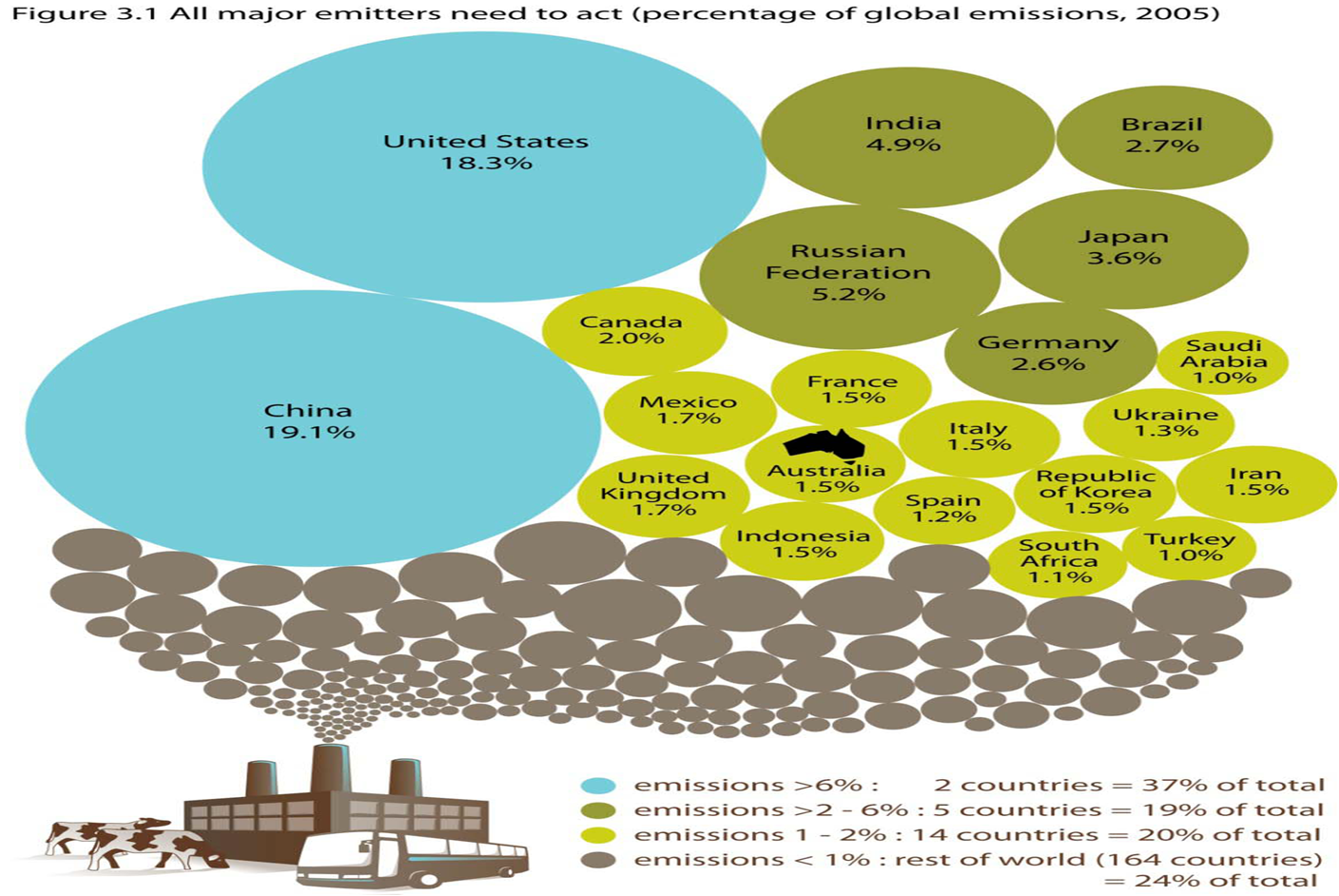
Source: Australian Delegation presentation to international forum held in Bonn in May 2012
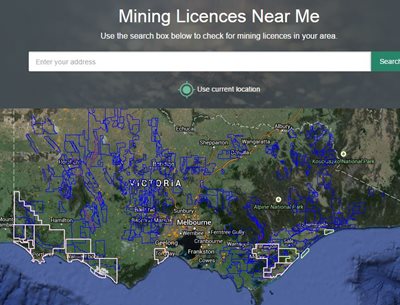
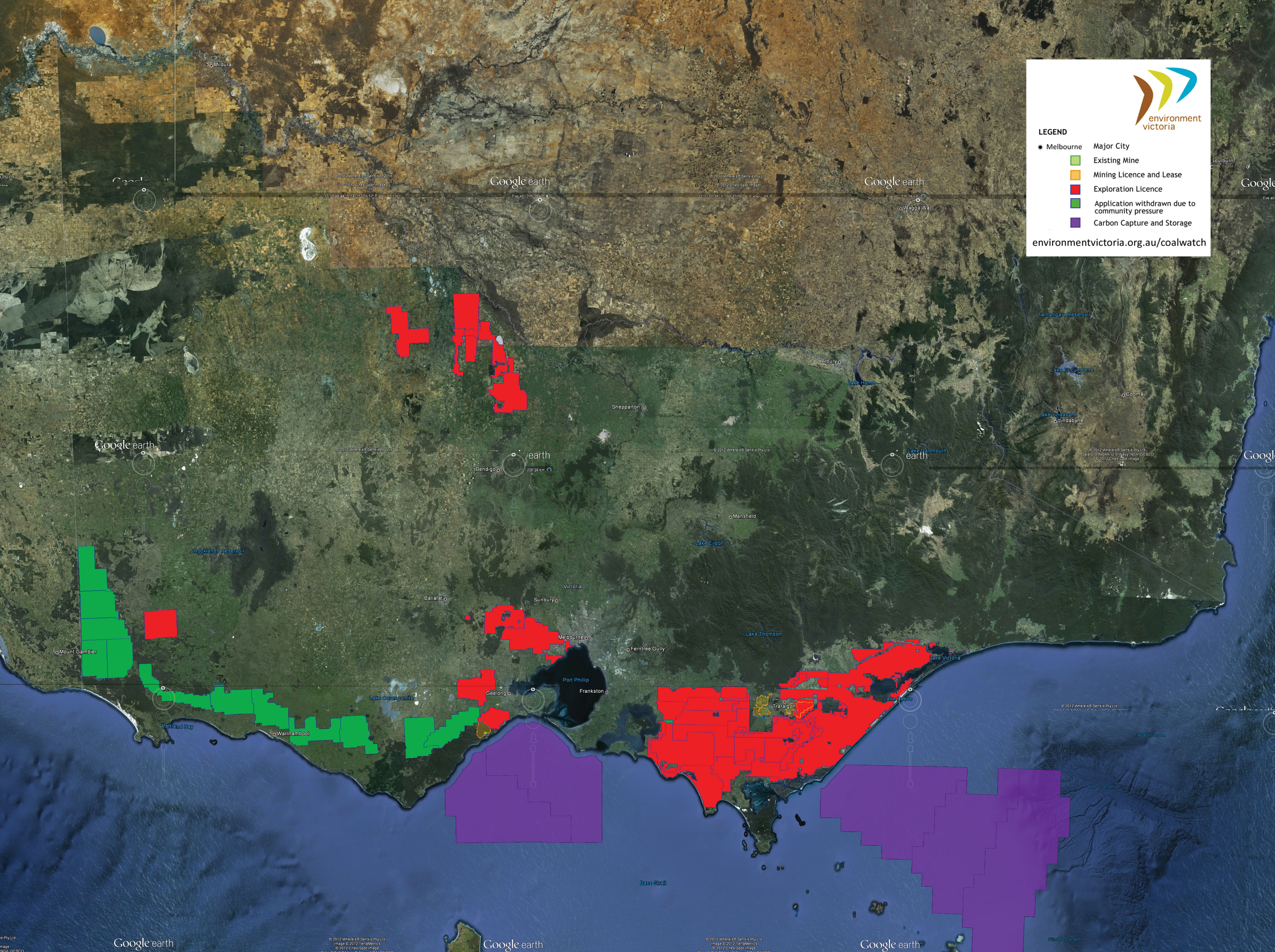
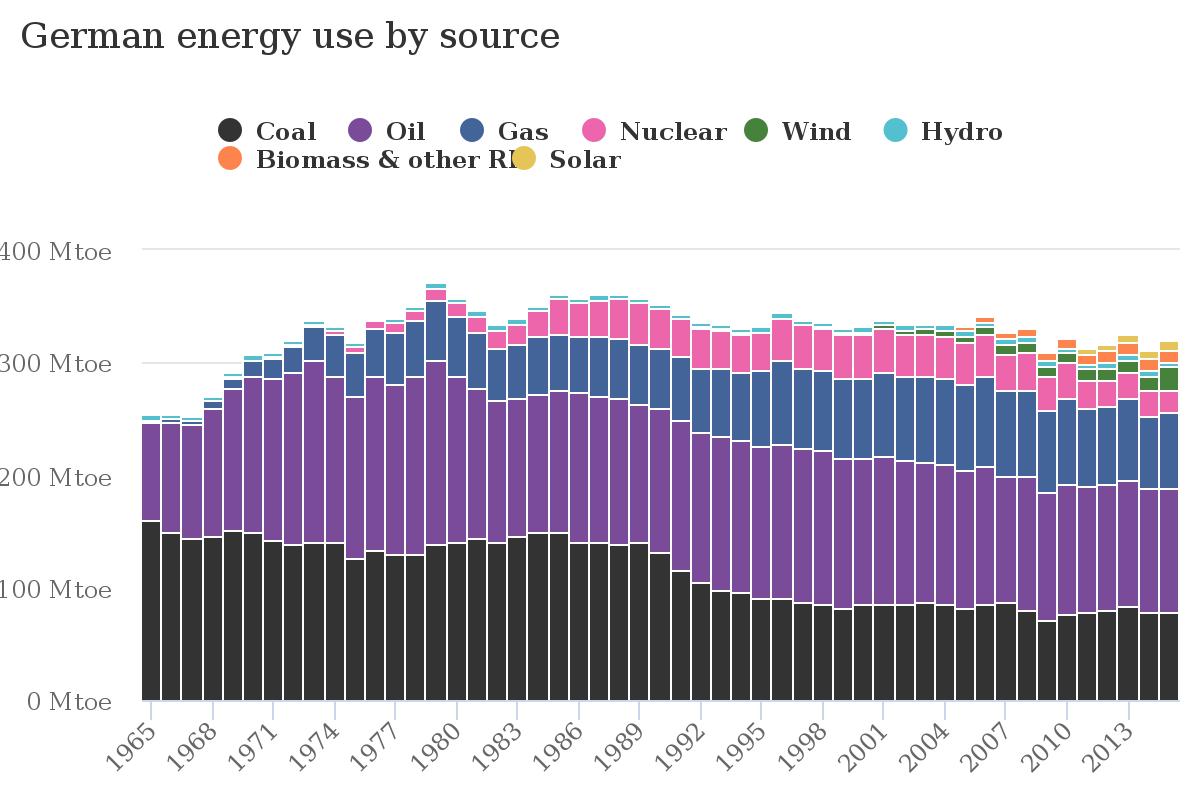
Latest News 3 February 2016, Renew Economy, Senate to inquire into carbon risk, despite Coalition objection. The Australian Senate is to begin an inquiry into carbon risk disclosure in Australia, following a proposal by the Greens after the ground-breaking Paris climate agreement reached late last year. The inquiry is due to report in June and will study carbon risk disclosure practices among Australian companies, regulatory oversight, international practice, and Australia’s involvement in the G20 Financial Stability Board discussions on carbon risk impacts. “The Paris Agreement finalised in December 2015 has fundamentally changed the investment landscape,” said Emma Herd, the head of The Investor Group on Climate Change (IGCC), which represents most major investment houses and superannuation funds. “When 195 nations agreed to a goal of limiting global warming to 2°C moving towards 1.5°C, it immediately became clear that all companies will need to stress test their commercial strategy for a two degree scenario and disclose to the market the risks and opportunities for their business.” The inquiry will focus on corporate disclosure, although given the decisions at state and federal level in recent weeks, it might also want to focus on the carbon risk for the Australian economy as a whole. New data this week revealed that Australia was increasing its emissions at a faster rate than any other developed economy, and was not likely to peak its emissions before 2030. The lack of new funding for Direct Action means that there is now no policy in place to reduce emissions. Investment in renewables remains at a standstill. Read More here 2 February 2016, The Guardian, Queensland gives Adani environmental permit for Carmichael coalmine. Huge project clears one more hurdle, but financial uncertainty still hovers over the mine and related rail and port construction at Abbot Point. Adani has secured an environmental permit from the Queensland government to build Australia’s largest coal mine. The Indian conglomerate was issued an environmental authority for its Carmichael mine, west of Bowen in north Queensland, by the department of environment and heritage on Tuesday. It is one less hurdle for Adani’s highly contested plans, after its Australian chief complained last week that delays in government approvals were “incentivising” green activists to plot further legal challenges to stymie the company’s progress. Adani still needs to obtain significant bank funding to realise its $16.5bn mine, rail and port project. It must convince the Queensland government it has obtained “financial closure” before it will be allowed to begin dredging near Great Barrier Reef waters to expand the Abbot Point export facility. A lull in world coal demand and moves in India to rely less on imported thermal coal have cast doubt on the future of the mine. Adani still has to obtain a mining lease from the Queensland government. The state land court last year recommended resources minister Anthony Lynham approve the lease after a legal challenge by conservation group Coast and Country failed to persuade the judge that the mine would have any impact on Asian coal consumption. Read more here 2 February 2016, Climate News Network, Useful waste offers win-win benefits. An unsung success story in the switch to renewable energy is the use of waste to produce gas – and a valuable by-product. The future is increasingly bright for renewable energy, with the US aiming to cut the price of solar photovoltaics by 75%between 2010 and 2020. Denmark plans to obtain 50% of its energy from windjust five years from now. But one form of renewable energy – and one which attracts few headlines – manages to create two useful products at the same time, and is making a growing contribution to combatting climate change. The medieval alchemists who sought to turn base metal into gold would have thrilled at chemistry that let them turn waste into both fuel and fertiliser. Their twenty-first century successors have discovered the secret of doing exactly that. Unwanted food, animal waste, municipal rubbish, crop and forestry residues, sewage and dozens of other left-overs of civilisation can and are now being turned into methane to generate electricity, provide district heating and to fuel road vehicles. Big contribution This largely unheralded revolution takes different forms across the world, mostly because governments set their own rules to encourage the technology, and also because local circumstances provide contrasting piles of waste. But in every case the waste can be converted into gas for use as fuel. Although the technology is only part of the solution to climate change, theEuropean Biogas Association estimates that over time it should be able to replace 30% of current natural gas consumption in Europe. The technology is roughly the same whatever the size of the plant or its location. Biogas plants use microbes to eat waste in an oxygen-free environment to produce methane, and leave fertiliser or soil conditioner as a useful by-product. The plants vary from small household types, very popular in China and India, to farm plants and larger-scale municipal installations in Europe. Read More here 1 February 2016, Renew Economy, Australia emissions surging to record high despite Paris climate deal. Australia’s greenhouse gas emissions are posed to surge to a record high after 2020, and may not reach a peak before 2030 – despite the government’s claim it has been reducing emissions and its support for the Paris climate deal. A new analysis from industry analyst Reputex – a division of global ratings agency Standard & Poor’s – confirms what we already know: despite the Coalition’s rhetoric, emissions in Australia actually rose 1.3 per cent in 2014/15, for the first time since the Coalition was last in power a decade earlier. But the Reputex survey also notes that Australia’s emissions growth is now among the highest in the world, with the government’s own forecast showing emissions will grow 6 per cent to 2020, despite its “Direct Action” plan and the billions spent in the Emissions Reduction Fund. Ironically, the emissions growth would have been faster, but for the fact that Australia’s economic growth has been downgraded sharply from the optimistic assumptions of successive Labor and Coalition governments. Read More here 2 October 2017, Australian Institute, We have enough cheap, easy-to-extract gas to last 100 years. There’s just one problem. Australia has plenty of cheap gas. The problem is private companies are selling it all overseas, writes principal adviser at the Australia Institute Mark Ogge. Hard to believe, isn’t it? But it’s true: in the last decade, tens of thousands of square kilometers of Queensland farmland has been covered in gas fields. The export gas rush in Australia is one of the largest and fastest expansions of a gas industry ever seen, anywhere in the world. We are awash with gas. The problem is we are allowing almost all of the cheap and easy-to-get-at gas to be sent overseas. The gas in some areas is close to the surface, in big reserves all together, where there are no bothersome farmers, aquifers or national parks in the way. That gas is relatively cheap to extract. But some gas is deeper and harder to get at for all sorts of geological reasons. And that gas is more expensive to extract. Some gas is not just deep and hard to get at, but is underneath valuable aquifers that would need to be drilled through to get the gas. Much of it is on properties of people who don’t want a gas field on their land, or on properties a long way from where the gas is needed. That gas is very expensive to extract. So, naturally, the gas companies’ first preference is for the easily extractable, cheap gas, and they drill that and sell it first. The problem is, there is a limited amount of that cheaper to extract gas. Once that gas is gone, only the difficult, expensive-to-extract gas remains. That was OK when it was just being sold to Australian customers. There was enough reasonably easily extractable, cheap gas to last for decades at least. Read More here 20 September 2017, Renew Economy, Back to 2009: Abbott declares war on everything. Well, that turned out well didn’t it. Despite prime minister Malcolm Turnbull’s desperate attempts to appease the conservative faction of his Coalition government by compromising everything he ever stood for on climate and clean energy, it’s clearly not enough. In doing so, Abbott has done what Turnbull dared not in the past two years: jettison Abbott-era policies. While Turnbull was too afraid to make those policies more ambitious, Abbott has now come out and effectively dumped the very policies he put in place: its Paris climate commitment, and the much-reduced renewable energy target.His predecessor Tony Abbott effectively dialled back the climate and energy debate to 2009 by announcing that he would cross the floor and vote against anything that looked remotely like a climate change policy, or represented even the smallest subsidy for renewable energy. Abbott has reinforced his assertion that climate science is “crap”. In an interview on Rupert Murdoch’s Sky News with climate denier and renewables hater Alan Jones and his former chief of staff Peta Credlin, Abbott rates climate changes as “a third order” issue. Read More here 15 September 2017, Renew Economy, Blackouts and baseload: Debunking myths of AEMO reports and Liddell. The day after the release of the two key reports from the Australian Energy Market Operator last week – its annual Electricity Statement of Opportunities and the specially commissioned report on dispatchable generation requested by the federal government – RenewEconomy could barely believe what it read and heard in the media. Consumers were being frightened into thinking that the lights were going out, the economy would collapse, and they’d all be better off going out to buy a generator and a supply of candles and batteries. The only possible solution to the crisis, we were told, was to stop renewable energy and keep the Liddell coal generator on line. What was missed – in the fog of politics, ideologies and deliberate misinformation – were the fundamental messages of the two reports: that the energy system is transitioning quickly, and it is more or less unstoppable, because of the march of technologies and global trends. This is not a bad thing, AEMO boss Audrey Zibelman underlined. But it does require some policy certainty and some co-ordination to ensure that Australia’s dirty, expensive and increasingly unreliable grid can be transformed into a smarter, cleaner, more reliable and cheaper source of power. Read More here 12 September 2017, Renew Economy,AEMO: Our advice was pretty straight forward, we need dispatchability. As the federal Coalition continues to push the case for an ageing, unreliable, and slow moving coal generator to maintain energy security in the 2020s, the Australian Energy Market Operator has underlined its advice to the government last week: it wasn’t a push for more baseload. “We need flexible capacity that can be switched on and off, and we need to transition to a new generation of Australia’s principal energy market institutions, and the newly-formed Energy Security Board. “Our advice was fairly pragmatic,” Zibelman said. “We are concerned that on a 45°C day if we lose a generator (which AEMO has said is quite likely) we want reserves in the system to be able to respond. “In our report we identified the fact that with amount of variability (from solar and wind energy and electricity usage) is changing rapidly, we need resources that can change rapidly. “That may be different to traditional baseload resources, which do not move a lot. It doesn’t mean baseload is bad, it’s just that we need a different portfolio. (Baseload) may not be able respond in the time period we need it to respond.” Sound like Liddell? Not really. The plant owner AGL Energy has made it clear that Liddell is old, increasingly unreliable, expensive to maintain, prone to unexpected outages and can’t be relied upon at times of peak demand, particularly as temperatures rise. Zibelman’s comments, like the two AEMO reports it released last week, contrast starkly with the Coalition government’s contention that AEMO had insisted that rapid action was needed, and that that rapid action must mean that Liddell’s life span must be extended. Zibelman made it absolutely clear that her preference was for fast, flexible technologies, both in supply and demand, and bother in front and behind the meter. Importantly, it had to be technology that the market operator could rely upon. Read More here 3 May 2023, The Conversation: Two trillion tonnes of greenhouse gases, 25 billion nukes of heat: are we pushing Earth out of the Goldilocks zone? Since the 18th century, humans have been taking fossil fuels out of their safe storage deep underground and burning them to generate electricity or power machinery. We’ve now converted coal, oil and gas into more than two trillion tonnes of heat-trapping carbon dioxide and other greenhouse gases and added them to the atmosphere. The current result? The average temperature at the planet’s surface is about 1.2℃ hotter than in the pre-industrial era. That’s because adding new carbon to the world’s natural carbon cycle has caused an imbalance in the amount of energy entering and leaving the Earth system. To warm the entire planet takes an extraordinary amount of extra energy. Recent research shows we’ve added the energy of 25 billion nuclear bombs to the Earth system in just the last 50 years. Billions of nuclear bombs to produce 1.2℃ of heating – so what? It seems small, considering how much temperature varies on a daily basis. (The world’s average surface temperature in the 20th century was 13.9℃.) But almost all of this energy to date has been taken up by the oceans. It’s no wonder we’re seeing rapid warming in our oceans. Read more here 20 April 2023, Bloomberg: Global Warming Is Already Hitting Europe Hard. If water is life, then Europeans are under mortal threat. That was the message in a nutshell transmitted today by the European Commission’s scientific advisers at the Copernicus Climate Change Service. Drought conditions not seen in some places since the Renaissance are becoming the continent’s new normal, with perilous knock-on effects for food security and supply chains in the European Union, the world’s third-biggest economy. Water levels on European rivers have been shrinking now for six years, with farmland drying up and Alpine glaciers in retreat. … While heat and drought are also afflicting regions from Asia to East Africa, Europe is a climate change front-runner, warming at twice the rate as other inhabited continents, according to Copernicus. Last year was 1.4C (2.5F) warmer than normal and right on the cusp of the 1.5C temperature-increase limit that scientists have set to keep life more-or-less normal this century. Read more here 19 April 2023, Climate Homes News: UN: World set to blow through 1.5C carbon budget in 10 years. Under governments’ current climate plans, the world will pump out enough greenhous gas in the next ten years to take global warming above 1.5C above pre-industrial levels, a United Nations report shows. To have a 50:50 chance of limiting global warming to the global target of 1.5C, the IPCC’s scientists said in 2018 that the world can’t produce more than 500 gigatonnes of carbon dioxide. But a new report to governments by the United Nations climate change body says that, even if governments meet their current climate targets (NDCs), they will produce about 430 gigatonnes by 2030. That leaves just 70 gigatonnes left for after 2030. On this trajectory, that will be burned through in just two years. At the Cop26 climate talks in Glasgow, all nations agreed to request each other “revisit and strengthen” their 2030 climate targets. But just a handful did so and none of the world’s biggest emitters have suggested they will improve their targets. Analysis by Climate Action Tracker has found that no government’s climate plans are compatible with limiting global warming to 1.5C. At Cop26, a UN work programme was set up to scale up emissions reductions in the 2020s but at Cop27 countries only debated how to set up these talks. They discussed how long they should talk for and what they should talk about. Read more here 18 April 2023, Climate Homes News: World set to blow through 1.5C carbon budget in 10 years. The US has offered $3.5 billion in grants towards direct air capture, hoping to bring down the costs of removing carbon from the atmosphere. The world is failing to cut carbon emissions fast enough to avoid disastrous climate change, a dawning truth that is giving life to a technology that for years has been marginal – pulling carbon dioxide from the air. Leading the charge, the U.S. government has offered $3.5 billion in grants to build the factories that will capture and permanently store the gas – the largest such effort globally to help halt climate change through Direct Air Capture (DAC) and expanded a tax credit to $180/tonne to bolster the burgeoning technology. The sums involved dwarf funding available in other regions, such as Britain which has pledged up to 100 million pounds ($124 million) for DAC research and development. That compares with $12 billion in federal spending to drive demand for personal and commercial electric vehicles, Boston Consulting Group estimated. While bids for the U.S. DAC hub funding were due on March 13, the government and some companies have yet to fully disclose details about the applications, many of which Reuters is reporting for the first time. The US Energy Department expects to announce winning bids this summer. Read more here 27 January 2025, Carbon Brief: A record surge of clean energy kept China’s carbon dioxide (CO2) emissions below the previous year’s levels in the last 10 months of 2024. However, the new analysis for Carbon Brief, based on official figures and commercial data, shows the tail end of China’s rebound from zero-Covid in January and February, combined with abnormally high growth in energy demand, stopped CO2 emissions falling in 2024 overall. While China’s CO2 output in 2024 grew by an estimated 0.8% year-on-year, emissions were lower than in the 12 months to February 2024. Other key findings of the analysis include: As ever, the latest analysis shows that policy decisions made in 2025 will strongly affect China’s emissions trajectory in the coming years. In particular, both China’s new commitments under the Paris Agreement and the country’s next five-year plan are being prepared in 2025. Read More Here 3 November 2020, Carbon Brief: Hydrogen gas has long been recognised as an alternative to fossil fuels and a potentially valuable tool for tackling climate change. Now, as nations come forward with net-zero strategies to align with their international climate targets, hydrogen has once again risen up the agenda from Australia and the UK through to Germany and Japan. In the most optimistic outlooks, hydrogen could soon power trucks, planes and ships. It could heat homes, balance electricity grids and help heavy industry to make everything from steel to cement. But doing all these things with hydrogen would require staggering quantities of the fuel, which is only as clean as the methods used to produce it. Moreover, for every potentially transformative application of hydrogen, there are unique challenges that must be overcome. In this in-depth Q&A – which includes a range of infographics, maps and interactive charts, as well as the views of dozens of experts – Carbon Brief examines the big questions around the “hydrogen economy” and looks at the extent to which it could help the world avoid dangerous climate change. Access full article here Fossil fuel emissions have stalled 14 November 2016, The Conversation, Fossil fuel emissions have stalled: Global Carbon Budget 2016. For the third year in a row, global carbon dioxide emissions from fossil fuels and industry have barely grown, while the global economy has continued to grow strongly. This level of decoupling of carbon emissions from global economic growth is unprecedented.Global CO₂ emissions from the combustion of fossil fuels and industry (including cement production) were 36.3 billion tonnes in 2015, the same as in 2014, and are projected to rise by only 0.2% in 2016 to reach 36.4 billion tonnes. This is a remarkable departure from emissions growth rates of 2.3% for the previous decade, and more than 3% during the 2000’s. Read More here Do you want to understand the complexity of energy systems which support our high consumption lifestyles? Most people don’t give too much thought to where their electricity comes from. Flip a switch, and the lights go on. That’s all. The origins of that energy, or how it actually got into our homes, is generally hidden from view. This link will take you to 11 maps which explain energy in America (it is typical enough as an example of a similar lifestyle as Australia – when I find maps for Oz I’ll add them in) e.g. above map showing the coal plants in the US. Source: Vox Explainers Mapped: how Germany generates its electricity – another example Power to the People – Lock the Gate looks back at the wins of 2015 And there’s lots more coming up in 2016. Some of the big priorities coming up next for the “Lock the Gate” movement are: If you want to give “Lock the Gate” your support – go here for more info This new report reveals that the pollution from Australia’s coal resources, particularly the enormous Galilee coal basin, could take us two-thirds of the way to a two degree rise in global temperature. To Read More and download report The 2006 UK government commissioned Stern Commission Review on the Economics of Climate Change is still the best complete appraisal of global climate change economics. The review broke new ground on climate change assessment in a number of ways. It made headlines by concluding that avoiding global climate change catastrophe was almost beyond our grasp. It also found that the costs of ignoring global climate change could be as great as the Great Depression and the two World Wars combined. The review was (still is) in fact a very good assessment of global climate change, which inferred in 2006 that the situation was a global emergency. Read More here The Garnaut Climate Change Review was commissioned by the Commonwealth, state and territory governments in 2007 to conduct an independent study of the impacts of climate change on the Australian economy. Prof. Garnaut presented The Garnaut Climate Change Review: Final Report to the Australian Prime Minister, Premiers and Chief Ministers in September 2008 in which he examined how Australia was likely to be affected by climate change, and suggested policy responses. In November 2010, he was commissioned by the Australian Government to provide an update to the 2008 Review. In particular, he was asked to examine whether significant changes had occurred that would affect the analysis and recommendations from 2008. The final report was presented May 2011. Since then the Professor has regularly participated in the debate of fossil fuel reduction, as per his latest below: To access his reports; interviews; submissions go here 27 May 2015, Renew Economy, Garnaut: Cost of stranded assets already bigger than cost of climate action. This is one carbon budget that Australia has already blown. Economist and climate change advisor Professor Ross Garnaut has delivered a withering critique of Australia’s economic policies and investment patterns, saying the cost of misguided over-investment in the recent mining boom would likely outweigh the cost of climate action over the next few decades. Read More here Live generation of electricity by fuel type Fossil Fuel Subsidies – The Age of entitlement continues 24 June 2014, Renew Economy, Age of entitlement has not ended for fossil fuels: A new report from The Australia Institute exposes the massive scale of state government assistance, totalling $17.6 billion over a six-year period, not including significant Federal government support and subsidies. Queensland taxpayers are providing the greatest assistance by far with a total of $9.5 billion, followed by Western Australia at $6.2 billion. The table shows almost $18 billion dollars has been spent over the past 6 years by state governments, supporting some of Australia’s biggest, most profitable industries, which are sending most of the profits offshore. That’s $18 billion dollars that could have gone to vital public services such as hospitals, schools and emergency services. State governments are usually associated with the provision of essential services like health and education so it will shock taxpayers to learn of the massive scale of government handouts to the minerals and fossil fuel industries. This report shows that Australian taxpayers have been misled about the costs and benefits of this industry, which we can now see are grossly disproportionate. Each state provides millions of dollars’ worth of assistance to the mining industry every year, with the big mining states of Queensland and Western Australia routinely spending over one billion dollars in assistance annually. Read More here – access full report here What is fossil fuel divestment? Local Governments ready to divest Aligning Council Money With Council Values A Guide To Ensuring Council Money Isn’t Funding Climate Change. 350.org Australia – with the help of the incredible team at Earth Hour – has pulled together a simple 3-step guide for local governments interested in divestment. The movement to align council money with council values is constantly growing in Australia. It complements the existing work that councils are doing to shape a safe climate future. It can also help to reshape the funding practices of Australia’s fossil fuel funding banks. The steps are simple. The impact is huge.The guide can also be used by local groups who are interested in supporting their local government to divest as a step-by-step reference point. Access guide here How coal is staying in the ground in the US Sierra Club Beyond Coal Campaign May 2015, Politico, Michael Grunwald: The war on coal is not just political rhetoric, or a paranoid fantasy concocted by rapacious polluters. It’s real and it’s relentless. Over the past five years, it has killed a coal-fired power plant every 10 days. It has quietly transformed the U.S. electric grid and the global climate debate. The industry and its supporters use “war on coal” as shorthand for a ferocious assault by a hostile White House, but the real war on coal is not primarily an Obama war, or even a Washington war. It’s a guerrilla war. The front lines are not at the Environmental Protection Agency or the Supreme Court. If you want to see how the fossil fuel that once powered most of the country is being battered by enemy forces, you have to watch state and local hearings where utility commissions and other obscure governing bodies debate individual coal plants. You probably won’t find much drama. You’ll definitely find lawyers from the Sierra Club’s Beyond Coal campaign, the boots on the ground in the war on coal. Read More here Oil – conventional & unconventional May 2015, Oil change International Report: On the Edge: 1.6 Million Barrels per Day of Proposed Tar Sands Oil on Life Support. The Canadian tar sands is among the most carbon-intensive, highest-cost sources of oil in the world. Even prior to the precipitous drop in global oil prices late last year, three major projects were cancelled in the sector with companies unable to chart a profitable path forward. Since the collapse in global oil prices, the sector has been under pressure to make further cuts, leading to substantial budget cuts, job losses, and a much more bearish outlook on expansion projections in the coming years. Read full report here. For summary of report USA Sierra Club Beyond Oil Campaign Coal Seam Gas battle in Australia Lock the Gate Alliance is a national coalition of people from across Australia, including farmers, traditional custodians, conservationists and urban residents, who are uniting to protect our common heritage – our land, water and communities – from unsafe or inappropriate mining for coal seam gas and other fossil fuels. Read more about the missions and principles of Lock the Gate. Access more Lock the Gate videos here. Access Lock the Gate fact sheets here 2014: Parliament of Victoria Research Paper: Unconventional Gas: Coal Seam Gas, Shale Gas and Tight Gas: This Research Paper provides an introduction and overview of issues relevant to the development of unconventional gas – coal seam, shale and tight gas – in the Australian and specifically Victorian context. At present, the Victorian unconventional gas industry is at a very early stage. It is not yet known whether there is any coal seam gas or shale gas in Victoria and, if there is, whether it would be economically viable to extract it. A moratorium on fracking has been in place in Victoria since August 2012 while more information is gathered on potential environmental risks posed by the industry. The parts of Victoria with the highest potential for unconventional gas are the Gippsland and Otway basins. Notably, tight gas has been located near Seaspray in Gippsland but is not yet being produced. There is a high level of community concern in regard to the potential impact an unconventional gas industry could have on agriculture in the Gippsland and Otway regions. Industry proponents, however, assert that conventional gas resources are declining and Victoria’s unconventional gas resources need to be ascertained and developed. Read More here 28 January 2015, ABC News, Coal seam gas exploration: Victoria’s fracking ban to remain as Parliament probes regulations: A ban on coal seam gas (CSG) exploration will stay in place in Victoria until a parliamentary inquiry hands down its findings, the State Government has promised. There is a moratorium on the controversial mining technique, known as fracking, until the middle of 2015. The Napthine government conducted a review into CSG, headed by former Howard government minister Peter Reith, which recommended regulations around fracking be relaxed. Labor was critical of the review, claiming it failed to consult with farmers, environmental scientists and local communities. Read more here Keep up to date and how you can be involved here Friends of the Earth Melbourne Coal & Gas Free Victoria 20 May 2015, FoE, Inquiry into Unconventional Gas: Check here for details on the Victorian government’s Inquiry into unconventional gas. The public hearings have not yet started, however the Terms of Reference have been released. The state government’s promised Inquiry into Unconventional Gas has now been formally announced, with broad terms of reference (TOR). FoE’s response to the TOR is available here. The Upper House Environment and Planning Committee will manage the Inquiry. You can find the Inquiry website here. The final TOR will be determined by the committee. Significantly, it is a cross party committee. The Chair is a Liberal (David Davis), and there is one National (Melinda Bath), one Green (Samantha Dunn), three from the ALP (Gayle Tierney, Harriet Shing, Shaun Leane), an additional MP from the Liberals (Richard Dalla-Riva), and one MP from the Shooters Party (Daniel Young). Work started by the previous government, into water tables and the community consultation process run by the Primary Agency, will be released as part of the inquiry.The moratorium on unconventional gas exploration will stay in place until the inquiry delivers its findings. The interim report is due in September and the final report by December. There is the possibility that the committee will amend this timeline if they are overwhelmed with submissions or information. Parliament will then need to consider the recommendations of the committee and make a final decision about how to proceed. This is likely to happen when parliament resumes after the summer break, in early 2016. Quit Coal is a Melbourne-based collective that campaigns against the expansion of the coal and unconventional gas industries in Victoria. Quit Coal uses a range of tactics to tackle this problem. We advise the broader Victorian community about plans for new coal and unconventional gas projects, we put pressure on our government to stop investing in these projects, and we help to inform and mobilise Victorian communities so they can campaign on their own behalf. We focus on being strategic, creative, and as much as possible, fun! The above screen shot is of the Victorian State government’s Mining Licences Near Me site. Go to this link to see what is happening in your area Environment Victoria’s campaign CoalWatch is an interactive resource that tracks the coal industry’s expansion plans and helps builds a movement to stop these polluting developments. CoalWatch provides a way for everyday Victorians to keep track of the coal industry’s ambitious expansion plans. To check what tax-payer money has been pledged to brown coal projects and the coal projects industry is spruiking to our politicians. Here’s another map via EV website (go to their website and you should be able to get better detail from Google Maps: Red areas: Exploration licences (EL). These areas are held by companies to undertake exploration activity. A small bond is held by government in case of any damage. If a company wants to progress the project it needs to obtain a mining licence. Exploration Licence applications are marked with an asterix in the Places Index eg. EL4684*. Yellow areas: Mining Licences (MIN). A mining licence is granted with the expectation that mining will occur. A larger bond is paid to government. Green areas: Exploration licences that have been withdrawn or altered due to community concern. Green outline: Existing mines within Mining Licences. Purple areas: Geological Carbon Storage Exploration areas for carbon capture and storage. On-shore areas have been released by the State Government, while off-shore areas have been released by the Federal Government. The Coal Watch wiki tracks current and future Victorian coal projects, whether they are power stations, coal mines, proposals to export coal or some other inventive way of burning more coal. To get the full picture of coal in Victoria visit our wiki page. Get more info and see the full list of Exploration Licences current at 17 August 2012 here August 2015, Institute for Energy Economics & Financial Analysis – powerpoint: Changing Dynamics in the Global Seaborne Thermal Coal Markets and Stranded Asset Risk. Information from one of the slides follows. To view full presentation go here Economic Implications for Australia 83% of Australian coal mines are foreign owned, hence direct leverage of fossil fuels to the ASX is relatively small at 1-2%. However, for Australia the exposure is high, time is needed for transition and the new industry opportunities are significant: 1. Energy Infrastructure: Australia spends $5-10bn pa on electricity / grid sector, much of it a regulated asset base that all ratepayers fund much of it stranded. BNEF estimate of Australia’s renewable energy infrastructure investment for 2015-2020 was cut 30% from A$20bn post RET. Lost opportunities. 2. Direct employment: The ABS shows a fall of ~20k from the 2012 peak of 70K from coal mining across Australia, and cuts are ongoing. Indirect employment material. 3. Terms of trade: BZE estimates the collapse in the pricing of iron ore, coal and LNG cuts A$100bn pa from Australia’s export revenues by 2030, a halving relative to government budget estimates of 2013/14. Coal was 25% of NSW’s total A$ value of exports in 2013/14 (38% of Qld). Australia will be #1 globally in LNG by 2018. 4. The financial sector: is leveraged to mining and associated rail port infrastructure. WICET 80% financed by banks, mostly Australian. Adani’s Abbot Point Port is foreign owned, but A$1.2bn of Australian sourced debt. Insurance firms and infrastructure funds are leveraged to fossil fuels vs little RE infrastructure assets. BBY! 5. Rehabilitation: $18bn of unfunded coal mining rehabilitation across Australia. 6. Economic growth: curtailed as Australia fails to develop low carbon industries. 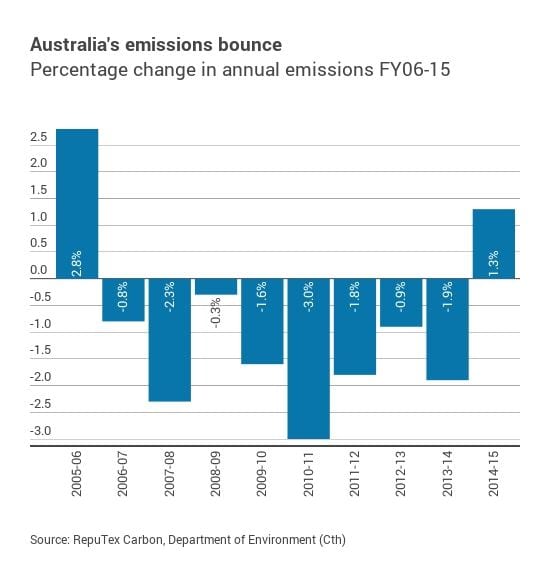
Analysis: Record surge of clean energy in 2024 halts China’s CO2 rise
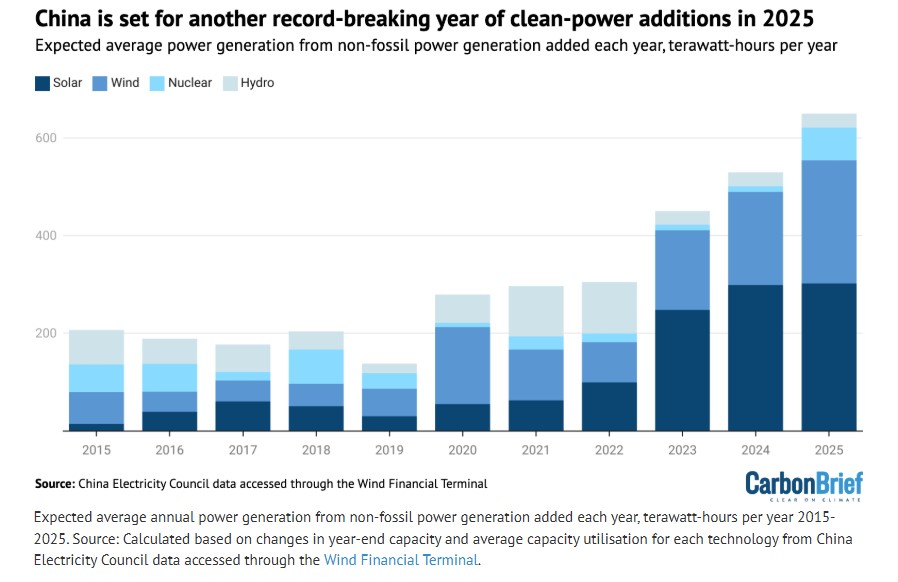
In-depth Q&A: Does the world need hydrogen to solve climate change?
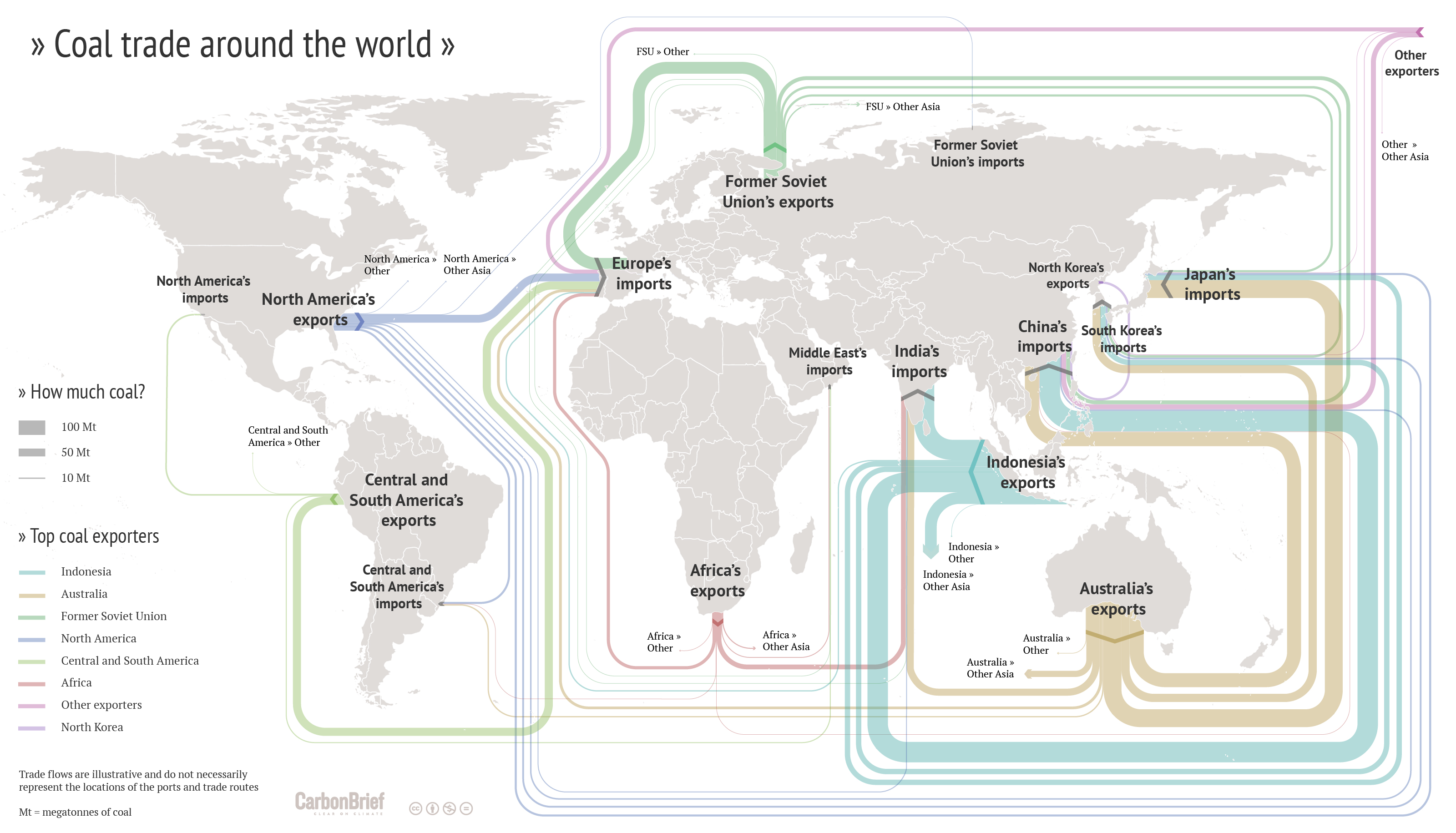 3 May 2016, Carbon Brief, The global coal trade doubled in the decade to 2012 as a coal-fueled boom took hold in Asia. Now, the coal trade seems to have stalled, or even gone into reverse. This change of fortune has devastated the coal mining industry, with Peabody – the world’s largest private coal-mining company – the latest of 50 US firms to file for bankruptcy. It could also be a turning point for the climate, with the continued burning of coal the biggest difference between business-as-usual emissions and avoiding dangerous climate change. Carbon Brief has produced a series of maps and interactive charts to show how the global coal trade is changing. As well as providing a global overview, we focus on a few key countries: Read More here
/cdn0.vox-cdn.com/uploads/chorus_asset/file/3915730/EIA%20coal%20power%20plants.png)
21 April 2015, Climate Council, Will Steffen: Unburnable Carbon: Why we need to leave fossil fuels in the ground.Stern Commission Review
Australia’s Garnaut Review
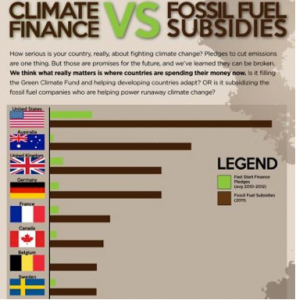 November 2014 – The Fossil Fuel Bailout: G20 subsidies for oil, gas and coal exploration report: Governments across the G20 countries are estimated to be spending $88 billion every year subsidising exploration for fossil fuels. Their exploration subsidies marry bad economics with potentially disastrous consequences for climate change. In effect, governments are propping up the development of oil, gas and coal reserves that cannot be exploited if the world is to avoid dangerous climate change. This report documents, for the first time, the scale and structure of fossil fuel exploration subsidies in the G20 countries. The evidence points to a publicly financed bailout for carbon-intensive companies, and support for uneconomic investments that could drive the planet far beyond the internationally agreed target of limiting global temperature increases to no more than 2ºC. It finds that, by providing subsidies for fossil fuel exploration, the G20 countries are creating a ‘triple-lose’ scenario. They are directing large volumes of finance into high-carbon assets that cannot be exploited without catastrophic climate effects. They are diverting investment from economic low-carbon alternatives such as solar, wind and hydro-power. And they are undermining the prospects for an ambitious climate deal in 2015. Access full report here For the summary on Australia’s susidisation of it’s fossil fuel industry go to page 51 of the report. The report said that the United States and Australia paid the highest level of national subsidies for exploration in the form of direct spending or tax breaks. Overall, G20 country spending on national subsidies was $23 billion. In Australia, this includes exploration funding for Geoscience Australia and tax deductions for mining and petroleum exploration. The report also classifies the Federal Government’s fuel rebate program for resources companies as a subsidy.