What you will find on this page: LATEST NEWS; Fossil fuel emissions have stalled; Analysis: Record surge of clean energy in 2024 halts China’s CO2 rise; does the world need hydrogen?; Mapped: global coal trade; Complexity of energy systems (maps); Mapped: Germany’s energy sources (interactive access); Power to the people (video); Unburnable Carbon (report); Stern Commission Review; Garnaut reports; live generation data; fossil fuel subsidies; divestment; how to run a divestment campaign guide; local council divestment guide; US coal plant retirement; oil conventional & unconventional; CSG battle in Australia (videos); CSG battle in Victoria; leasing maps for Victoria; coal projects Victoria
Huge task to decarbonise
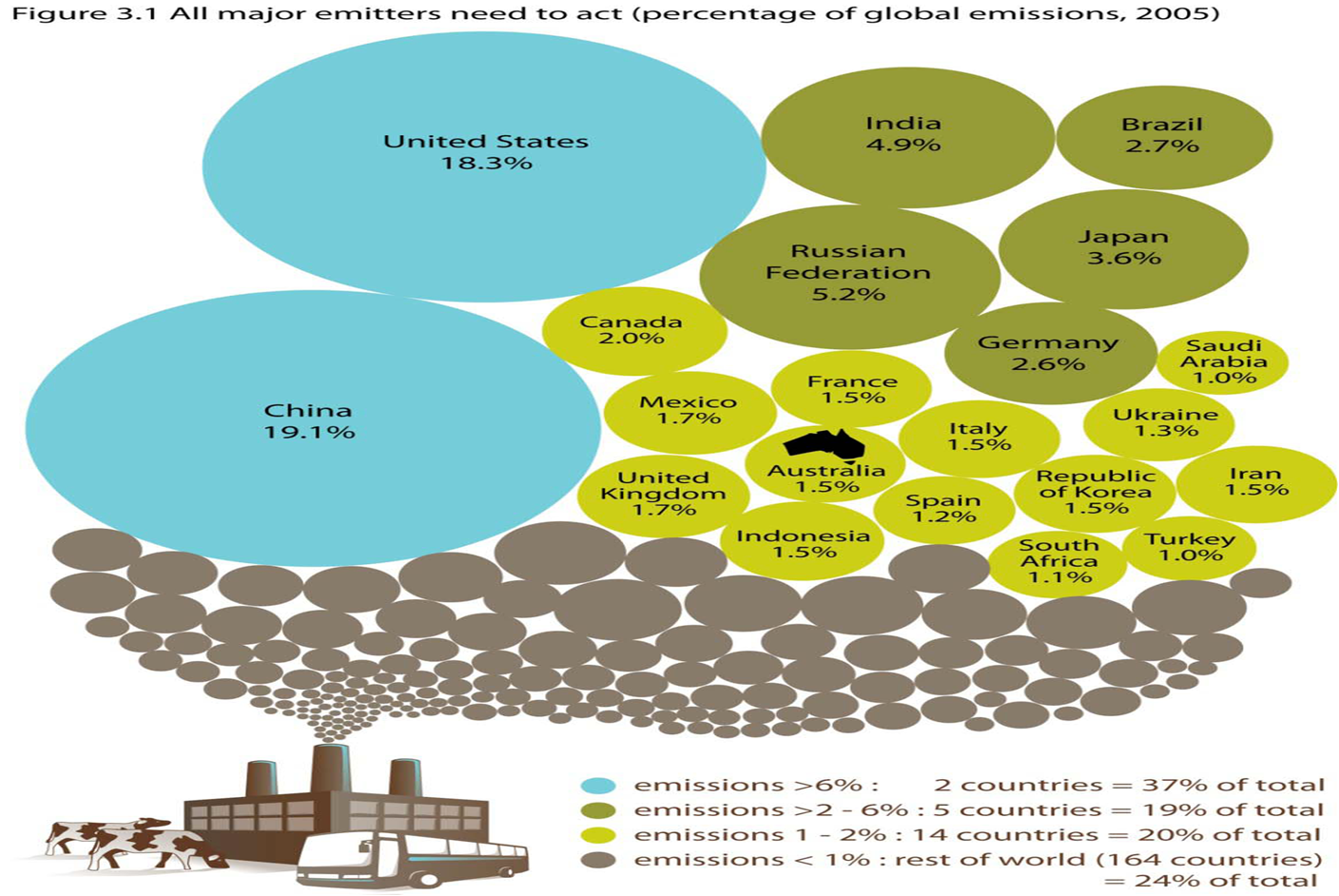
Source: Australian Delegation presentation to international forum held in Bonn in May 2012
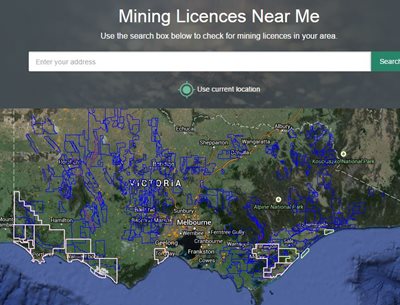
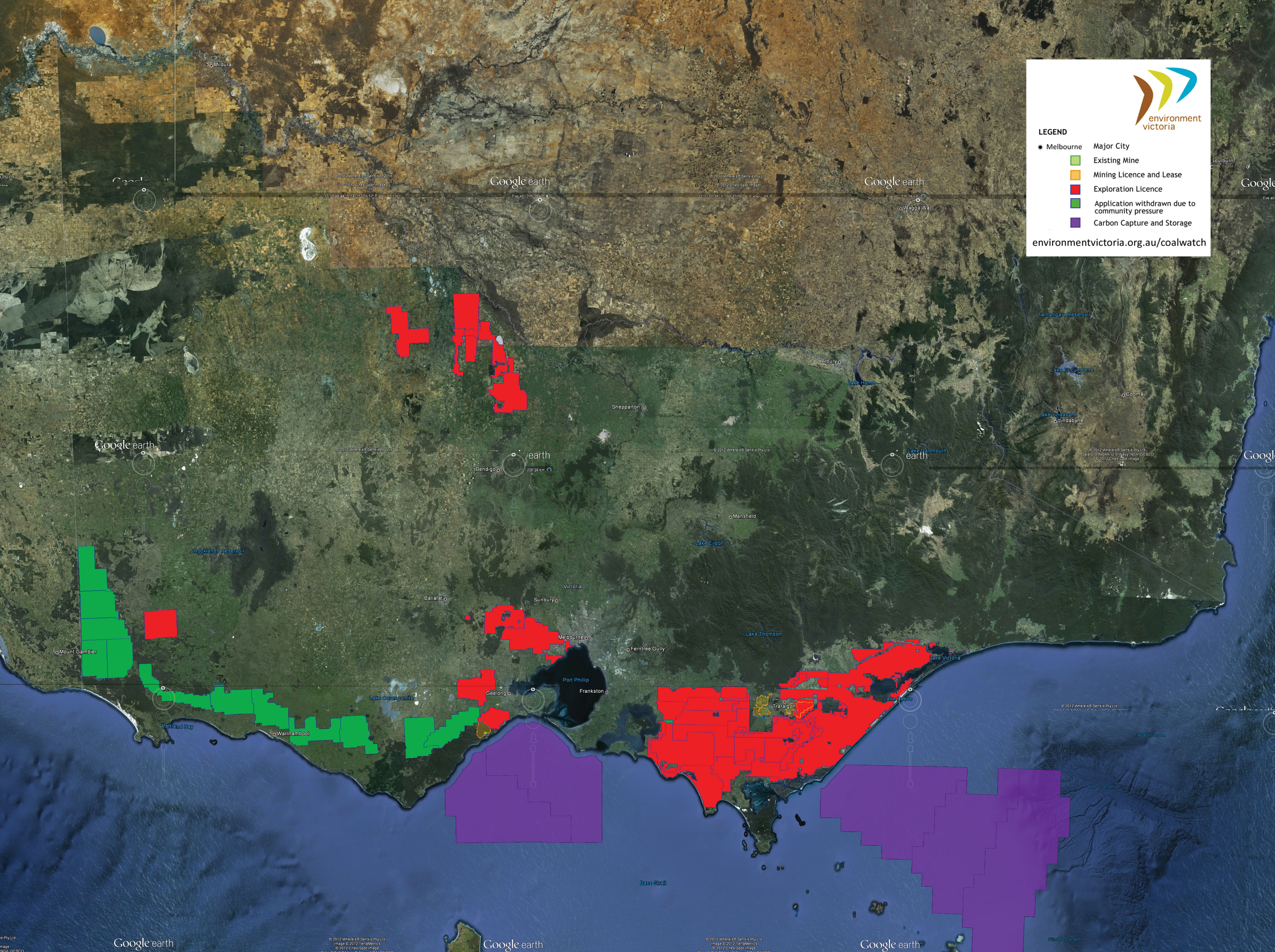
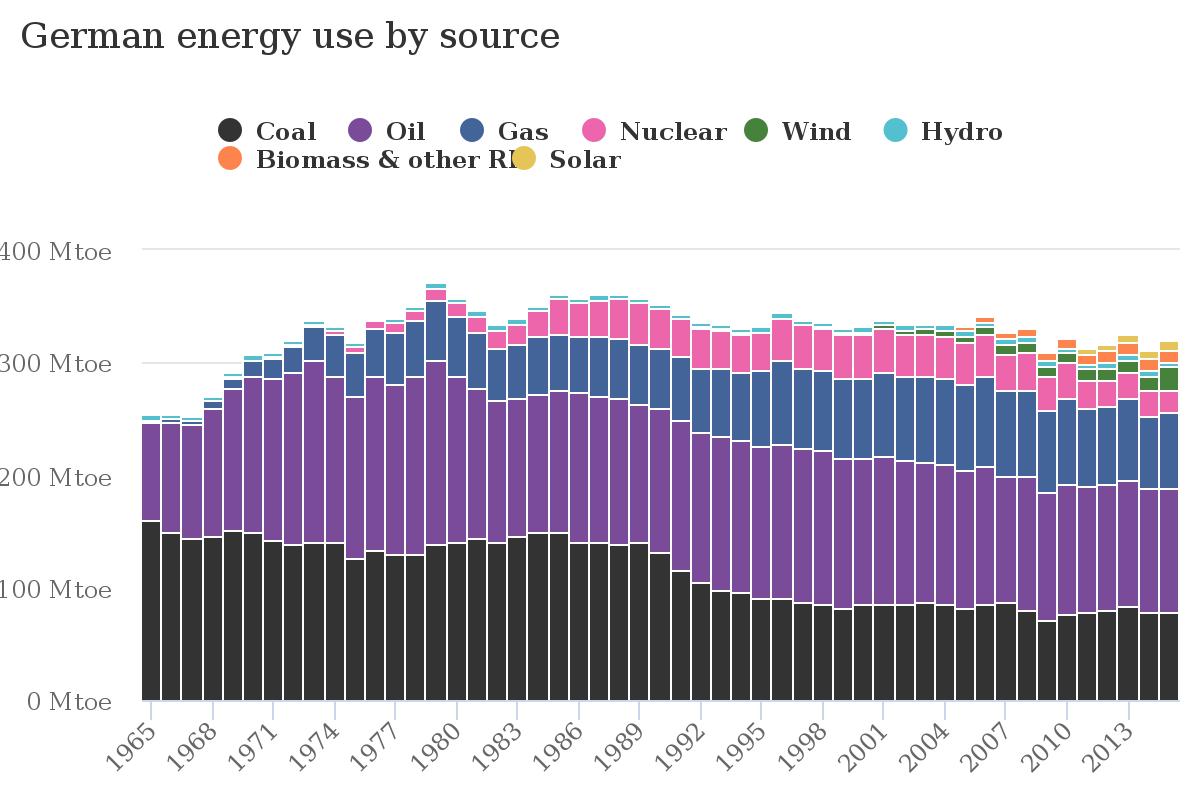
Latest News 30 November 2016, The Conversation, Will the latest electricity review bring climate and energy policy together at last? The Australian government is reviewing our electricity market to make sure it can provide secure and reliable power in a rapidly changing world. Faced with the rise of renewable energy and limits on carbon pollution, The Conversation has asked experts what kind of future awaits the grid. Australia’s National Electricity Market (NEM) is under review following the state-wide blackout that hit South Australia in September. The review, led by Chief Scientist Alan Finkel, will “develop a national reform blueprint to maintain energy security and reliability”. Importantly, the Council of Australian Governments (COAG) specifically agreed that the review would consider Australia’s commitment under the Paris climate agreement, and how climate and energy policy can be integrated. Before we consider how the NEM might need to change, it is important to understand how it came about. State responsibility Electricity supply began as a state responsibility. Originally, state-based utilities owned and operated the entire supply chain, from generation to transmission, distribution and retail. With the exception of the Snowy Hydro Scheme, there were no interstate transmission lines. Accessibility and affordability were (and still are) key concerns for the states. As such, electricity prices were equal for all citizens, irrespective of their location or the actual cost of bringing electricity to them. This is still partly reflected in network tariffs today. In the late 1980s, concerns about rising costs to government, but also a worldwide ideological move towards privatisation of public services, drove a shift away from publicly owned utilities. This began with a New South Wales inquiry, which found that NSW could avoid billions of dollars in new investment by connecting its network with Victoria. This set the scene for the development of a more interconnected grid and more general reform. In particular, this was followed by a report from the former Industry Commission in 1991 and the Hilmer Reviewon National Competition Policy in 1993. These reports were dominated by market logic. They argued that competition would make the system more efficient. Governments specifically agreed to reforms that would lead to a fully competitive national electricity market. This involved breaking up and selling the three layers of the electricity sector: generation, networks and retail. Read More here 18 November 2016, Energy Post, Why the future belongs to decentralised renewables, not centralised hydrogen and giga-scale nuclear. What the future of our energy system will look like continues to be a subject of heated debate. According to one well-established tradition, writes Professor John Mathews of Macquarie University in Australia, the route to decarbonisation will run via massive nuclear power systems to the hydrogen economy. But China and to some extent India are emerging as the principal practitioners of an alternative vision of energy growth, underpinning their vast industrialisation efforts with conventional renewables that are the products of manufacturing. According to Mathews, the world is much more likely to follow the second route. Renewables, he argues, are benign, provide energy security, create jobs and above all are the least expensive option. How we envision the future of our energy systems is important as this tends to drive our policies and decisions. In a new scientific paper, “Competing principles driving energy futures: Fossil fuel decarbonisation vs. manufacturing learning curves”, published this month in the journal Futures, I contrast two broad energy visions. Read More here 22 November 2016, One Step off the Grid, Victoria town (Newstead) calls for partners for 100% renewable energy plan. he Victorian town of Newstead is seeking proposals from potential project partners who could help refine its plan to reach 100 per cent renewable energy within 5 years, and which could act as a blue-print for other towns in the state to follow. Newstead, a town of around 500 people, is considered a flagship project project for the state, and is looking to build up its renewable energy capacity and then integrate these into the local grid with battery storage and new “energy market” ideas. Tosh Szatow, director for Energy for the People, which is advising the township, says the call for expressions of interest is designed to flush out ideas from solar companies, retailers, trading platforms and others that could be adapted to the town’s plans. “We have sketched out a plan, and know what a model could look like,” Szatow says. “Now we want to test some of this thinking and identify some of the partners that could help in the project.” The Newstead plan is seen as a fore-runner for other towns and cities in the state, and elsewhere in Australia. And far from being a rogue proposal, the idea has the support of the state Labor government and even the local network operator, Powercor, which is co-operating on data, network capacity and tariff design. Read More here 21 November 2016, Yale Climate Connections, Fuel Cells: Promising, but struggling to catch on. Fuel cells are efficient, generate clean electricity, and they run around the clock. So why aren’t we using them on a mass scale? Fuel cells have been the next best clean-energy thing for, well, a long time. The byproducts of that reaction are heat and water. The heat can be recycled into the fuel cell itself and/or used for external heating and cooling – generally referred to as combined heat and power. That makes stationary fuel cells – the kind used for electricity, as opposed to ones used in vehicles – extremely efficient and as clean an energy source as solar and wind.A technology with roots in the 1800s and modern-day use in every NASA-manned space flight from Apollo through the end of the space shuttle program, fuel cells just kind of look like a big box. Inside, they electrochemically combine hydrogen and the oxygen from ambient air to create electricity. But because the hydrogen source for most fuel cells comes from natural gas, they are generally not considered renewable, leaving them in an environmental limbo. Read More here 25 February 2019, Renew Economy, Morrison puts lipstick on Tony Abbott’s pig of a climate policy. Prime minister Scott Morrison has finally unveiled his climate policy and it is clearly designed to do two things: Placate the core rump of climate deniers and ideologues within his own party and the conservative media, and try to fool enough others that the Coalition is doing something to address a problem it barely admits exists, or worth doing anything about. The $2 billion funding over 10 years for emissions reduction projects shows that the Coalition’s climate policy and commitment has barely moved in a decade. Tony Abbott’s Direct Action funnelled more money in less than half the time – even if the emissions benefits of many of the projects funded are questionable and being questioned. But Morrison, even as Australia lags ever further behind its modest commitments to Paris, and as the warning signs over climate change grow every stark, is putting on lipstick on a pig of a policy. He has rebadged Direct Action and called it “Climate Solutions”. It is clearly anything but. It remains, to borrow former prime minister Malcolm Turnbull first assessment, a fig leaf of a climate plan, and a shrunken one at that. Morrison’s game plan is to hope that the huge carry-over of credits created by Australia’s cynical game playing at Kyoto more than two decades ago, and the reductions from the renewables boom that it can barely stomach, will be enough to get Australia over the line of its initial Paris commitment. If he cares. Read more here 8 February 2019, Renew Economy, NSW coal mine ruled out due to climate change, in landmark court decision. Australia’s coal-lump caressing prime minister won’t speak its name, but a NSW judge has cited climate change in a landmark ruling on Friday, blocking plans to develop an open-cut coal mine in the state’s Hunter Valley region. Chief judge Brian Preston dismissed an appeal by Gloucester Resources, which was seeking – via the NSW Land and Environment Court – to overturn the state government’s rejection of the Rocky Hill mine, proposed for around 1km from a retirement community. The NSW Department of Planning rejected the development application of the Gloucester Resources project in October 2017, citing the impact it would have on the nearby town, its people and amenity, but not mentioning climate. In delivering his judgment, Preston – who co-founded the NSW Environmental Defenders Office – said that an open-cut coal mine in the Gloucester Valley “would be in the wrong place at the wrong time”. Read more here 17 January 2019, DESMOGUK, Climate Change High on Agenda at Davos Summit Despite Privileged Access For Fossil Fuel Industry. As the world’s rich and powerful gather in Davos for the World Economic Forum (WEF), the threats to the global economy caused by environmental disasters and climate change are set to be high on the agenda. Attended by David Attenborough, 15-year-old school strike activist Greta Thunberg and Bank of England Governor Mark Carney, this year’s WEF conference will hear from influential voices which have repeatedly warned that time for world leaders to address climate change is running out. But the fossil fuel industry continues to be a guest of honour at the meeting, with some of the world’s largest oil, gas and mining companies having a say in shaping the forum’s agenda and sitting on the conference’s front bench as “strategic partners”. Here’s a run down of what to watch. Read more here 18 December 2018, Renew Economy, Coalition has an energy vision: No more renewables, or emission cuts, before 2030. The Coalition government has effectively confirmed what is already suspected – that it expects no further investment in large scale renewables, and no more significant emissions cuts – from 2022 all the way through to 2030, should it stay in power. The admission came in a press release from the energy minister and accompanying data from the government’s Emissions Projections 2018 Report, which is due out later this week. Energy minister Angus Taylor said it showed that emissions from electricity generation in the National Electricity Market (NEM) – which covers most states apart from W.A. and the Northern Territory – will fall to 26 per cent below 2005 levels by 2022. “This means emissions in the NEM will drop to levels consistent with Australia’s Paris target eight years ahead of time,” Taylor said in a statement. Taylor noted that much of the decline will be driven by an increase in renewable energy, a direct result of the Renewable Energy Target, the mechanism that that the Abbott government tried to kill back in 2015, along with the carbon price, and only succeeded in reducing. But a 26 per cent reduction in emissions from the electricity sector, apparently, is enough – notwithstanding the recent IPCC report, the latest Bureau of Meteorology warnings, and the lack of any policy detail about how the rest of the economy can reach its share of the 26-28 per cent reductions that Australia signed up for in Paris. An excerpt from the report included by Taylor’s office shows that it expects emissions from the electricity sector remaining “relatively stable” from 2021 through to 2030. Read More here Climate Home News, 5 August 2025: IPCC’s input into key UN climate review at risk as countries clash over timeline. Governments have again failed to agree on a schedule for producing key climate science reports as deep divergences blocked progress at a meeting of the U.N.’s Intergovernmental Panel on Climate Change (IPCC) last week. At the talks in Sofia, Bulgaria, most countries supported a faster process that would see three flagship reports assessing the state of climate science delivered by mid-2028, in time for the next global stocktake – the UN’s scorecard of collective climate action. But a group of high-emitting developing countries made up of China, India, Saudi Arabia, Russia and South Africa – backed by Kenya – opposed an accelerated timeline, citing concerns that it would be harder to include scientists from the Global South, three sources present at the talks told Climate Home. Governments were unable to reach a decision for the second time this year after “fraught talks” in January ended with the same outcome. The issue will be debated again at the next gathering in February 2025, while a separate expert meeting is tasked with drafting the outline of those reports by the end of 2024. Fight over climate science Adão Soares Barbosa, IPCC representative for Timor-Leste within the Least Developed Countries (LDCs) group, expressed his disappointment over the lack of agreement in Sofia resulting from “strong polarisation in the room”. “If the assessment reports are not able to feed information into the global stocktake process, what are they good for?” he said, speaking to Climate Home. Joyce Kimutai, who represented Kenya at the Sofia talks, said her country’s opposition to the proposed shortened timeline was “absolutely not intended to frustrate the process” but to highlight the challenges countries with more limited resources would be facing. “With such a tight timeline, it is likely that we will produce a report that is not comprehensive, not robust. We found that very problematic,” she told Climate Home on Monday. Read more here Carbon Brief, 13 June 2024: Analysis: What record global heat means for breaching the 1.5C warming limit. Global temperatures in 2023 blew past expectations to set the warmest year on record, even topping 1.5C in one of the main datasets. This warmth has continued into 2024, meaning that this year is also on track to potentially pass 1.5C in one or more datasets. Crossing 1.5C in one or even two years is not the same as exceeding the 1.5C limit under the Paris Agreement. The goal is generally considered to refer to long-term warming, rather than annual temperatures that include the short-term influence of natural fluctuations in the climate, such as El Niño. Nonetheless, recent warming has led to renewed debate around whether the world might imminently pass the 1.5C Paris Agreement limit – sooner than climate scientists and Intergovernmental Panel on Climate Change (IPCC) have previously estimated. Here, Carbon Brief provides an updated analysis of when the world will likely exceed the Paris 1.5C limit (in a scenario where emissions are not rapidly cut), using both the latest global surface temperature data and climate model simulations. The findings show that, while the best estimate for crossing 1.5C has moved up by approximately two years compared to Carbon Brief’s earlier 2020 analysis, it remains most likely to happen in the late 2020s or early 2030s – rather than in the next few years. Understanding global temperature targets Human emissions of CO2 and other greenhouse gasses have substantially warmed the planet over the past 150 years. On top of this human-driven warming, there is year-to-year natural variability largely associated with El Niño and La Niña events. A big El Niño or La Niña event can result in global temperatures up to 0.2C warmer or cooler, respectively, than they would otherwise be. As the world has been warming by around 0.2C per decade, a large El Niño event can represent an early look at what typical global temperatures will be a decade in the future. Or, to put it another way, human emissions are adding a permanent super-El Niño’s worth of heat to the climate system each decade. Read more here 6 June 2024, NOAA: During a year of extremes, carbon dioxide levels surge faster than ever. The two-year increase in Keeling Curve peak is the largest on record. Carbon dioxide is accumulating in the atmosphere faster than ever — accelerating on a steep rise to levels far above any experienced during human existence, scientists from NOAA and the Scripps Institution of Oceanographyoffsite link at the University of California San Diego announced today. Levels of carbon dioxide (CO2) measured at NOAA’s Mauna Loa Atmospheric Baseline Observatory by NOAA’s Global Monitoring Laboratory surged to a seasonal peak of just under 427 parts per million (426.90 ppm) in May, when CO2 reaches its highest level in the Northern Hemisphere. That’s an increase of 2.9 ppm over May 2023 and the 5th-largest annual growth in NOAA’s 50-year record. When combined with 2023’s increase of 3.0 ppm, the period from 2022 to 2024 has seen the largest two-year jump in the May peak in the NOAA record. CO2 measurements sending ominous signs Scientists at Scripps, the organization that initiated CO2 monitoring at Mauna Loa in 1958 and maintains an independent record, calculated a May monthly average of 426.7 ppm for 2024, an increase of 2.92 ppm over May 2023’s measurement of 423.78 ppm. For Scripps, the two-year jump tied a previous record set in 2020. From January through April, NOAA and Scripps scientists said CO2 concentrations increased more rapidly than they have in the first four months of any other year. The surge has come even as one highly regarded international reportoffsite link has found that fossil fuel emissions, the main driver of climate change, have plateaued in recent years. Read more here 30 May 2024, Carbon Brief: Rich countries met $100bn climate-finance goal by ‘relabelling existing aid’, Billions of dollars of foreign aid have been reclassified as “climate finance”, thereby helping rich countries to meet a long-overdue target, according to new analysis. Newly released figures suggest that developed nations achieved their goal of raising $100bn in climate aid for developing countries in 2022 – two years after the deadline. The Organisation for Economic Co-operation and Development (OECD) says these countries raised $115.9bn for climate-related projects, following a record surge in spending. However, analysis conducted by the Center for Global Development (CGD) and shared with Carbon Brief suggests that around $27bn of the $94.2bn annual increase in public climate funds in 2022, compared to figures two decades ago, came from existing development aid. Specifically, the CGD identified at least $6.5bn of climate aid within the record 2022 increase that was diverted from other bilateral development aid programmes. This is despite the widespread expectation that wealthy countries should provide climate finance that is “new and additional”. Such accounting changes could allow some developed countries to reach their climate targets, even while slashing their wider aid budgets. Meanwhile, wealthy nations are under pressure to rapidly increase climate spending in the global south. At COP29 this year, all parties must agree on a new climate target that will help raise the trillions of dollars these nations say they need to address climate change. ‘Largest increase’ The $100bn target was set in 2009 at COP15 in Copenhagen to help developing countries cut their emissions and protect themselves from climate change. A group of “developed” countries, including many European nations, the US, Canada, Japan, Australia and New Zealand, agreed to “mobilise” this amount by 2020 and then each year through to 2025. This money largely comes from countries’ foreign-aid budgets, which finance climate-related development projects. A smaller proportion is also raised from the private sector. Crucially, countries have determined during UN climate negotiations that climate finance should be “new and additional”. This is widely interpreted as meaning the $100bn objective should all be supplied on top of existing aid, although such an interpretation has sometimes been contested by developed countries. Developed countries failed to hit the $100bn goal by 2020, raising just $83.3bn that year. This was poorly received by developing country governments, who view this money as essential to meet their climate targets under the Paris Agreement. Read more here 27 January 2025, Carbon Brief: A record surge of clean energy kept China’s carbon dioxide (CO2) emissions below the previous year’s levels in the last 10 months of 2024. However, the new analysis for Carbon Brief, based on official figures and commercial data, shows the tail end of China’s rebound from zero-Covid in January and February, combined with abnormally high growth in energy demand, stopped CO2 emissions falling in 2024 overall. While China’s CO2 output in 2024 grew by an estimated 0.8% year-on-year, emissions were lower than in the 12 months to February 2024. Other key findings of the analysis include: As ever, the latest analysis shows that policy decisions made in 2025 will strongly affect China’s emissions trajectory in the coming years. In particular, both China’s new commitments under the Paris Agreement and the country’s next five-year plan are being prepared in 2025. Read More Here 3 November 2020, Carbon Brief: Hydrogen gas has long been recognised as an alternative to fossil fuels and a potentially valuable tool for tackling climate change. Now, as nations come forward with net-zero strategies to align with their international climate targets, hydrogen has once again risen up the agenda from Australia and the UK through to Germany and Japan. In the most optimistic outlooks, hydrogen could soon power trucks, planes and ships. It could heat homes, balance electricity grids and help heavy industry to make everything from steel to cement. But doing all these things with hydrogen would require staggering quantities of the fuel, which is only as clean as the methods used to produce it. Moreover, for every potentially transformative application of hydrogen, there are unique challenges that must be overcome. In this in-depth Q&A – which includes a range of infographics, maps and interactive charts, as well as the views of dozens of experts – Carbon Brief examines the big questions around the “hydrogen economy” and looks at the extent to which it could help the world avoid dangerous climate change. Access full article here Fossil fuel emissions have stalled 14 November 2016, The Conversation, Fossil fuel emissions have stalled: Global Carbon Budget 2016. For the third year in a row, global carbon dioxide emissions from fossil fuels and industry have barely grown, while the global economy has continued to grow strongly. This level of decoupling of carbon emissions from global economic growth is unprecedented.Global CO₂ emissions from the combustion of fossil fuels and industry (including cement production) were 36.3 billion tonnes in 2015, the same as in 2014, and are projected to rise by only 0.2% in 2016 to reach 36.4 billion tonnes. This is a remarkable departure from emissions growth rates of 2.3% for the previous decade, and more than 3% during the 2000’s. Read More here Do you want to understand the complexity of energy systems which support our high consumption lifestyles? Most people don’t give too much thought to where their electricity comes from. Flip a switch, and the lights go on. That’s all. The origins of that energy, or how it actually got into our homes, is generally hidden from view. This link will take you to 11 maps which explain energy in America (it is typical enough as an example of a similar lifestyle as Australia – when I find maps for Oz I’ll add them in) e.g. above map showing the coal plants in the US. Source: Vox Explainers Mapped: how Germany generates its electricity – another example Power to the People – Lock the Gate looks back at the wins of 2015 And there’s lots more coming up in 2016. Some of the big priorities coming up next for the “Lock the Gate” movement are: If you want to give “Lock the Gate” your support – go here for more info This new report reveals that the pollution from Australia’s coal resources, particularly the enormous Galilee coal basin, could take us two-thirds of the way to a two degree rise in global temperature. To Read More and download report The 2006 UK government commissioned Stern Commission Review on the Economics of Climate Change is still the best complete appraisal of global climate change economics. The review broke new ground on climate change assessment in a number of ways. It made headlines by concluding that avoiding global climate change catastrophe was almost beyond our grasp. It also found that the costs of ignoring global climate change could be as great as the Great Depression and the two World Wars combined. The review was (still is) in fact a very good assessment of global climate change, which inferred in 2006 that the situation was a global emergency. Read More here The Garnaut Climate Change Review was commissioned by the Commonwealth, state and territory governments in 2007 to conduct an independent study of the impacts of climate change on the Australian economy. Prof. Garnaut presented The Garnaut Climate Change Review: Final Report to the Australian Prime Minister, Premiers and Chief Ministers in September 2008 in which he examined how Australia was likely to be affected by climate change, and suggested policy responses. In November 2010, he was commissioned by the Australian Government to provide an update to the 2008 Review. In particular, he was asked to examine whether significant changes had occurred that would affect the analysis and recommendations from 2008. The final report was presented May 2011. Since then the Professor has regularly participated in the debate of fossil fuel reduction, as per his latest below: To access his reports; interviews; submissions go here 27 May 2015, Renew Economy, Garnaut: Cost of stranded assets already bigger than cost of climate action. This is one carbon budget that Australia has already blown. Economist and climate change advisor Professor Ross Garnaut has delivered a withering critique of Australia’s economic policies and investment patterns, saying the cost of misguided over-investment in the recent mining boom would likely outweigh the cost of climate action over the next few decades. Read More here Live generation of electricity by fuel type Fossil Fuel Subsidies – The Age of entitlement continues 24 June 2014, Renew Economy, Age of entitlement has not ended for fossil fuels: A new report from The Australia Institute exposes the massive scale of state government assistance, totalling $17.6 billion over a six-year period, not including significant Federal government support and subsidies. Queensland taxpayers are providing the greatest assistance by far with a total of $9.5 billion, followed by Western Australia at $6.2 billion. The table shows almost $18 billion dollars has been spent over the past 6 years by state governments, supporting some of Australia’s biggest, most profitable industries, which are sending most of the profits offshore. That’s $18 billion dollars that could have gone to vital public services such as hospitals, schools and emergency services. State governments are usually associated with the provision of essential services like health and education so it will shock taxpayers to learn of the massive scale of government handouts to the minerals and fossil fuel industries. This report shows that Australian taxpayers have been misled about the costs and benefits of this industry, which we can now see are grossly disproportionate. Each state provides millions of dollars’ worth of assistance to the mining industry every year, with the big mining states of Queensland and Western Australia routinely spending over one billion dollars in assistance annually. Read More here – access full report here What is fossil fuel divestment? Local Governments ready to divest Aligning Council Money With Council Values A Guide To Ensuring Council Money Isn’t Funding Climate Change. 350.org Australia – with the help of the incredible team at Earth Hour – has pulled together a simple 3-step guide for local governments interested in divestment. The movement to align council money with council values is constantly growing in Australia. It complements the existing work that councils are doing to shape a safe climate future. It can also help to reshape the funding practices of Australia’s fossil fuel funding banks. The steps are simple. The impact is huge.The guide can also be used by local groups who are interested in supporting their local government to divest as a step-by-step reference point. Access guide here How coal is staying in the ground in the US Sierra Club Beyond Coal Campaign May 2015, Politico, Michael Grunwald: The war on coal is not just political rhetoric, or a paranoid fantasy concocted by rapacious polluters. It’s real and it’s relentless. Over the past five years, it has killed a coal-fired power plant every 10 days. It has quietly transformed the U.S. electric grid and the global climate debate. The industry and its supporters use “war on coal” as shorthand for a ferocious assault by a hostile White House, but the real war on coal is not primarily an Obama war, or even a Washington war. It’s a guerrilla war. The front lines are not at the Environmental Protection Agency or the Supreme Court. If you want to see how the fossil fuel that once powered most of the country is being battered by enemy forces, you have to watch state and local hearings where utility commissions and other obscure governing bodies debate individual coal plants. You probably won’t find much drama. You’ll definitely find lawyers from the Sierra Club’s Beyond Coal campaign, the boots on the ground in the war on coal. Read More here Oil – conventional & unconventional May 2015, Oil change International Report: On the Edge: 1.6 Million Barrels per Day of Proposed Tar Sands Oil on Life Support. The Canadian tar sands is among the most carbon-intensive, highest-cost sources of oil in the world. Even prior to the precipitous drop in global oil prices late last year, three major projects were cancelled in the sector with companies unable to chart a profitable path forward. Since the collapse in global oil prices, the sector has been under pressure to make further cuts, leading to substantial budget cuts, job losses, and a much more bearish outlook on expansion projections in the coming years. Read full report here. For summary of report USA Sierra Club Beyond Oil Campaign Coal Seam Gas battle in Australia Lock the Gate Alliance is a national coalition of people from across Australia, including farmers, traditional custodians, conservationists and urban residents, who are uniting to protect our common heritage – our land, water and communities – from unsafe or inappropriate mining for coal seam gas and other fossil fuels. Read more about the missions and principles of Lock the Gate. Access more Lock the Gate videos here. Access Lock the Gate fact sheets here 2014: Parliament of Victoria Research Paper: Unconventional Gas: Coal Seam Gas, Shale Gas and Tight Gas: This Research Paper provides an introduction and overview of issues relevant to the development of unconventional gas – coal seam, shale and tight gas – in the Australian and specifically Victorian context. At present, the Victorian unconventional gas industry is at a very early stage. It is not yet known whether there is any coal seam gas or shale gas in Victoria and, if there is, whether it would be economically viable to extract it. A moratorium on fracking has been in place in Victoria since August 2012 while more information is gathered on potential environmental risks posed by the industry. The parts of Victoria with the highest potential for unconventional gas are the Gippsland and Otway basins. Notably, tight gas has been located near Seaspray in Gippsland but is not yet being produced. There is a high level of community concern in regard to the potential impact an unconventional gas industry could have on agriculture in the Gippsland and Otway regions. Industry proponents, however, assert that conventional gas resources are declining and Victoria’s unconventional gas resources need to be ascertained and developed. Read More here 28 January 2015, ABC News, Coal seam gas exploration: Victoria’s fracking ban to remain as Parliament probes regulations: A ban on coal seam gas (CSG) exploration will stay in place in Victoria until a parliamentary inquiry hands down its findings, the State Government has promised. There is a moratorium on the controversial mining technique, known as fracking, until the middle of 2015. The Napthine government conducted a review into CSG, headed by former Howard government minister Peter Reith, which recommended regulations around fracking be relaxed. Labor was critical of the review, claiming it failed to consult with farmers, environmental scientists and local communities. Read more here Keep up to date and how you can be involved here Friends of the Earth Melbourne Coal & Gas Free Victoria 20 May 2015, FoE, Inquiry into Unconventional Gas: Check here for details on the Victorian government’s Inquiry into unconventional gas. The public hearings have not yet started, however the Terms of Reference have been released. The state government’s promised Inquiry into Unconventional Gas has now been formally announced, with broad terms of reference (TOR). FoE’s response to the TOR is available here. The Upper House Environment and Planning Committee will manage the Inquiry. You can find the Inquiry website here. The final TOR will be determined by the committee. Significantly, it is a cross party committee. The Chair is a Liberal (David Davis), and there is one National (Melinda Bath), one Green (Samantha Dunn), three from the ALP (Gayle Tierney, Harriet Shing, Shaun Leane), an additional MP from the Liberals (Richard Dalla-Riva), and one MP from the Shooters Party (Daniel Young). Work started by the previous government, into water tables and the community consultation process run by the Primary Agency, will be released as part of the inquiry.The moratorium on unconventional gas exploration will stay in place until the inquiry delivers its findings. The interim report is due in September and the final report by December. There is the possibility that the committee will amend this timeline if they are overwhelmed with submissions or information. Parliament will then need to consider the recommendations of the committee and make a final decision about how to proceed. This is likely to happen when parliament resumes after the summer break, in early 2016. Quit Coal is a Melbourne-based collective that campaigns against the expansion of the coal and unconventional gas industries in Victoria. Quit Coal uses a range of tactics to tackle this problem. We advise the broader Victorian community about plans for new coal and unconventional gas projects, we put pressure on our government to stop investing in these projects, and we help to inform and mobilise Victorian communities so they can campaign on their own behalf. We focus on being strategic, creative, and as much as possible, fun! The above screen shot is of the Victorian State government’s Mining Licences Near Me site. Go to this link to see what is happening in your area Environment Victoria’s campaign CoalWatch is an interactive resource that tracks the coal industry’s expansion plans and helps builds a movement to stop these polluting developments. CoalWatch provides a way for everyday Victorians to keep track of the coal industry’s ambitious expansion plans. To check what tax-payer money has been pledged to brown coal projects and the coal projects industry is spruiking to our politicians. Here’s another map via EV website (go to their website and you should be able to get better detail from Google Maps: Red areas: Exploration licences (EL). These areas are held by companies to undertake exploration activity. A small bond is held by government in case of any damage. If a company wants to progress the project it needs to obtain a mining licence. Exploration Licence applications are marked with an asterix in the Places Index eg. EL4684*. Yellow areas: Mining Licences (MIN). A mining licence is granted with the expectation that mining will occur. A larger bond is paid to government. Green areas: Exploration licences that have been withdrawn or altered due to community concern. Green outline: Existing mines within Mining Licences. Purple areas: Geological Carbon Storage Exploration areas for carbon capture and storage. On-shore areas have been released by the State Government, while off-shore areas have been released by the Federal Government. The Coal Watch wiki tracks current and future Victorian coal projects, whether they are power stations, coal mines, proposals to export coal or some other inventive way of burning more coal. To get the full picture of coal in Victoria visit our wiki page. Get more info and see the full list of Exploration Licences current at 17 August 2012 here August 2015, Institute for Energy Economics & Financial Analysis – powerpoint: Changing Dynamics in the Global Seaborne Thermal Coal Markets and Stranded Asset Risk. Information from one of the slides follows. To view full presentation go here Economic Implications for Australia 83% of Australian coal mines are foreign owned, hence direct leverage of fossil fuels to the ASX is relatively small at 1-2%. However, for Australia the exposure is high, time is needed for transition and the new industry opportunities are significant: 1. Energy Infrastructure: Australia spends $5-10bn pa on electricity / grid sector, much of it a regulated asset base that all ratepayers fund much of it stranded. BNEF estimate of Australia’s renewable energy infrastructure investment for 2015-2020 was cut 30% from A$20bn post RET. Lost opportunities. 2. Direct employment: The ABS shows a fall of ~20k from the 2012 peak of 70K from coal mining across Australia, and cuts are ongoing. Indirect employment material. 3. Terms of trade: BZE estimates the collapse in the pricing of iron ore, coal and LNG cuts A$100bn pa from Australia’s export revenues by 2030, a halving relative to government budget estimates of 2013/14. Coal was 25% of NSW’s total A$ value of exports in 2013/14 (38% of Qld). Australia will be #1 globally in LNG by 2018. 4. The financial sector: is leveraged to mining and associated rail port infrastructure. WICET 80% financed by banks, mostly Australian. Adani’s Abbot Point Port is foreign owned, but A$1.2bn of Australian sourced debt. Insurance firms and infrastructure funds are leveraged to fossil fuels vs little RE infrastructure assets. BBY! 5. Rehabilitation: $18bn of unfunded coal mining rehabilitation across Australia. 6. Economic growth: curtailed as Australia fails to develop low carbon industries. Analysis: Record surge of clean energy in 2024 halts China’s CO2 rise
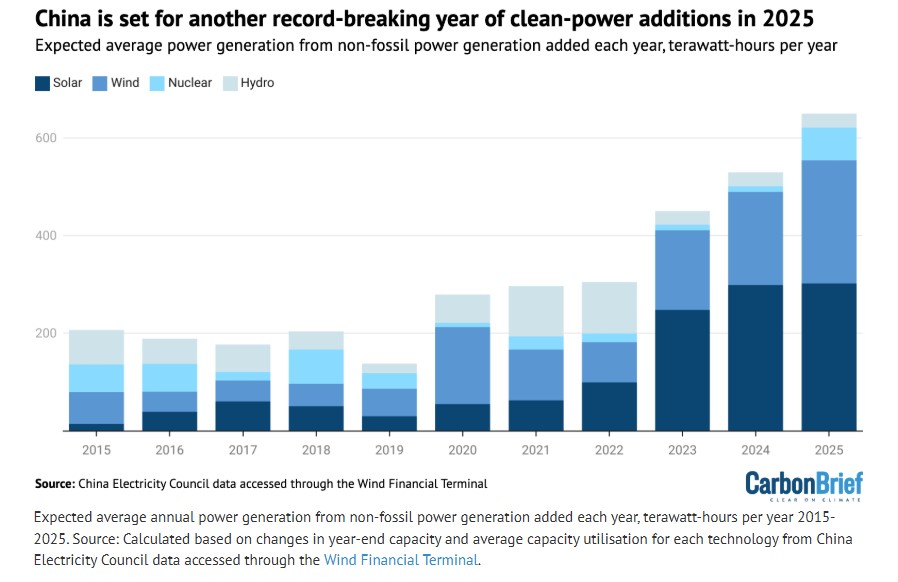
In-depth Q&A: Does the world need hydrogen to solve climate change?
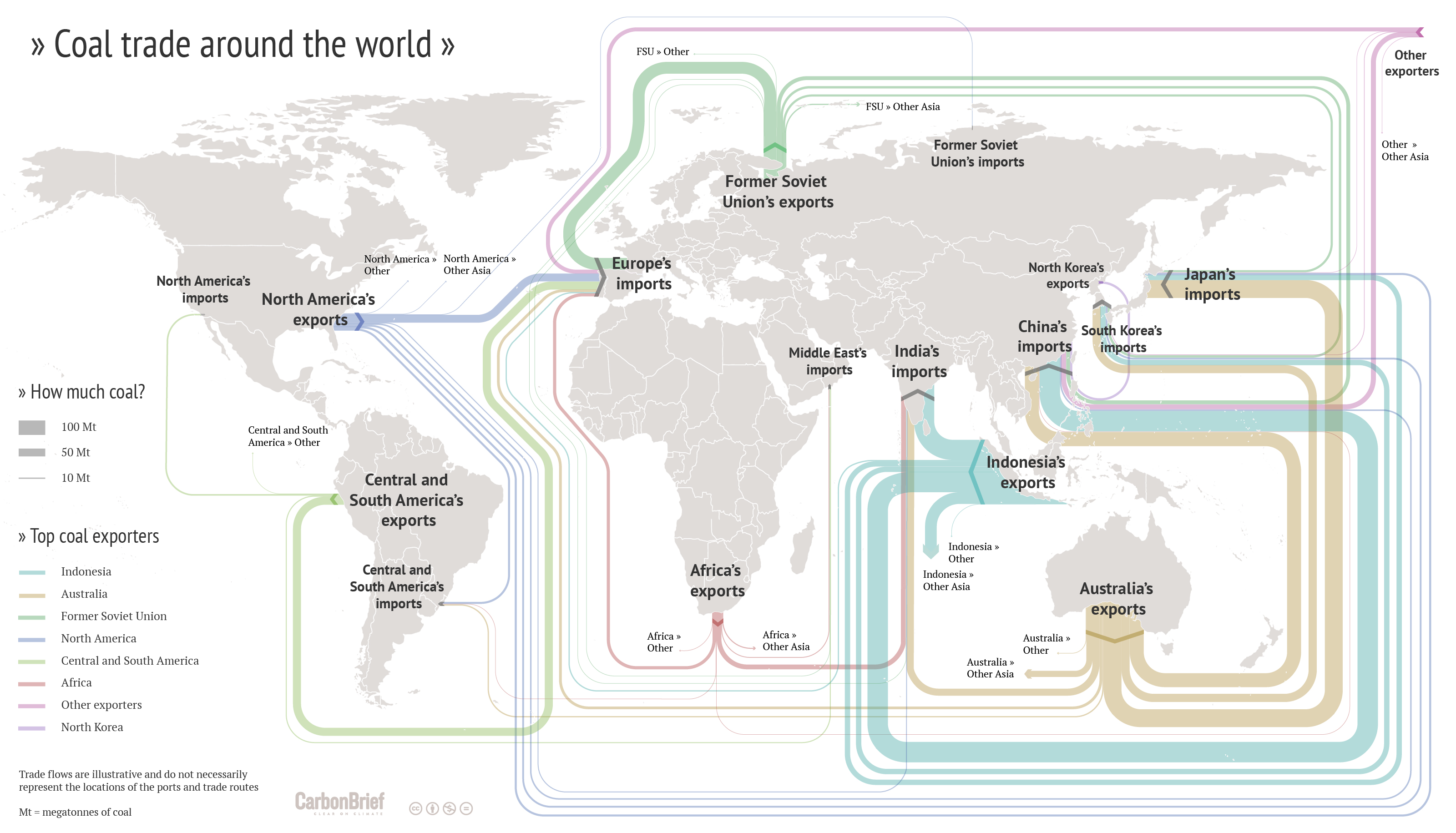 3 May 2016, Carbon Brief, The global coal trade doubled in the decade to 2012 as a coal-fueled boom took hold in Asia. Now, the coal trade seems to have stalled, or even gone into reverse. This change of fortune has devastated the coal mining industry, with Peabody – the world’s largest private coal-mining company – the latest of 50 US firms to file for bankruptcy. It could also be a turning point for the climate, with the continued burning of coal the biggest difference between business-as-usual emissions and avoiding dangerous climate change. Carbon Brief has produced a series of maps and interactive charts to show how the global coal trade is changing. As well as providing a global overview, we focus on a few key countries: Read More here
/cdn0.vox-cdn.com/uploads/chorus_asset/file/3915730/EIA%20coal%20power%20plants.png)
21 April 2015, Climate Council, Will Steffen: Unburnable Carbon: Why we need to leave fossil fuels in the ground.Stern Commission Review
Australia’s Garnaut Review
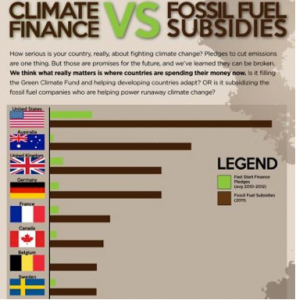 November 2014 – The Fossil Fuel Bailout: G20 subsidies for oil, gas and coal exploration report: Governments across the G20 countries are estimated to be spending $88 billion every year subsidising exploration for fossil fuels. Their exploration subsidies marry bad economics with potentially disastrous consequences for climate change. In effect, governments are propping up the development of oil, gas and coal reserves that cannot be exploited if the world is to avoid dangerous climate change. This report documents, for the first time, the scale and structure of fossil fuel exploration subsidies in the G20 countries. The evidence points to a publicly financed bailout for carbon-intensive companies, and support for uneconomic investments that could drive the planet far beyond the internationally agreed target of limiting global temperature increases to no more than 2ºC. It finds that, by providing subsidies for fossil fuel exploration, the G20 countries are creating a ‘triple-lose’ scenario. They are directing large volumes of finance into high-carbon assets that cannot be exploited without catastrophic climate effects. They are diverting investment from economic low-carbon alternatives such as solar, wind and hydro-power. And they are undermining the prospects for an ambitious climate deal in 2015. Access full report here For the summary on Australia’s susidisation of it’s fossil fuel industry go to page 51 of the report. The report said that the United States and Australia paid the highest level of national subsidies for exploration in the form of direct spending or tax breaks. Overall, G20 country spending on national subsidies was $23 billion. In Australia, this includes exploration funding for Geoscience Australia and tax deductions for mining and petroleum exploration. The report also classifies the Federal Government’s fuel rebate program for resources companies as a subsidy.