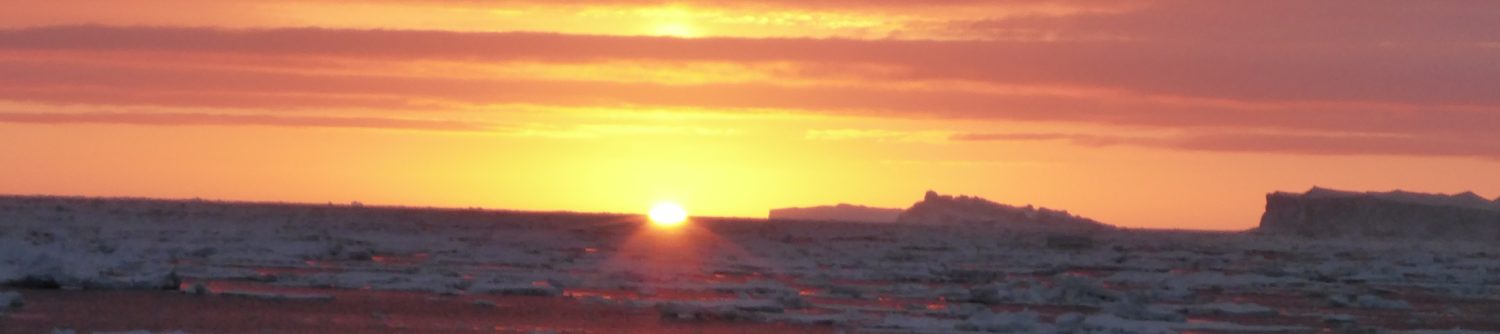
16 January 2016, Climate News Network, Giant boost for south polar waters. Massive icebergs more than 18km long are feeding vital nutrients into the Southern Ocean and helping to increase its carbon storage capacity. British scientists have identified the monsters that fertilise the Southern Ocean and help remove carbon dioxide from the atmosphere. Giant icebergs drifting northwards could be responsible for storing up to a fifth of all the carbon that sinks into the south polar waters. Geographers at the University of Sheffield report in Nature Geoscience journal that they analysed 175 satellite images of ocean colour – an indicator ofphytoplankton activity. They learned that each huge iceberg, as it breaks off the ice shelf and begins to float away, also begins to cascade iron and other vital mineral nutrients in its melting waters. This is enough to stimulate ferocious plankton productivity for up to a month in its wake. The icebergs are not small − the researchers define “giant” as at least 18 kilometres in length − and nor can they be very frequent. Area of influence “We detected substantially enhanced chlorophyll levels, typically over a radius of at least four to 10 times the iceberg’s length,” says Grant Bigg, Professor in Earth Systems Science, who led the research. “The evidence suggests that carbon export increases by a factor of five to 10 over the area of influence, and up to a fifth of the Southern Ocean’s downward carbon flux originates with giant iceberg fertilisation. “If giant iceberg calving increases this century, as expected, this negative feedback on the carbon cycle may become more important than we previously thought.” The guess is that the Southern Ocean accounts for perhaps 10% of the ocean’s absorption of carbon dioxide from the atmosphere. Research such as this is part of the global process of understanding all theintricacies of the carbon cycle − in turn, an important part of modelling future climate change as a consequence of rising levels of greenhouse gas in the atmosphere, driven by human combustion of fossil fuels. Read More here
9 December 2015, Climate News Network, Ice melt highlights Inuit plight. COP21: As Arctic peoples’ leaders appeal for unity to halt global warming, scientists report that Greenland’s glaciers are now melting at a speed not seen since the last Ice Age. The glaciers of Greenland are retreating two to three times faster now than at any time since the last Ice Age ended 9,500 years ago, according to new research. The news comes as indigenous peoples from the northern polar region staged anArctic Day at the COP21 climate change summit in Paris. Leaders of Greenland peoples, the Nunavut region of Canada and the Inuit Circumpolar Council appealed to the governments of the world to unite to dramatically reduce greenhouse gas emissions and keep global warming to between 1.5˚C and 2˚C. That is because the Arctic is now warming faster than almost anywhere else on Earth, and both human settlements and natural ecosystems are vulnerable. That the Greenland glaciers are in retreat is itself not news. Satellite data and measurements on the ground have repeatedly confirmed the retreat of the glaciers, the loss of ice and the acceleration of flow. The Jakobshavn Isbrae glacier has even reached a speed of 17 kilometres a year. Sediment cores But US scientists report in Climate of the Past journal that the present rate of loss is without precedent. Read More here