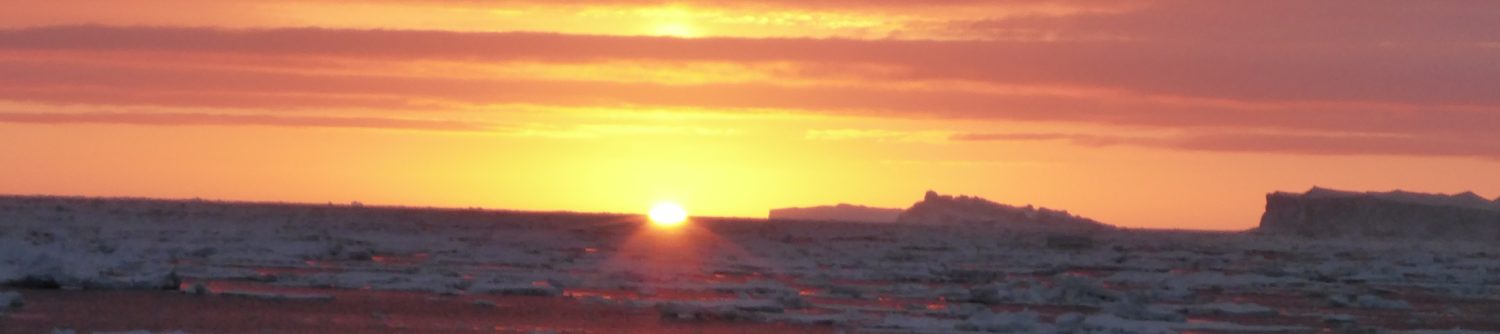
28 March 2016, NASA, 2016 Arctic sea ice wintertime extent hits another record low. Arctic sea ice appears to have reached a record low wintertime maximum extent for the second year in a row, according to scientists at the NASA-supported National Snow and Ice Data Center (NSIDC) and NASA. Every year, the cap of frozen seawater floating on top of the Arctic Ocean and its neighboring seas melts during the spring and summer and grows back in the fall and winter months, reaching its maximum yearly extent between February and April. On March 24, Arctic sea ice extent peaked at 5.607 million square miles (14.52 million square kilometers), a new record low winter maximum extent in the satellite record that started in 1979. It is slightly smaller than the previous record low maximum extent of 5.612 million square miles (14.54 million square kilometers) that occurred last year. The 13 smallest maximum extents on the satellite record have happened in the last 13 years. The new record low follows record high temperatures in December, January and February around the globe and in the Arctic. The atmospheric warmth probably contributed to this lowest maximum extent, with air temperatures up to 10 degrees Fahrenheit above average at the edges of the ice pack where sea ice is thin, said Walt Meier, a sea ice scientist at NASA’s Goddard Space Flight Center in Greenbelt, Maryland. Read More here
Tag Archives: oceans
19 March 2016, Climate News Network, Western Europe coasts face a pounding. Extreme weather caused by global warming could lead to more violent and more frequent storms devastating beaches on exposed Atlantic coastlines in Europe. The Atlantic seas could be getting rougher, with winter storms capable of causing dramatic changes to the beaches of Western Europe. And new research shows that the pounding delivered to the shorelines of the UK and France in the winter of 2013-2014 was the most violent since 1948. Gerd Masselink, professor of coastal geomorphology at Plymouth University School of Marine Science and Engineering, UK, and colleagues report in Geophysical Research Letters that they decided to switch focus from sea level rise resulting from global warming. Instead, they concentrated on the energy delivered by the rising waves as they crashed onto the beaches, dunes, shingle beds and rocky coasts, and on the consequent erosion of sediment. Rising levels For decades, climate scientists have predicted that rising levels of atmospheric greenhouse gases from the human combustion of fossil fuel could lead to global warming, and that warming would be accompanied by more frequent or more violent storms. That sea level rise inexorably means damage to coastlines has been repeatedly confirmed. And the fact that Atlantic waves have been getting higher was settled long ago. A study in 1991 revealed that wave heights − measured from a lightship and an ocean weather station − had been rising by 2% a year since 1950. ” “It should undoubtedly be considered in future coastal and sea defence planning along the Atlantic coast of Europe” The latest study examined open-coast sites across Scotland, Ireland, England, France, Portugal, Spain and Morocco. The researchers found that, along exposed coastlines in France and England, the beaches had taken a hammering. For every one metre strip of beach, there had been sand and shingle losses of up to 200 cubic metres. Read more here
16 March 2016, The Conversation ,Droughts and flooding rains: it takes three oceans to explain Australia’s wild 21st-century weather. Australia is a land of extremes, and famously of “droughts and flooding rains”. That’s been truer than ever in the 21st century; since 1999 the country has see-sawed from drought to deluge with surprising speed. There was the millennium drought, which lasted more than a decade and culminated in disasters such as Victoria’s Black Saturday bushfires in 2009. Then, in 2011, Cyclone Yasi struck Queensland and a large swathe of Australia exploded under a green carpet of grasses, shrubs and trees. Filming of the movie Mad Max: Fury Road was moved from outback Australia to Namibia after the big wet of 2010-11, because Australia’s luxurious growth of wildflowers and metre-high grasses didn’t quite match the post-apocalyptic landscape the movie’s producers had in mind. In Alice Springs, the Henley-on-Todd Regatta was almost cancelled in 2011 because there was water in the normally dry river. Globally, the big wet on land caused a 5 mm drop in sea levels as large amounts of rain were deposited on Australia, South America and Africa. This coincided with an unprecedented increase in carbon stored in vegetation, especially in arid and semi-arid regions of the southern hemisphere. The greening of Australia in particular had a globally significant impact. Meteorologists have struggled to explain these wild variations in Australia’s weather. Dry years with disappointing crops have been linked to the Pacific Ocean’s El Niño phase (part of a cycle called the El Niño-Southern Oscillation (ENSO)). But despite its huge influence, not even ENSO can fully account for Australia’s extreme rainfall patterns. Our research, published this week in Nature’s Scientific Reports, offers an explanation. We found that conditions in the three oceans that surround Australia – the Pacific, Indian and Southern Oceans – combine to amplify each other’s influences on Australian weather. Read More here
14 March 2016, The Guardian, Severe coral bleaching worsens in most pristine parts of Great Barrier Reef. Expert blames global warming, as coral bleaches when water temperatures go above a certain threshold for an extended period of time. Damage to parts of the Great Barrier Reef has worsened, leading authorities to raise the alert to the second-highest level, indicating severe local coral bleaching. The bleaching is worst in the most pristine and remote parts of the reef north of Cairns, according to Terry Hughes, convenor of the National Coral Taskforce. “It’s the jewel in the crown of the Great Barrier Reef and it’s now getting a quite a serious impact from this bleaching event,” he said. “The northern reefs are bleaching quite badly now.” Hughes said it appeared there was some coral death occurring in northern reefs. Russell Reichelt, the chairman of the Great Barrier Reef Marine Park Authority said the area around Lizard Island, 250km north of Cairns, and sites further north, had fared the worst. The US National Oceanographic and Atmospheric Administration predicts bleaching conditions to worsen over the coming weeks. The world is currently in the grips of the third global coral bleaching event. Coral bleaches when water temperatures are raised above a certain threshold for an extended period of time. Hughes, director of the ARC centre of excellence for coral reef studies at James Cook University, said although the strong El Niño occurring now is partly to blame for the bleaching event, the real culprit is global warming caused by carbon emissions. Read More here