
What you will find on this page: LATEST NEWS; climate changes and (US) security issues; REPORT: Conflict vs Climate; cost of sanctioned violence (video); trends in military spending; climate change as a stressor; security & national interests (video); REPORT: Combat vs Climate; sanctioned violence; battle for resources
Latest News 17 December 2025, SCI AM: Scientists Denounce Trump’s Plan to Kill Crucial Atmospheric Science Center. The U.S. government is dismantling the National Center for Atmospheric Research, jettisoning key climate science projects in the process. The Trump administration is dismantling the National Center for Atmospheric Research (NCAR), long considered the crown jewel in the U.S.’s earth science infrastructure. Scientists who study climate, weather and other earth sciences have decried the move, first reported by USA Today, as “taking a sledgehammer” to an “iconic” center dedicated to studying our planet. “NCAR is quite literally our global mothership,” wrote Katharine Hayhoe, a climate scientist at Texas Tech University and chief scientist of the Nature Conservancy, on Bluesky. “Dismantling NCAR is like taking a sledgehammer to the keystone holding up our scientific understanding of the planet. Unbelievable.” The center, based in Boulder, Colo., has become a target because of what Russ Vought, director of the White House Office of Management and Budget, described as “climate alarmism” in a statement to USA Today. Weather modeling and supercomputing work also done at the center will be moved to other research hubs, Vought said. Read more here 15 December 2025, Reuters: US demands EU exempt its gas from methane emissions law, document shows. The U.S. has demanded that the European Union exempt its oil and gas from obligations under the bloc’s methane emissions law on fuel imports until 2035, a U.S. government document seen by Reuters showed. Starting this year, the EU requires importers of oil and gas to Europe to monitor and report methane emissions associated with those imports, in a bid to curb emissions of the potent planet-warming gas. The world-first climate policy has faced opposition from U.S. Energy Secretary Chris Wright, who has called it impossible to implement and warned it could disrupt U.S. gas supplies to Europe. European countries have increased imports of U.S. liquefied natural gas as they phase out oil and gas from Russia. The U.S. document said that in the absence of a “full repeal” of the EU law, Washington was asking the EU to “delay requiring U.S. emissions data reporting under the EUMR [EU Methane Regulation] until October 2035.” “The EU Methane Regulations is a critical non-tariff trade barrier that imposes an undue burden on U.S. exporters and our trade relationship,” said the document, circulated to EU member governments ahead of a meeting of their energy ministers in Brussels on Monday. Read more here 11 December 2025: Jeffrey Sachs: The 2025 National Security Strategy (NSS) recently released by President Donald Trump presents itself as a blueprint for renewed American strength. It is dangerously misconceived in four ways. First, the NSS is anchored in grandiosity: the belief that the United States enjoys unmatched supremacy in every key dimension of power. Second, it is based on a starkly Machiavellian view of the world, treating other nations as instruments to be manipulated for American advantage. Third, it rests on a naïve nationalism that dismisses international law and institutions as encumbrances on US sovereignty rather than as frameworks that enhance US and global security together. Fourth, it signals a thuggery in Trump’s use of the CIA and military. Within days of the NSS’s publication, the US brazenly seized a tanker carrying Venezuelan oil on the high seas—on the flimsy grounds that the vessel had previously violated US sanctions against Iran. The seizure was not a defensive measure to avert an imminent threat. Nor is it remotely legal to seize vessels on the high seas because of unilateral US sanctions. Only the UN Security Council has such authority. Instead, the seizure is an illegal act designed to force regime change in Venezuela. It follows Trump’s declaration that he has directed the CIA to carry out covert operations inside Venezuela to destabilize the regime. Read more here 7 November 2025, The Guardian: Net zero is an insidious loophole that distracts from the scientific imperative to eliminate fossil fuels. History tells us that polite incrementalism and political kowtowing will prevail at Cop30 – even as catastrophe unfolds around us. Despite 30 years of UN climate summits, about half of the carbon dioxide accumulated in the atmosphere since the Industrial Revolution has been emitted since 1990. Incidentally, 1990 was the year the Intergovernmental Panel on Climate Change – the global authority on climate change science – released its First Assessment Report confirming the threat of human-caused global warming. As scientists all over the world prepare the IPCC’s Seventh Assessment Report, we do so knowing that our work is still being overshadowed by politics. Despite all the well-intentioned half-measures, the truth is that the world is still disastrously off track to limit dangerous climate change. In the avalanche of technical reports released before Cop30, the World Meteorological Organization stated that CO2 concentrations reached a record high of 423.9 parts per million in 2024, with the growth rate from 2023 to 2024 surging by the largest yearly increase since modern measurements began in 1957. The latest figures from Global Carbon Project show that 90% of total global CO2 emissions in 2024 were generated from the burning of fossil fuels, with the remaining 10% coming from land-use changes including deforestation and wildfires. Instead of focusing on economic incentives to encourage the rapid phase-out of fossil fuels, climate policies are heavily reliant on feelgood “nature positive” solutions that aim to neutralise carbon emissions by essentially planting trees instead of reducing industrial emissions. While the protection, expansion and rehabilitation of natural carbon sinks like forests and wetlands is an inherently good thing to do, researchers have shown that there is not enough land to meet the global goal of net zero emissions using nature-based solutions alone. Read more here End Latest News US/DNI Releases Report on Implications of Climate Change on National Security © MCT 2014 Since man first became aware of his neighbours “resources” war or more precisely “sanctioned violence” has been the mechanism for obtaining from others what you believe should be rightly yours. The battle for resources is not new and continues unabated in our supposed “civilised” world of today. With all the misery, lost lives, displaced peoples, wasted resources that war produces climate change has now added to this already complex mess. And as pressure builds to keep fossil fuels in the ground the battles to access and use them more apparently goes on. A bit like Golum and his “precious”…..What on earth are they thinking! There are many direct and indirect ramifications of war – all of which distract/undermine the capacity of the global community to respond in a concerted and positive way to the pandora’s box of climate change. Source: Center for Naval Analysis The cost of sanctioned violence Environmental Costs: The impact of the wars in Iraq, Afghanistan and Pakistan can be seen not only in the social, economic and political situations of these areas but also in the environments in which these wars have been waged. The long years of war have resulted in a radical destruction of forest cover and an increase in carbon emissions. In addition, the water supply has been contaminated by oil from military vehicles and depleted uranium from ammunition. Along with the degradation of the natural resources in these countries, the animal and bird populations have also been adversely affected. Read More here And what has this to do with climate change? It is adding to the problem. Human Costs: UNHCR’s annual Global Trends report, which is based on data compiled by governments, non governmental partner organizations, and from the organization’s own records, shows 51.2 million people were forcibly displaced at the end of 2013, fully six million more than the 45.2 million reported in 2012. “We are seeing here the immense costs of not ending wars, of failing to resolve or prevent conflict,” said UN High Commissioner for Refugees Antonio Guterres. “Peace is today dangerously in deficit. Humanitarians can help as a palliative, but political solutions are vitally needed. Without this, the alarming levels of conflict and the mass suffering that is reflected in these figures will continue.” Read More here. Access Global Emergency Overview here. Civilians Killed and Wounded:The ongoing conflicts in Iraq, Afghanistan and Pakistan have taken a tremendous toll on the people of those countries. At the very least, 174,000 civilians have been determined to have died violent deaths as a result of the war as of April 2014. The actual number of deaths, direct and indirect, as a result of the wars are many times higher than this figure. And what has this to do with climate change? It is often stated that the “vulnerable” are the ones that will suffer the most in facing the impacts of climate change as they have not the resources or resilience to adapt or “bounce back”. The futility of war has literally placed over 50 million people, to date, into this vulnerable category and have denied them the opportunity to be part of the solution. A loss that the rest of the world must cover. Economic Costs: A quote from James Madison, Political Observations, 1795: “Of all the enemies to public liberty war is, perhaps, the most to be dreaded because it comprises and develops the germ of every other. War is the parent of armies; from these proceed debts and taxes … known instruments for bringing the many under the domination of the few.… No nation could preserve its freedom in the midst of continual warfare.” Nothing much has changed in 200+ years has it? Trends in World Military Expenditure 2014 Source: From 13 April 2015 the SIPRI Military Expenditure Database includes newly released information on military expenditure in 2014. This Fact Sheet describes the global, regional and national trends in military expenditure that are revealed by the new data. Look at the following map of the 15 leaders in military expenditure – and what questions come to your mind? Access map for further details here Trends in World Military Expenditure 2014 A sign of things to come? Climate change impacts becoming a “stressor” in conflicts Did Drought Trigger The Crisis In Syria? What caused the conflict in Syria to erupt when it did, pushing citizens from discontent with the regime to outright rebellion? One possibility is that environmental factors, particularly a long-lasting drought, helped ignite the crisis. Drought affected north-eastern Syria (as well as adjacent regions in Turkey and Iraq) from 2006 to 2011 and resulted in widespread food insecurity, malnutrition, internal displacement from agricultural areas, and the creation of shanty towns on the edges of cities. Read More here National/global security issues and climate change If the deniers want us to believe that climate change is a fabrication and it isn’t a problem then they forgot to convince those “looking after” the security interests of governments. Following are a number of reports that indicate that they are treating climate change as a high profile security issue. From the Center for Naval Analysis. In the videos below, CNA Corporation Military Advisory Board (MAB) members discuss the new report, National Security and the Accelerating Risks of Climate Change. In the first video, Brigadier General Gerald Galloway details how climate change impacts American national security and military readiness, affecting the lives of thousands of military personnel and American civilians around the U.S. In the second video, Admiral Frank “Skip” Bowman emphasizes how climate change is already impacting our national security and international military dynamics. The work of the MAB has been important in advancing the understanding that energy choices are not future threats—they are taking place now—and that actions to build resilience against the projected impacts of climate change are required today. US: National Security and the Accelerating Risks of Climate Change (2014): As a follow-up to its landmark 2007 study on climate and national security, the CNA Corporation Military Advisory Board’s National Security and the Accelerating Risks of Climate Change re-examines the impact of climate change on U.S. national security in the context of a more informed, but more complex and integrated world. The Board’s 2007 report described projected climate change as a “threat multiplier.” In this report the 16 retired Generals and Admirals who make up the board look at new vulnerabilities and tensions posed by climate change, which, when set against the backdrop of increasingly decentralized power structures around the world, they now identify as a “catalyst for conflict.” US 2014 Quadrennial Defense Review: A rather chilling document (a quote: ” The rapidly accelerating spread of information is challenging the ability of some governments to control their populations and maintain civil order.”) Note risk of climate change exec summary and pages 8 & 25. The impacts of climate change may increase the frequency, scale, and complexity of future missions, including defense support to civil authorities, while at the same time undermining the capacity of our domestic installations to support training activities… Climate change poses another significant challenge for the United States and the world at large…. Climate change may exacerbate water scarcity and lead to sharp increases in food costs. The pressures caused by climate change will influence resource competition while placing additional burdens on economies, societies, and governance institutions around the world. These effects are threat multipliers that will aggravate stressors abroad such as poverty, environmental degradation, political instability, and social tensions – conditions that can enable terrorist activity and other forms of violence.….The Department’s operational readiness hinges on unimpeded access to land, air, and sea training and test space. Consequently, we will complete a comprehensive assessment of all installations to assess the potential impacts of climate change on our missions and operational resiliency, and develop and implement plans to adapt as required. Climate change also creates both a need and an opportunity for nations to work together, which the Department will seize through a range of initiatives. We are developing new policies, strategies, and plans, including the Department’s Arctic Strategy and our work in building humanitarian assistance and disaster response capabilities, both within the Department and with our allies and partners. War – Sanctioned Violence/ protecting national security interest Thus, we take another step deeper into the tragedy of U.S. intervention in the Middle East that has become a noxious farce. Consider just one of the head-spinning subplots: We are allied with our declared enemy, Iran, against the bloody Islamic State, which was spawned from the chaos created by our own earlier decisions to invade Iraq and to overthrow the Assad regime in Syria, which has us fighting side-by-side with jihadist crazies financed by Saudi Arabia, whom we are supporting against the Houthis in Yemen, the bitter rivals of Al Qaeda — the perpetrators of 9/11! Read More here NOTE: For those readers that have got this far, if you wish to explore further the dysfunction of our world you may need to include the vast implications of organised crime and corporate and political corruption and the implications for climate change response as well. Climate change and national security issues
 19 September 2016, American Security Project: The National Intelligence Council, part of the Office of the Director of National Intelligence, has just released a new White Paper titled “Implications for U.S. national security of Anticipated Climate Change.” The report analyzes the potential effects of climate change on national security in the coming 20 years. The report uses previous IPCC reports as a scientific baseline for analysis. The report begins with a strong assertion of the dangers of climate change for societies, economies, and governments across the world: t goes on to list some of the pathways to “wide-ranging national security challenges for the United States and other countries,” including “threats to the stability of countries, adverse effects on food prices and availability, and negative impacts on investments and economic competitiveness.” The report gives possible time-frames for these emerging national security challenges, suggesting that based on “changing trends in extreme weather,” the future will almost certainly hold more “climate related disruptions.” The majority of climate change-related risks to U.S. national security in the next five years will come from “distinct extreme weather events”, and “the exacerbation of currently strained conditions,” including water shortages. The report comes after years of significant research inside and outside of the government on climate security. The National Intelligence Council last released a report on this issue in 2009. Many in the security community have spoken on the emerging national security risks posed by climate change. ASP and countless other organizations have urged policy makers not to underestimate the security challenges posed by climate change and the rising seas. Read More here and access full report here
10 November 2015, Yale Connections: Drought, water, war, and climate change” is the title of this month’s Yale Climate Connections video (above) exploring expert assessments of the interconnections between and among those issues. With historic 1988 BBC television footage featuring Princeton University scientist Syukuru (“Suki”) Manabe and recent news clips and interviews with MIT scientist Kerry Emanuel, Ohio State University scientist Lonnie Thompson, CNN reporter Christiane Amanpour, and New York Times columnist and book author Tom Friedman, the six-minute video plumbs the depths of growing climate change concerns among national security experts. Source: Yale Connections
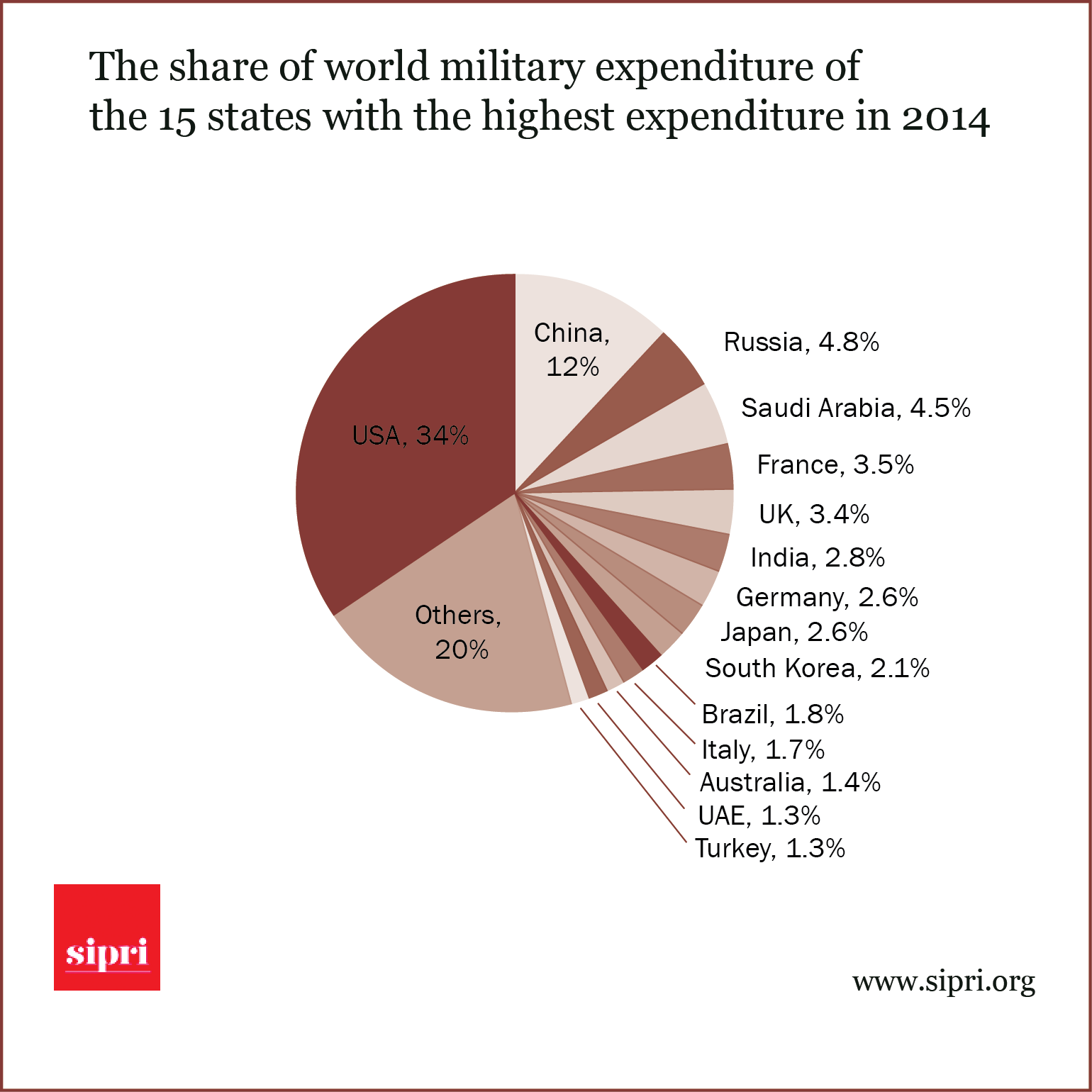 Total world military expenditure in 2014 was $1776 billion. This is equivalent to 2.3 per cent of global GDP. According to the SIPRI Military Expenditure Database, Australia is ranked at number 13 as the biggest spender for 2014.Total Australia spending AUD29.3 billion ($b.,MER) 25.4. Share of GDP 1.8%. Share of world military expenditure 1.4%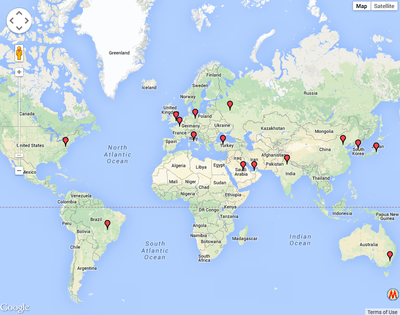
And what has this to do with climate change? It goes with out saying that responding to climate change and transforming the energy and economic systems of the world in a carbon restricted world would be made a lot easier on everyone if military budgets were focused on what could help the world rather than plunder it.  5 October 2016. The Military and Climate Security Budgets Compared. Fifteen of the sixteen hottest years ever recorded have occurred during this new century, and the near-unanimous scientific consensus attributes the principal cause to human activity. The U.S. military’s latest National Security Strategy says that climate change is “an urgent and growing threat to our national security, contributing to increased natural disasters, refugee flows, and conflicts over basic resources like food and water.” What they don’t say is that the overall balance of U.S. security spending should be adjusted to fit that assessment. And we know less about how much we are spending on this urgent threat than we used to, since the federal government hasn’t produced a climate security budget since 2013. In this new report, Combat vs. Climate, the Institute for Policy Studies steps in to provide the most accurate climate change security budget currently available, drawing data from multiple agencies. And it looks at how these expenditures stack up within our overall security budget. Then, the report ties the military’s own assessment of its urgent threats to a budget that outlines a “whole of government” reapportionment that will put us on a path to averting climate catastrophe. This is our status quo: As global temperatures hit one record after another, the stalemate in Congress over funding to respond continues. Climate scientists warn that, as in Syria, unless the global greenhouse gas buildup is reversed, the U.S. could be at risk for conflicts over basic resources like food and water. Meanwhile, plans to spend $1 trillion to modernize our entire nuclear arsenal remain in place, and projected costs of the ineffective F-35 fighter jet program continue to climb past $1.4 trillion. Unless we get serious about moving the money, alarms from all over about the national security dangers of climate change will ring hollow. Access article here. Access report here.