
Decarbonizing Failure – the language is changing
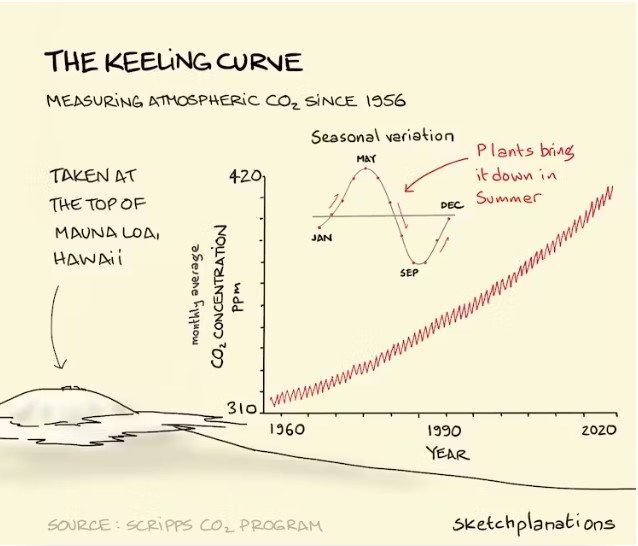 The purpose of this page: As the global efforts to rapidly decarbonise (by reducing CO2 emissions) are failing, the language around what to do is changing. That failure is being voiced louder and louder in official circles. The difficulty is that decarbonizing has been PLAN A for over a decade and THERE IS NO PLAN B! This page tracks this changing paradigm. Other pages on this site provides further background: The Science; All Things Carbon and Emissions; Fairyland of 2 degrees; Global Action/Inaction.
The greenhouse gas (GHG) emissions reduction strategy promoted over the last three decades by the Conference of the Parties (COP) to the UN Framework Convention on Climate Change (UNFCCC) has yet to stop the growth in emissions, much less forge a pathway toward net zero emissions. As a result, there has been no progress in reversing the increasing occurrence and intensity of climate-change induced impacts. Policies are inadequate: According to the IPCC, governments are not acting with the necessary speed, and current policies will lead to about 3∘𝐶 of warming. Offsetting schemes are ineffective: A review of carbon offsetting programs found deep-seated, systemic problems that make most credits poor quality and fail to cut global heating. High-emission sectors are growing: The increase in natural gas consumption, driven by China, the United States, the Middle East, and India, was the largest source of emissions growth in 2024, overshadowing reductions in other areas.
The Atlantic 24 Nov 2025: For years, the idea of geoengineering—artificially lowering global temperatures through technological means—has been met with skepticism. Only a handful of dedicated and much-criticized scientists have argued for researching it at all, and when others weighed in, it was generally to trash the idea. This September, in a study published in the journal Frontiers in Science, more than 40 experts in climate change, polar geosciences, and ocean patterns warned that geoengineering was extremely unlikely to work and likely to have dangerous consequences. Spraying reflective aerosols into the atmosphere to deflect the sun’s heat, could, for instance, “cause stratospheric heating, which may alter atmospheric circulation patterns, leading to wintertime warming over northern Eurasia,” they wrote. Things are accelerating and not for the good…
What you will find on this page: Where it began; how the messaging has NOW changed; the new buzz words – Global Cooling – articles:
Where it began:
The United Nations Framework Convention on Climate Change (UNFCCC) was created in 1992 to prevent “dangerous human interference with the climate system” by stabilising greenhouse gas concentrations in the atmosphere. It provides the international framework for countries to cooperate on climate action, with the ultimate goal of allowing ecosystems to adapt naturally to climate change and ensuring sustainable development.
It aims to stabilise greenhouse gas concentrations to a level that allows ecosystems to adapt naturally, food production to be unthreatened, and sustainable development to proceed. The UNFCCC is the foundation for agreements like the Paris Agreement and the Kyoto Protocol, and it holds annual conferences to measure progress and set new goals.
The Paris Agreement is a legally binding international treaty adopted in 2015 to combat climate change. Its main goal is to keep the global average temperature increase to well below 2oC above pre-industrial levels and to pursue efforts to limit the increase to 1.5oC. To achieve this, nearly 200 countries have submitted climate action plans, called Nationally Determined Contributions (NDCs), which they are required to update with progressively stronger targets every five years.
For many years there has been diligent efforts by many to work towards achieving the Paris Agreement goals and yet there have also been many diligently working against them for short-sighted ends, profit, or to maintain the status quo as it suits the power they have or wish to have. So far, the expected warming this century is still far above the Paris goals of keeping warming to 1.5°C and well below 2°C. The highest possible ambition as set out in the Paris Agreement to achieve deep, rapid, and sustained emissions reductions is STILL urgently needed. Emissions continue to grow…
23 March 2023, Richard Heinberg: Why We Can’t Just Do It: The Truth about Our Failure to Curb Carbon Emissions. We all know what needs to be done: reduce carbon emissions. But so far, we members of global humanity just haven’t been able to turn the tide. The latest IPCC report documents that carbon emissions are still increasing, despite all the promises and efforts of the past few decades. The report tells us there’s only a narrow (and rapidly shrinking) pathway to averting climate catastrophe. That path requires us to cut emissions 50 percent by 2030, and to reach net zero emissions by 2050. So far, we’re going in the opposite direction. Why is this so hard? Because it would require sacrifice. Why would it require sacrifice? Let’s walk through the logic:
- Lowering emissions requires reducing our extraction and burning of fossil fuels. But right now, 85 percent of our energy comes from fossil fuels, and energy is what makes the economy go and grow.
- Replacing fossil fuels with low-emissions energy sources like solar and wind would still give us energy, but right now it takes fossil energy to build solar panels, wind turbines, batteries, and all the other electrical infrastructure we would need to replace the fuel-based infrastructure we now have.
- Renewable energy sources require energy investment up front for construction; they pay for themselves energetically over a period of years. Therefore, a fast transition requires increased energy usage over the short term. And, in the early stages at least, most of that energy will have to come from fossil fuels, because those are the energy sources we currently have.
- Again, the only way to reliably reduce emissions is to cut fossil fuel extraction and combustion directly and immediately. As we have seen over the past decades, just waiting for renewables to replace fossil fuels is too slow. Global emissions increased last year despite a record nearly 10 percent growth in renewables.
- So, if more fossil energy will be needed for the energy transition, but we need to extract less coal, oil, and gas overall, that means that, at least over the next couple of decades, much less fuel will be available for non-transition purposes—i.e., for transport, manufacturing, and food production, which are the mainstays of the economy.
That’s why we can’t just do it. That’s why, when governments get to decision points like having to approve or deny permits to drill for oil in Alaska, the decision often goes in favor of more fossil energy extraction. Read more here
The constant message time and time repeated throughout these years up to today has been: “Yes, emissions are growing BUT there is STILL time to turn it around. WE can STILL do it with concerted effort from all!!” But the language, very recently has now CHANGED:
IT’S OFFICIAL: António Guterres has acknowledged it is now “inevitable” that humanity will overshoot the target in the Paris climate agreement, with “devastating consequences” for the world. “Let’s recognise our failure,” he told the Guardian and Amazon-based news organisation Sumaúma. “The truth is that we have failed to avoid an overshooting above 1.5C in the next few years”.
How has the language changed?
For years climate scientists have been voicing their concerns, unofficially/off the record/between themselves, that the progress of the decarbonizing efforts will not be enough to keep the planet’s rising warming within safe limits. More and more longstanding reputable organisations are now coming out of the closet and also acknowledging decarbonisation efforts have failed but what happens now?
What is being said?
August 2025: Today the level of greenhouse gases in the atmosphere is already so high that rapid emissions reduction is no longer sufficient to avoid an unmanageable future for mankind. We also must have the capability to remove GHGs at scale from the atmosphere, and to repair those parts of the climate system, such as the Arctic Circle, which are passing or have passed their tipping point.” Sir David King, former UK Chief Scientist & founder, Centre for Climate Repair
While much of the climate community remains committed to the 1.5°C Paris goal, this target is fundamentally flawed: it does not represent a safe boundary, will not prevent large-scale Earth system elements passing tipping points, nor does it mark a point of system stability… Advocates now face difficult questions, including whether a safe climate can be achieved if climate actions involve only the elimination of greenhouse gas emissions… Breakthrough – National Centre for Climate Restoration
June 2025: “The remaining carbon budgets are declining rapidly and the main reason is the world’s failure to curb global CO2 emissions,” said Prof Joeri Rogelj, at Imperial College London, UK.
October 2024: Continuation of current policies will lead to a catastrophic temperature rise of up to 3.1°C; Current commitments for 2030 are not being met; even if they are met, temperature rise would only be limited to 2.6-2.8°C. UN Environment Programme
The new buzz words – Global Cooling
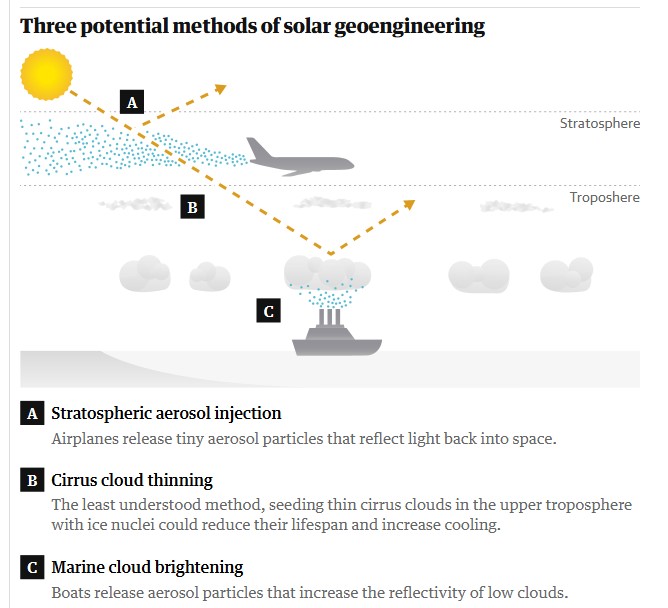 Following are articles and reports both for and against “SOLAR RADIATION MODIFICATION, the geoengineering technology that is swiftly gaining traction as the next step as PLAN A is not making the headway as it so desperately needs to do.
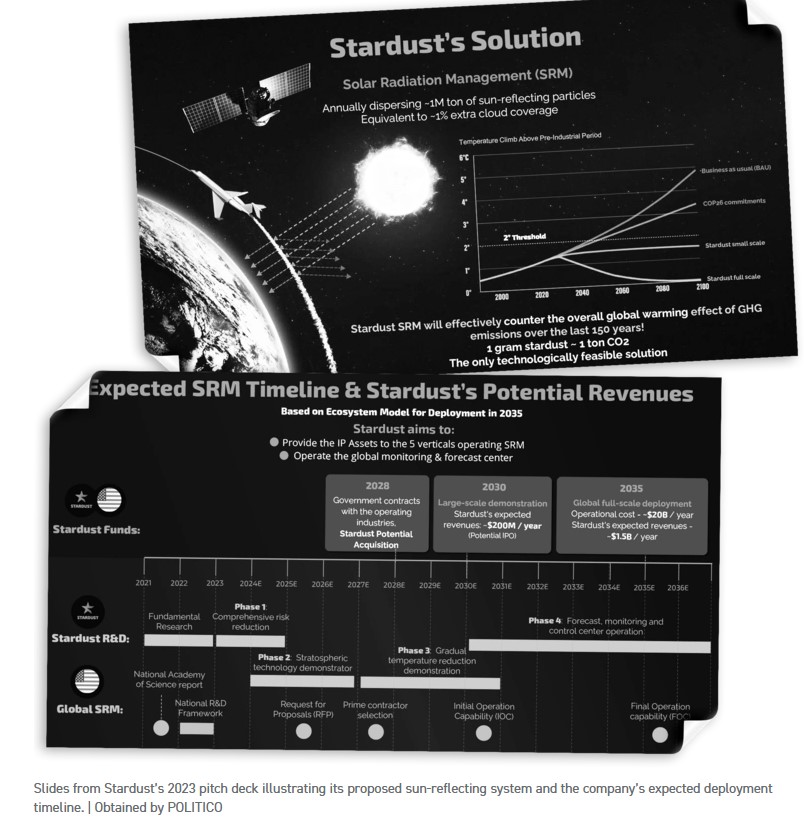
24 October 2025, POLITICO: Global cooling startup raises $60M to test sun-reflecting technology. The fundraising haul marks strong enthusiasm for experiments aimed at lowering temperatures, said the company. But it also raises questions about commercializing technologies with potentially damaging consequences. A once-outlandish idea for reversing global warming took a major step toward reality Friday when Israeli-U.S. startup Stardust Solutions announced the largest-ever fundraising round for any company that aims to cool the Earth by spraying particles into the atmosphere. Its plan to limit the sun’s heat raised $60 million from a broad coalition of investors that included Silicon Valley luminaries and the Agnelli family, an Italian industrial dynasty. The disclosure, critics said, raises questions about involvement of venture capital firms in driving forward a largely untested, thinly researched and mostly unregulated technology that could disrupt global weather patterns and trigger geopolitical conflict.

The firm has now raised a total of $75 million. It is registered in the U.S. state of Delaware and headquartered outside Tel Aviv but is not affiliated with the state of Israel.
Stardust claims to have created a particle that would reflect sunlight in the same way debris from volcanic eruptions can temporarily cool the planet. The company says its powder is inert, wouldn’t accumulate in humans or ecosystems, and can’t harm the ozone layer or create acid rain like the sulfur-rich particles from volcanoes. It plans to seek government contracts to manufacture, disperse and monitor the particles in the stratosphere. The company is in the process of securing patents and preparing academic papers on its integrated solar geoengineering system. The startup would use the money it has raised to begin “outdoor contained experiments” as soon as April, Yedvab told POLITICO. Those tests would release the company’s reflective particles inside a modified plane flying about 11 miles (18 kilometers) above sea level. Read more here
 POLITICO, 21 November 2025: The Strange and Totally Real Plan to Blot Out the Sun and Reverse Global Warming. … Janos Pasztor, a deliberate and self-assured Hungarian with thick, arched eyebrows that give him the appearance of a mildly perturbed owl, was stunned by the seriousness of Stardust’s operation. He had long been expecting that some company would try this. But the emergence of a well-financed, highly credentialed group represented a shocking acceleration for a technology still largely confined to research papers, backyard debates and science fiction novels…. For decades, scientists had theorized that lacing the atmosphere with a cloak of dust could temporarily reduce global warming. Few, however, had actually advocated researching the practice, and none could say how dangerously it might destabilize weather patterns, food supplies or global politics. Many scientists still warn it will take many years to know whether such technology would prove wise or disastrous. The terms for it — “solar geoengineering,” “stratospheric aerosol injection” or “solar radiation management” — sound deceptively anodyne. To most people, the idea of blotting out the sun still induces derision and disgust — a kind of planetary body horror.
If what Stardust was claiming on the Zoom with Pasztor was true, then a key threshold had already been crossed. Humanity had gained the power to turn down the sun, and barely anyone on the planet even knew. What’s more, that untested power was now effectively for sale. In a world of rising chaos, sci-fi-pilled billionaires and nationalist leaders, a private company offering the means to control the world’s temperature — with almost no international laws regarding the deployment of such technology — was a disturbing prospect, thought Pasztor…
Access article here: It is very long but it sets out the issue extremely well. Who is Janos Pasztor? Former Carnegie Council Senior Fellow & Executive Director, Carnegie Climate Governance Initiative.
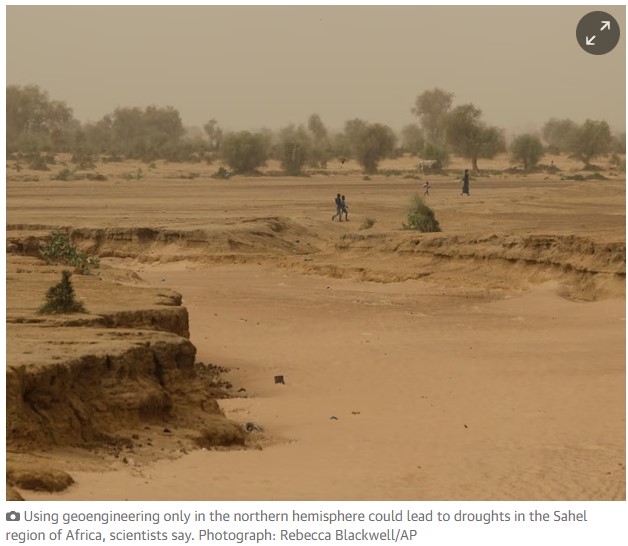
5 November 2025: The Guardian: Solar geoengineering in wrong hands could wreak climate havoc, scientists warn. Blocking the sun may reduce global heating – but ‘rogue actor’ could cause drought or more hurricanes, report finds. Solar geoengineering could increase the ferocity of North Atlantic hurricanes, cause the Amazon rainforest to die back and cause drought in parts of Africa if deployed above only some parts of the planet by rogue actors, a report has warned.
However, if technology to block the sun was used globally and in a coordinated way for a long period – decades or even centuries – there is strong evidence that it would lower the global temperature, the review from the UK’s Royal Society concluded. The world is failing to halt the climate crisis and the researchers said that in future, a judgment might need to be made between the risks of geoengineering and the those of continued global heating, which is already costing lives and livelihoods. The logistics of a large-scale geoengineering effort would be daunting, the experts said, but the cost would be small relative to climate action – billions of dollars a year against trillions.
The researchers emphasised that geoengineering only masked the symptoms of the climate crisis, and did not tackle the root cause – the burning of fossil fuels. Geoengineering could only complement the cutting of emissions, not replace it, they said. If geoengineering was halted abruptly but emissions had not been reduced, there would be a termination shock of rapidly rising temperatures – 1-2C within a couple of decades – that would have severe effects on people and ecosystems unable to rapidly adapt. Geoengineering has divided the scientific community. Some researchers argue that research should continue in order to increase the knowledge of the likely effects of using it, in case it was ever judged necessary. Others say that further research would increase the chances of its use as it may increasingly be seen as a fast way to fight the climate crisis. The Royal Society report does not take a position but aims to set out the current state of understanding to better inform debate. Read more here:
27 May 2025, Solar Geoengineering Non-Use Agreement: ARIA’s ‘Exploring Climate Cooling’ Folly. On 7 May 2025, the UK Advanced Research and Invention Agency (ARIA) announced the list of projects to be funded under its £60 million solar geoengineering research initiative. Readers of this blog will already be familiar with solar geoengineering (also known as Solar Radiation Modification, or SRM for short), why it is a false response to the climate crisis, and why its implementation would put the Earth’s environment in a dangerously precarious state. There has been a disturbing upsurge in funding for SRM research and development in the past few years, almost exclusively by private philanthropy such as the Simons Foundation or Quadrature Climate Fund, but this is different. The ARIA programme constitutes a new escalation in the push to normalize this dangerous set of technologies.

The ARIA programme is the first time that a major government has put this scale of money into an SRM programme. Worse, unlike essentially all previous programmes funded at a significant level, it puts some of this money into outdoor field trials of the technology. That crosses a red line that has mostly held up until now. A limited amount of Australian government money, funnelled controversially through the Great Barrier Reef foundation (additional commentary here), has gone into cloud-brightening trials off the Australian coast. But the ARIA programme is a step change in the level and prominence of SRM development funding. To our knowledge, it is the first programme to allow field experiments in the stratosphere for development of stratospheric aerosol injection technology.
15 October 2024, Center for International Environmental Law (CIEL): Why Geoengineering is a False Solution to the Climate Crisis. As global temperature records continue to be broken month after month and extreme weather events increase in severity as a result of climate change, governments and companies worldwide are increasingly investing in and exploring climate geoengineering as a supposed “solution” to global warming. Once dismissed as science fiction, geoengineering has started to enter mainstream climate discourse. Despite being at odds with international law and subject to a de facto global moratorium, an alarming number of geoengineering field experiments are planned or underway, many driven by voluntary carbon markets. Behind the shiny facade of these highly speculative “techno-fixes,” geoengineering is fraught with risks, uncertainties, and dangers that threaten to delay real climate action and cause more harm than good.
What Is Geoengineering?
Geoengineering refers to large or planetary-scale interventions in the Earth’s atmosphere, oceans, and land to counteract some of the effects of climate change. These methods range from reflecting sunlight to removing carbon dioxide from the atmosphere. Crucially, none tackle the root causes of the climate crisis, the primary driver of which is the production and burning of fossil fuels.
Why is Geoengineering a Bad Idea?
-
It won’t fix the climate crisis
Geoengineering technologies do nothing to address the drivers of the climate crisis, and all come with major risks and unknowns. For example, solar geoengineering is inherently unpredictable and risks further destabilizing an already destabilized climate system. Models show that it would have an uneven effect regionally and could exacerbate climate change in countries on the front line of the crisis. What’s more, it carries the risk of ‘termination shock’ where temperatures suddenly spiral if, for whatever reason, deployment is paused or stopped. Meanwhile, no marine carbon dioxide removal techniques have been proven effective in the long-term removal and storage of CO2, and some could undermine the ocean’s ability to sequester carbon.
-
It’s a dangerous distraction that undermines real climate solutions
The illusion that geoengineering can help “fix” climate change is a dangerous distraction from the real solutions to the crisis and risks prolonging fossil fuel dependence. In fact, geoengineering technologies are inherently unpredictable and pose new, significant, unprecedented risks to the fragile ecosystems that sustain life on Earth, which are our best allies in the fight against the crisis. What’s more, relying on the promise of future speculative technologies instead of implementing real solutions today will lead to an overshoot of the critical climate threshold of 1.5ºC and lock in catastrophic climate change. By undermining transformative, justice-centered solutions to the climate crisis, geoengineering approaches also risk entrenching inequitable political and social power and perpetuating neocolonialism.
-
It would turn Earth into a risky lab
By their very nature, it’s impossible to test geoengineering technologies for their intended impact on the climate without large-scale outdoor deployment, by which time any harmful and potentially irreversible impacts would be locked in. Research showing theoretical benefits tends to use highly idealized models underplaying harmful impacts and the likelihood that deployment would not go as planned in the real world. Small-scale outdoor experiments only serve to help develop technology and risk a slippery slope to deployment.
-
It requires an unprecedented scale for any meaningful climate impact
To have any chance of their intended impact on the climate geoengineering technologies would have to be deployed at a truly unprecedented scale – with enormous political, social, and environmental consequences. For example, ocean fertilization and ocean alkalinity enhancement would require approximately 10 percent of the ocean’s surface for a meaningful climate impact. While for SRM to have its intended effect, the Earth would be locked into using these risky technologies for an indeterminate amount of time while emissions were reduced by highly speculative CDR approaches, with so-called “peak-shaving” scenarios for stratospheric aerosol injection implying deployment of 100- 200 years.
-
It risks undermining human rights of billions
The United Nations Human Rights Council’s Advisory Committee has warned that geoengineering technologies “could seriously interfere with the enjoyment of human rights for millions and perhaps billions of people” – because of the intended scale of deployment and the inherent risks involved. It has also drawn attention to the disproportionate impact on those who have done the least to cause the climate crisis, including communities in the global South, Indigenous Peoples, peasants, and fisherfolk.
-
It’s at odds with international law
Geoengineering has been restricted by a de facto moratorium under the Convention on Biological Diversity since 2010. States Parties to the London Convention / London Protocol, which regulates pollution at sea, are considering expanding its 2008 prohibition on ocean fertilization to include four additional categories of marine geoengineering techniques. The development and deployment of geoengineering technologies are also potentially inconsistent with a wide range of legal obligations and principles under international law.
-
It would be impossible to govern deployment fairly or safely
Because of the proposed scale and duration of geoengineering, and the inherent risks it poses, there is nothing in human history to suggest that deployment could ever be fairly or safely governed. For example, Stratospheric Aerosol Injection is likely to require constant injection of sulfur compounds in the upper stratosphere over multiple generations if not centuries – a feat that only powerful nation-states or military regimes would be able to attempt. What’s more, the uneven impact of any cooling would create ‘winners and losers’, exacerbating geo-political tensions, and the risk of termination shock from any pause or cessation. Access report here
24 April 2024, Columbia Climate School: Solar Geoengineering To Cool the Planet: Is It Worth the Risks? … For many years, all geoengineering research was discouraged by many scientists and experts for fear it would provide an excuse not to cut emissions. Some right-wing politicians such as Newt Gingrich promoted it as a way to reduce global warming without having to cut emissions. Geoengineering research is also controversial because there were and still are many uncertainties about its potential effects on the climate system and ecosystems.
Nevertheless, James Hansen, director of the Program on Climate Science, Awareness and Solutions at Columbia’s Climate School, who first warned Congress about climate change risks in 1988, and a group of over 60 scientists are calling for more research into solar geoengineering. In addition, the US National Academy of Sciences, the Environmental Defense Fund, the Natural Resources Defense Council and the Union of Concerned Scientists all support solar geoengineering research. A 2023 White House report also expressed strong support for the research. Experts say support for research is growing because humanity is not doing enough fast enough to reduce carbon emissions to forestall severe and worsening climate impacts. Due to air quality regulations, a decrease in the sulfur dioxide aerosol emissions from coal plants and shipping that helped shield Earth from solar radiation has resulted in the world warming faster than was previously projected, according to a new study by Hansen and colleagues. They project that warming will surpass 1.5°C by the end of this decade and 2°C by 2050, which could result in disastrous climate impacts…
For example, NOAA, Cornell and Indiana University studied a number of deployment strategies by using a model that varied the amount of sulfur dioxide injected into the stratosphere and also where it was injected. The results showed decreased surface temperatures but also a reduction of ozone over Antarctica and impacts on large-scale circulation patterns and regional weather. Twelve other models projected that if enough SAI were deployed to offset the warming of quadrupled CO2, parts of the tropics could have 5% to 7% less rainfall each year compared to preindustrial times, which could damage crops and rainforests. One model indicated that SAI deployed over the Indian Ocean to increase precipitation over the drought-stricken Sahel in North Africa would end up pushing the drought to countries in East Africa. And a 2022 study found that SAI could shift malaria from highland areas in East Africa to lowland areas in South Asia and sub-Saharan Africa as they became cooler. …
In 2010, a global de facto moratorium on large-scale geoengineering, including solar geoengineering, was put in place. Recently a motion to convene a research group to study the potential applications, risks and ethical considerations of solar geoengineering was voted down by delegates at the U.N. Environment Assembly. The panel would have comprised experts from the UNEP and international scientific organizations. Because the motion might have undermined the existing moratorium, however, the African, Pacific, and Latin American countries, which are more vulnerable to climate impacts, blocked it. In 2022, 500 scientists from around the world signed a call for an International Non-Use Agreement on Solar Geoengineering, stipulating no public funding, no outdoor experiments, no patents, no deployment and no support in international organizations. Read more here
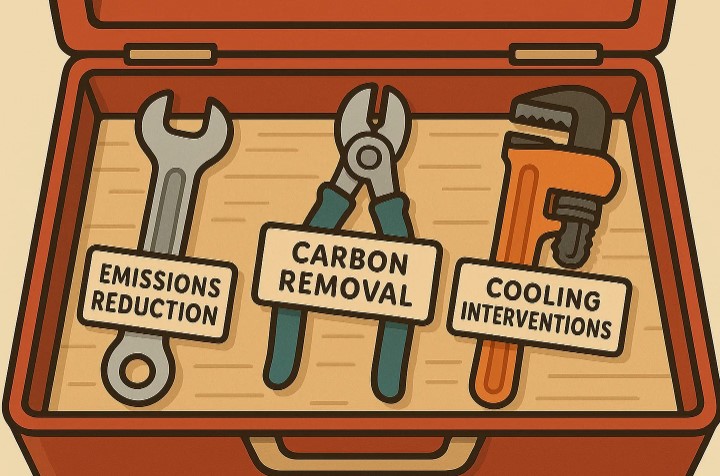 1 August 2025, Paul Gambill: The Positive Case For Global Cooling That Few Seem Willing to Make. The Temperature Stabilization Imperative. I spent a decade building carbon removal infrastructure, believing we could scale our way out of the climate crisis. The math proved me wrong. In a more perfect world, we would today be well on our way to removing 285 million tonnes of CO2 per year by 2030, but what we’ve achieved so far is barely a drop in the bucket.
This forced me to step back and see the bigger picture. We have exactly three tools to prevent catastrophic warming: emissions reduction, carbon removal, and cooling interventions. Despite heroic efforts, emissions aren’t falling fast enough. Carbon removal isn’t scaling fast enough. That leaves cooling—which could stabilize temperatures while the other two catch up. Yet we’ve barely begun preparing this option. When I work backwards from our objective—safe atmospheric CO2 levels and limited warming—the evidence points strongly toward needing all three.
I’ve come to an uncomfortable but logical conclusion: temperature stabilization through cooling interventions will be required. Not as a replacement for emissions cuts or carbon removal, but to buy them time to succeed. Cooling is going to be needed, and what we must do now is evaluate which methods we’ll use and how we’ll govern them responsibly.
Mapping the Current Ecosystem: Over the past months, I’ve been exploring the global cooling landscape. What I found was both encouraging and concerning.
The encouraging part: excellent organizations are doing vital work. ARIA is pushing research boundaries with serious government backing. SRM360 translates complex science and ecosystem data into resources journalists and policymakers can actually use. Reflective builds tools that help researchers coordinate and share findings. The Degrees Initiative ensures Global South voices are included from the start. Even Make Sunsets, controversial as they are, demonstrates what happens when someone decides to just start.Beyond these NGOs and startup, research labs and think tanks are advancing the science. Universities are running climate models. Policy centers are exploring governance frameworks. The quality of work is impressive.
The concerning part: scale. My best estimate is that only 1,000 to 3,000 people globally work on cooling interventions. That’s absurdly small for what might be humanity’s most consequential intervention. To put it in perspective, more people work at my local shopping mall than on potentially cooling the entire planet. Each organization excels at its mission. But when you map the whole ecosystem, you notice what’s missing. Read more here
15 December, Science Direct article: Solar geoengineering research in the global public interest: A proposal for how to do it. An overshoot of the 1.5°C temperature target is looking inevitable. Research and conversations are increasing around whether and how solar geoengineering could blunt some of the worst impacts of this overshoot. But the status quo of investigator-driven, privately funded solar geoengineering research is insufficient for this moment. Policy and societal decisions about solar geoengineering need to be informed by research that is comprehensive, interdisciplinary, and globally engaged. A new, major research initiative is needed. Here we outline a proposal for a global network of climate action research centers that would provide appropriate conditions to produce reliable and legitimate solar geoengineering research. To develop this proposal, we refer to an illustrative example of a global research effort to further an international public good: the 15 CGIAR (formerly the Consultative Group on International Agricultural Research) research centers, largely based in the Global South, which have a 50-year history of agricultural research to promote food security. Using insights from CGIAR’s successes and failures, we examine key considerations for policymakers and donors considering institutions or programs to fill global research needs for solar geoengineering.
Overshoot is not just a biophysical situation but a social and political condition. Entering overshoot brings a new context to climate politics, with the goal not just about reducing emissions but about bringing warming back to safer levels, and there are concerns about how quickly this return to 1.5°C could be accomplished. The context of overshoot means that new technologies and policies in carbon removal and solar geoengineering will receive more scientific and societal examination for their theoretical ability to lower global mean temperatures. . Read more here
At the 2024 session of the UN Environment Assembly in Nairobi, Switzerland proposed that a United Nations expert group be asked to ‘examine risks and opportunities’ associated with solar geoengineering. Amid deep international disagreement the resolution was first revised and then rejected (McLaren and Corry Citation2024). Yet, whereas a previous Swiss proposal in 2019 was wholly opposed by the Trump Administration, it was noteworthy that the Biden Administration worked to ensure the 2024 resolution was presented in a form it could support.Footnote1
The debate in Nairobi saw an increasing number of states contributing to debate and outlining their positions on the issue (McLaren and Corry Citation2024). Australia was not among them. Indeed to date, Australia has played virtually no role in global discussion of solar geoengineering. Australia also stands out among comparable nations for its limited examination of potential national impacts. One explanation attributes this inattention to Australia’s ‘role conception’. By this account, Australian policy-makers identify as faithful US allies and so commonly defer to US leadership on global issues (Horton Citation2023). Yet, Australia’s climate and geography are quite dissimilar to North America’s. If global solar geoengineering were implemented it would have highly distinct impacts on Australian agriculture, biodiversity, costal protection, rainfall patterns and fire risks. Australian and US interests therefore appear quite distinct.