
23 June 2015, Common Dreams, ‘A Great Day for Corporate America’: US Senate Passes Fast Track. ‘Shameful’ vote all but ensures approval of mammoth trade deals like the TransPacific Partnership. In a win for multinational corporations and the global one percent, the U.S. Senate on Tuesday narrowly advanced Fast Track, or Trade Promotion Authority (TPA) —ensuring for all practical purposes the continued rubber-stamping of clandestine trade agreements like the Trans Pacific Partnership (TPP) and TransAtlantic Trade and Investment Partnership (TTIP). The cloture motion to end debate needed 60 votes and it got just that, passing the chamber60-37. The full roll call is here. A final vote will come on Wednesday. Having overcome the biggest hurdle, the legislation is expected to pass, and will then be sent to President Barack Obama’s desk to become law. Read More here
Category Archives: Global Action Inaction
18 June 2015, Carbon Brief, China has greatest potential to raise climate ambition: The world is not on track to avoid dangerous climate change and China has the greatest potential to close the gap in climate ambition, according to the International Energy Agency (IEA). In a special report on energy and climate change the IEA has added up the combined impact of current climate pledges and other likely policies, including China’s hotly anticipated contribution for the post-2020 period. Dr Fatih Birol, IEA chief economist, says in an interview with Carbon Brief that these pledges are far from what would be needed to limit warming to below 2C. We’ve taken a look at which countries would make the biggest contribution to bridging the gap towards 2C, under the IEA’s cost-neutral bridge scenario.
Climate ambition gap
The climate ambition gap is widely recognised. Last week, UN climate chief Christiana Figueres told Carbon Brief it was “completely clear” that current pledges would be insufficient to avoid 2C of warming above pre-industrial temperatures over the course of the century – the internationally agreed climate target. The IEA’s new assessment suggests they would instead put the world on track for 2.6C by 2100 and 3.5C after 2200. Their long-term impact may be “rather small”, says Birol, but that’s largely because they extend at most 15 years out to 2030. The pledges collectively bend the world’s emissions trajectory (blue line, below) away from business as usual emissions (green line) by 6 gigatonnes of carbon dioxide (GtCO2). Even in the short term, however, the gap between the pledges and what would be needed for 2C (yellow line) grows rapidly, reaching 9GtCO2 in 2030.
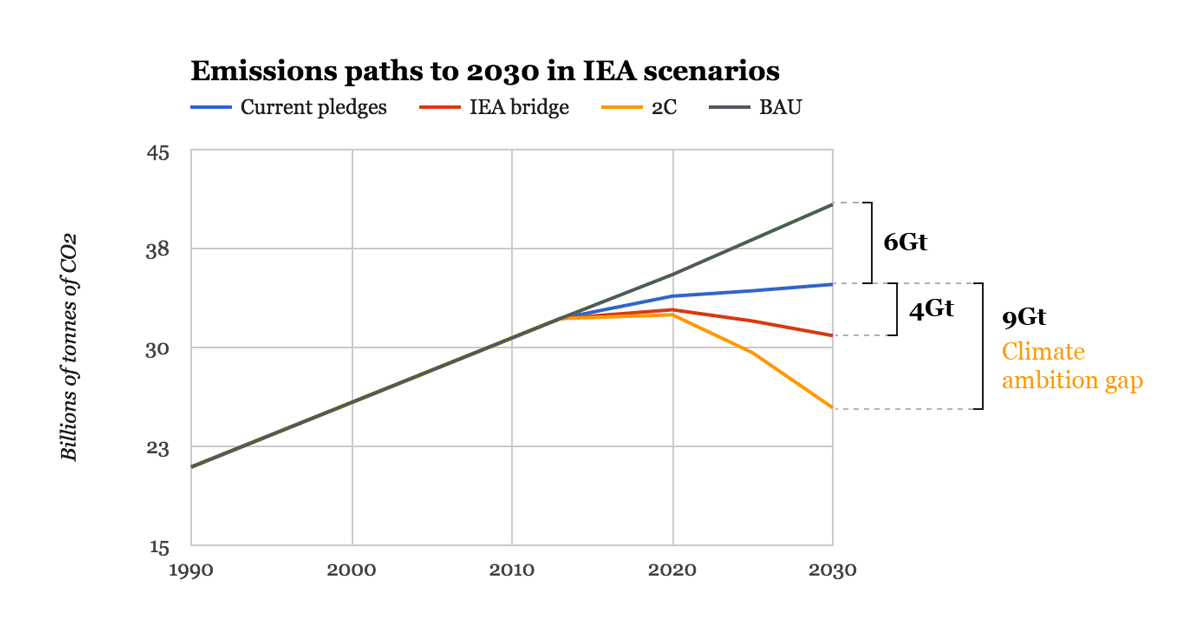
Emissions growth under the IEA’s ‘current policies’ scenario, corresponding to business as usual (BAU), compared to the path with current climate pledges, the IEA’s bridge scenario and a scenario consistent with 2C. Source: IEA special report on climate and energy, IEA World Energy Outlook 2014. Chart by Carbon Brief.
12 June 2015, Renew Economy, Negotiators told to hit accelerator as climate talks inch forward: Against a backdrop of real world momentum for climate action, the latest round of UN climate talks wrapped up today in Bonn, delivering some progress on the road to a meaningful climate deal in Paris but with widespread demands for negotiators to “pick up the pace” in the coming months….Pressure is now on governments to “make more rapid progress” and “make the necessary, bold decisions in the coming months that will ensure historic international action on climate change”. With business leaders, major investors, faith groups, youth networks, trade unions, and frontline communities all adding to the momentum demanding and driving the transition away from fossil fuels and towards a future powered by renewables, the message to governments is clear: “The transition to a low carbon world is speeding up. Countries can either ride that wave or be washed away by it.”… Read More
12 June 2015, The Carbon Brief, Letting the fox into the chicken coop! UN welcomes oil groups’ help to fight global warming: The UN will accept an unusual offer from six of Europe’s largest oil and gas groups to help it fight global warming as countries work on sealing a new international climate change agreement due in December. The proposal from companies including Royal Dutch Shell and Britain’s BP was “very, very welcome”, the UN’s top climate official, Christiana Figueres, told the Financial Times. Chief executives of the six companies wrote to Figueres in May saying they wanted to help countries devise a global carbon-pricing system ahead of the climate agreement. The move laid bare a transatlantic rift between some of the world’s largest energy groups, after US oil producers, Chevron and ExxonMobil, declined to join. Pilita Clark, Financial Times Read More here