
What you will find on this page: knowledge vs understanding (video); when facts are not just facts (video); Comedy & climate change (video); PLEASE stop talking about the environment (video); book excerpt – why we are wired to ignore climate change; book trailer (video); How to talk to a climate change denier (video); ideas for digging our way out of this hole; Climate Access publication -The Preparation Frame; New Guide: Communicating effectively with the centre-right; human psychology and why don’t “they” get it?; door-knocking on climate guide; talking to the right (video); election guide; engaging centre-right; religious leaders speak out; brightsiding; echo chambers; latest news; latest opinion poll; key information & resource sites
Complexity of turning knowledge into understanding
 For a person to change their behaviour a critical light bulb moment is needed when knowledge becomes understanding. Watch this video for an excellent example of why knowledge does not necessarily equal understanding, and why it may be so hard for people to change their inbuilt biases.
When the facts are not just the facts!
6 March 2017, The Conversation: The paradox of science communication … “Never have human societies known so much about mitigating the dangers they faced but agreed so little about what they collectively know,” writes Yale law professor Dan Kahan, a leading researcher in the science of science communication. Read more here
PLEASE Stop Talking About the Environment!
The dangers of framing climate change as an environmental issue and why this does not speak to peoples real concerns.
August 2014, Excerpt from Don’t Even Think About It: Why Our Brains Are Wired to Ignore Climate Change, George Marshall
 Chapter 41: Why We Are Wired to Ignore Climate Change… “And Why We Are Wired to Take Action Through our long evolution, we have inherited fundamental and universal cognitive wiring that shapes the way that we see the world and interpret threats and that motivates us to act on them. Without doubt, climate change has qualities that play poorly to these innate tendencies. It is complex, unfamiliar, slow moving, invisible, and inter-generational. Of all the possible combinations of loss and gain, climate change contains the most challenging: requiring certain short-term loss in order to mitigate against an uncertain longer-term loss. Climate change also challenges and reverses some deeply held assumptions. We are told that the way of life that we associate with our comfort and the protection of our families is now a menace; that gases we have believed to be benign are now poisonous; that our familiar environment is becoming dangerous and uncertain. Our social intelligence is well attuned to keeping track of debts and favors, and ensuring equitable distribution of gains and losses. Climate change poses a major challenge here too, with all solutions requiring that rival social groups agree on a distribution of losses and thereafter the allocation of a greatly diminished shared atmospheric commons.” To read more access Climate Conviction website here
Trailer for Don’t Even Think About It: Why Our Brains Are Wired to Ignore Climate Change
How to Talk to a Climate Change Denier
To date 19,000 people have watched this twenty minute video on how to talk about climate change with someone who is still unconvinced (they are called a ‘denier’ because this is the standard search phrase). It draws on many of the arguments in the book, including the need to find common values and speak with respect. The evidence behind it is provided on the TalkingClimate website.
To access more video presentation featuring George Marshall go here
Another Excerpt: Chapter 42. In a Nutshell: Some Personal and Highly Biased Ideas for Digging Our Way Out of This Hole

To create proximity we need to EMPHASIZE THAT CLIMATE CHANGE IS HAPPENING HERE AND NOW. In particular, we should BE WARY OF CREATING DISTANCE…….. There is therefore a potential to express climate change as an opportunity to RESTORE PAST LOSS, whether it is social (lost community, values, purpose) or environmental (lost ecosystems, species, or beauty)….We are very well adapted to respond to immediate threats but slow to accommodate moving change. Climate change is a process, not an event, so it requires that we RECOGNIZE MOMENTS OF PROXIMITY that can demand attention….Sometimes the act of CREATING THE SYMBOLIC MOMENT is far more important than its overall relevance……… the best option for building conviction lies with providing the information for trusted local communicators to OPEN UP A CONVERSATION ABOUT LONG-TERM PREPAREDNESS… we need to remember that not everyone wants to protect the status quo, especially if they are already struggling against economic and social injustice. So we need a NARRATIVE OF POSITIVE CHANGE…..People form their response to the narratives, not the science, and so it always needs to FOLLOW NARRATIVE RULES, WITH RECOGNIZEABLE ACTORS, MOTIVES, CAUSES, AND EFFECTS. People will be inclined to follow the most compelling narrative, so be careful: DON’T LET THE NARRATIVE TAKE OVER the way we think or talk about it….Most of the factors that enable us to ignore climate change derive from attempts to limit its meaning; that it is an environmental issue, a threat or an opportunity (but not both), a wellhead problem or a tailpipe problem (but not both). So, RESIST SIMPLE FRAMINGS and BE OPEN TO NEW MEANINGS…..We all need to ENSURE THAT A WIDE RANGE OF SOLUTIONS IS CONSTANTLY UNDER REVIEW — a process that planners call iterative risk management…. NEVER ACCEPT YOUR OPPONENT’S FRAMES — “don’t negate them, or repeat them, or structure your arguments to counter them.”… BE CAREFUL THAT ENEMY NARRATIVES DO NOT FUEL DIVISION…..for example CREATE A HEROIC QUEST in which the enemy may be our internal weaknesses rather than an outside group….Overall, we need to BUILD A NARRATIVE OF COOPERATION that can bring people together around a common cause. This should STRESS COOPERATION NOT UNITY … ACCEPT THE SPECTRUM OF APPROACHES with radical protesters, lobbyists, policy makers, and multiple different sectors, all pushing in the same direction if not with the same detailed objectives….In the way that we tell the climate change story, we need to BE HONEST ABOUT THE DANGER — but remember that this will only motivate people if they hear it from trusted communicators and can see opportunities for action and change. ENCOURAGE POSITIVE VISIONS, but remember that these may carry social cues that may repel others. The bright side technocratic future vision, for example, is elitist and materialistic, and alienates those who already feel disenfranchised…..” For the details and more suggestions access full excerpt here
But what do climate scientists say?
Climate Access publication: The Preparation Frame
A Guide to Building Understanding of Climate Impacts and Engagement in Solutions. A communications and engagement guide from Climate Access on how to break the manufactured scientific uncertainty debate with a focus on climate impacts and solutions. Access publication here This link will also provide other publications to peruse
March 2016, Climate Outreach, New Guide: Communicating effectively with the centre-right
Download the report NOTE: The above guide is from a British perspective but should relate well to the Australian context.
Human psychology or why don’t “they” get it?
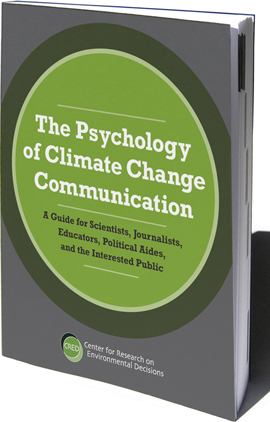 “Societies must be motivated and empowered to adopt the needed changes. for that, the public must be able to interpret and respond to often bewildering scientific, technological, and economic information. …This guide powerfully details many of the biases and barriers to scientific communication and information processing. It offers a tool—in combination with rigorous science, innovative engineering, and effective policy design—to help our societies take the pivotal actions needed to respond with urgency and accuracy to one of the greatest challenges ever faced by humanity: global-scale, human-induced environmental threats, of which the most complex and far reaching is climate change.” —Jeffrey Sachs, Director, the earth institute, Columbia University. Click on booklet image to open
Talking climate change with conservatives: UK election 2015
The video above, comes from COIN (Climate Outreach & Information Network UK). George Marshall is the co-founder of COIN and I have found his perspective and balanced way of presenting an excellent resource in answering “Why they don’t get it?” and what to do about it. Even though the Election Guide has the UK election focus I thought it could easily be adapted to the Australian context.
The COIN Election Guide is intended for communicators and campaigners from across the political spectrum who would like to learn new ways of talking about climate change in ways that resonate with centre-right voters, particularly in the context of an election. I think it has value even with no elections in sight at present. It explores the following: What the centre-right thinks about climate change; Centre-right values and finding the right words; 4 narratives that can work with the centre-right; establishing communicator trust; what not to say; election tips. Access Election Guide here
Engaging with the centre-right
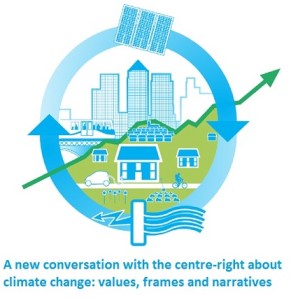 13 June 2013, COIN’s ground breaking report presents the evidence for more effectively engaging centre-right citizens around climate change. It argues that if climate change is to break out of its ‘left wing ghetto’, it must be communicated in a way that resonates with the values of the centre-right – and offers four narratives for bringing climate change into the mainstream. This report takes the first steps towards developing a better understanding of how to engage centre-right citizens on climate change. At the end of 2012, a roundtable meeting with some of the UK’s leading experts on communicating climate change to centre-right audiences was convened. In the words of one meeting participant, climate change must break out of its left-wing ghetto in order for a new, meaningful conversation with the centre -right to begin. Access Report here
Religious leaders finally speaking out
18 August 2015, The Carbon Brief, Islamic climate declaration calls for fossil fuel phase out. Islamic scholars from around the world have endorsed a declaration calling on nations to phase out greenhouse gas emissions and switch to 100% renewable energy. The Islamic Declaration on Climate Change will be seen as the religion’s major contribution ahead of the UN climate talks in Paris this December. Released during a two-day symposium on Islam and climate change in Istanbul, the declaration lays out why Muslims should be concerned about the planet, and sets out a series of demands to world leaders and the business community. It is the second major intervention to have emerged from the faith community this year, after Pope Francis released his encyclical on climate change and the environment in June. Writing the declaration. The process of drafting the declaration began around six months ago. A team of five Islamic scholars were involved in crafting the initial document. Read More here
18 June, The Guardian, The Pope’s encyclical on climate change: Eight things we learned from the pope’s climate change encyclical. From calling on rich countries to pay their social debt to his thoughts on GM food and UN climate talks, here are the top highlights. Pope Francis has called on global leaders and individuals to dedicate themselves to curbing climate change and ending policies and personal habits that are destroying the planet. Pope Francis has released an unprecedented encyclical on climate change and the environment. The 180-page document calls on rich nations to pay their “grave social debt” to poorer countries and lambasts the UN climate talks for a lack of progress. Here are eight things we learned: Read More here
15 July 2015, Climate News Network, Muslim scholars say climate change poses dire threat: Islamic declaration adds to growing pressure religious leaders are exerting on richer nations to reduce the burden they are putting on the Earth’s climate. Human beings could cause the ending of life on the planet, says a group of Islamic scholars − and countries round the world, particularly the rich ones, must face up to their responsibilities. Climate change, they say, is induced by human beings: “As we are woven into the fabric of the natural world, its gifts are for us to savour – but we have abused these gifts to the extent that climate change is upon us.” The views of the scholars – some of the strongest yet expressed on climate from within the Muslim community – are contained in a draft declaration on climate change to be launched officially at a major Islamic symposium in Istanbul in mid-August. Read More here

Brightsiding climate is a bad strategy: Is all “good news” and no “bad news” a good climate action and communications strategy? This analysis finds that the answer is a resounding “no”. “Always look on the bright side of life”: Bright-siding climate advocacy and its consequences. Most climate advocacy and campaigning appears to assume that as long as you tell a positive story and move “in the right direction”, it doesn’t matter if people understand or agree about the problem. It’s all about selling “good news” and not mentioning “bad news”. This is how the Obama administration, Australia’s Labor government, the Say Yes campaign and many national climate advocacy organisations worked in 2011. Click on image for more
An interesting “brightsiding example – Sustainia
Politicians living in echo chambers
27 May, Climate Progress: If You have Wondered Why So Many Politicians Deny Climate Change, Science Has Your Answer. Scientists have known for a long time what’s causing current climate change. What’s been less clear is why so many U.S. politicians are not listening. Sure, there’s been falsely balanced media coverage of climate science. And there are both financial and ideological incentives to deny that carbon emissions are causing the phenomenon. But according to new research published in Nature Climate Change, there’s at least one statistically proven reason why more than 56 percent of Congressional Republicans deny climate change: echo chambers. Read More here View full research article here
Latest News 19 February, Politico: US succeeds in erasing climate from global energy body’s priorities. Trump’s energy chief had threatened to leave the International Energy Agency if it continued to focus on climate. The United States has succeeded in removing climate change from the main priorities of the International Energy Agency, following a tense ministerial meeting in Paris that reflected a dramatic shift in political mood around the clean energy transition. In the chair’s summary released at the end of the two-day meeting, addressing climate change is not listed among the agency’s priorities. Instead, the document focuses on energy security, resilience, critical minerals and electricity systems. The development, which comes after the U.S. threatened to leave the agency if it continued to focus on climate change, is a remarkable turnaround from the last ministerial two years ago, when addressing the climate crisis and phasing out fossil fuels was named as the IEA’s top priority. Unusually, there was no joint communique from the ministers at the end of this week’s meeting. The chair’s summary mentioned climate change just once, saying “a large majority of ministers stressed the importance of the energy transition to combat climate change and highlighted the global transition to net zero emissions in line with COP28 outcomes.” Read more here 12 February 2026, Carbon Brief: Analysis: Trump has overseen larger coal decline than any other US president. Donald Trump has overseen a larger fall in coal-fired power capacity than any other US president, according to Carbon Brief analysis. His administration’s latest efforts to roll back US climate policy have been presented by interior secretary Doug Burgum as an opportunity to revive “clean, beautiful, American coal”. The administration is in the process of attempting to repeal the 2009 “endangerment” finding, which is the legal underpinning of many federal climate regulations. On 11 February, the White House issued an executive order on “America’s beautiful clean coal power generation fleet”, calling for government contracts and subsidies to keep plants open. On the same day, Trump was presented with a trophy by coal-mining executives declaring him to be the “undisputed champion of beautiful clean coal”. These words are in sharp contrast to Trump’s record in office, with a larger fall in coal-fired power capacity under his leadership than any other president, as shown in the figure below. This is because coal plants have been uneconomic to operate compared with cheaper gas and renewables – and because most of the US coal fleet is extremely old. Read more here 21 January 2026, SBS News: $1.5 billion for a seat: Is Trump’s new Board of Peace an ‘irreparable’ threat? Experts say Trump’s new body is susceptible to nepotism and corruption, and could undermine the role of the United Nations. A Donald Trump-led organisation that seeks to facilitate peace in the Middle East and beyond could, in fact, do the opposite and cause damage to the international order, experts warn. Trump has invited world leaders to join his so-called ‘Board of Peace’, an entity that started with a mandate to oversee the administration and reconstruction of Gaza, but has quickly ballooned in its planned remit. Israel and the Palestinian militant group Hamas signed off on Trump’s plan, which says a Palestinian technocratic administration will be overseen by an international board, which will supervise Gaza’s governance for a transitional period. Diplomats have said the plan risks undermining existing United Nations structures, with reports that permanent seats could be bought for a billion dollars, according to media reports. Hugh Lovatt, a senior policy fellow with the Middle East and North Africa Program at the European Council on Foreign Relations, said officials around the world have been privately concerned the Board of Peace is a “Trumpian effort to replace the United Nations”. “Those concerns are indeed borne out by virtue of the sheer number of UN members that are now invited to this Board of Peace,” he told ABC radio. “It is clear that Trump himself has greater aspirations and has talked about the Board of Peace potentially taking charge to some extent in Ukraine and potentially also Venezuela and in Iran.” Read more here 22 December 2025, The Guardian: Trump’s shuttering of the National Center for Atmospheric Research is Stalinist. This is the latest in the relentless purge of climate researchers who refuse to be co-opted by the fossil fuel industry. The Soviet dictator Joseph Stalin would no doubt have understood and even appreciated the latest attack by the Trump administration on climate researchers and their work. The National Center for Atmospheric Research in Boulder, Colorado, is to be dismantled after more than 50 years at the forefront of global research on climate science and monitoring. This is the latest step in the administration’s climate Lysenkoism and its relentless purge of climate researchers who refuse to be co-opted into its quest for American energy dominance though fossil fuels. Stalin’s embrace of the work of Trofim Denisovitch Lysenko, who wrongly believed that wheat could inherit characteristics acquired by previous generations, underpinned policies that failed to prevent crop failures and millions of deaths from famine during the 1930s. Scientists who opposed Lysenkoism were denounced, fired, imprisoned and even executed. While Trump has not gone as far as Stalin, his administration’s persecution of climate researchers could ultimately lead to many millions of deaths from increases in extreme weather and sea level rise in the United States and across the world. Read more here End Latest News To view opinion poll results go here: countries doing enough on climate change; carbon emissions; Key Information and Resource Sites CLIMATE OUTREACH (formally known as COIN – Climate Outreach & Information Network UK: Their work on climate change communication gathers the best research evidence and translates it into practical guides. With a comprehensive and frequently updated database of academic papers, a regular newsletter, and a blog featuring comment and analysis from climate change communication experts, it is the gateway which ensures academics and practitioners get the most from climate change communication research.To access their resource page go here Australian Religious Response to Climate Change: ARRCC is a multi-faith, member-based organisation of people from around Australia who are committed to taking action on climate change. We bring together representatives from all the major faith traditions to work together in addressing climate change. Climate Denial: This is George Marshall’s blog that explores the topic of the psychology of climate change denial – with observations and anecdotes about our weird and disturbed response to the problem. It seeks to answer a question that has puzzled me for years: why, when the evidence is so strong, and so many agree that this is our greatest problem, are we doing so little about climate change? George is the founder of COIN above. DeSmog Blog Project: A Canada based and began in January 2006 and quickly became the world’s number one source for accurate, fact based information regarding global warming misinformation campaigns. If you’re looking for information on noted climate change skeptics, or on the use of PR techniques and spin by politicians, scientists, and in the media, this is the place to go. They encourage using their media centre to full advantage for your own reporting. To access their media centre go here Psychology for a Safe Climate (Aust): Through workshops, presentations, and publications we contribute by: Increasing understanding of the psychology behind the challenges and difficulties of engagement with climate change; fostering psychological support and self care; and helping improve communication on climate change.